

Ancient manuscripts · evidence guide
Why a rubbish heap became an archive
The Oxyrhynchus Papyri are powerful evidence precisely because they were not collected as a modern library. They came from ancient rubbish mounds in a dry Egyptian environment, where scraps of literary texts, contracts, letters, tax documents and school exercises could survive by accident. That accident makes the archive unusually broad, but also uneven.
A fragment from Oxyrhynchus can show that a text, transaction or habit existed in a particular documentary setting. It cannot by itself prove how common the practice was across the Roman Empire or even across Egypt. The strength of the archive is scale; the danger is treating survival as a statistical sample without asking why it survived.
How historians read the fragments
The first task is physical: identify the material, handwriting, damage, joins and possible date. The second task is contextual: compare the fragment with parallel texts, excavation records, publication history and later cataloguing. A famous literary scrap and a mundane receipt both need the same chain of custody before they become reliable evidence.
Many Oxyrhynchus texts are known through edited publication rather than through a simple photograph online. That means responsible readers distinguish the ancient object, the modern edition and any translation. Each layer can introduce useful expertise as well as uncertainty.
What the archive can and cannot prove
The papyri can illuminate literacy, administration, private disputes, religious reading and the circulation of Greek literary works. They cannot restore a whole ancient town without gaps. Missing groups, destroyed pieces and uncertain find contexts remain part of the evidence.
The best use of Oxyrhynchus is therefore modest and cumulative: one fragment rarely settles a large historical question, but thousands of fragments can change the questions historians know how to ask.
Sources and image rights
- University of Oxford: exhibition introduction — discovery and the publication history of P.Oxy. I 1.
- Project management and image policy — custody and modern reproduction permissions.
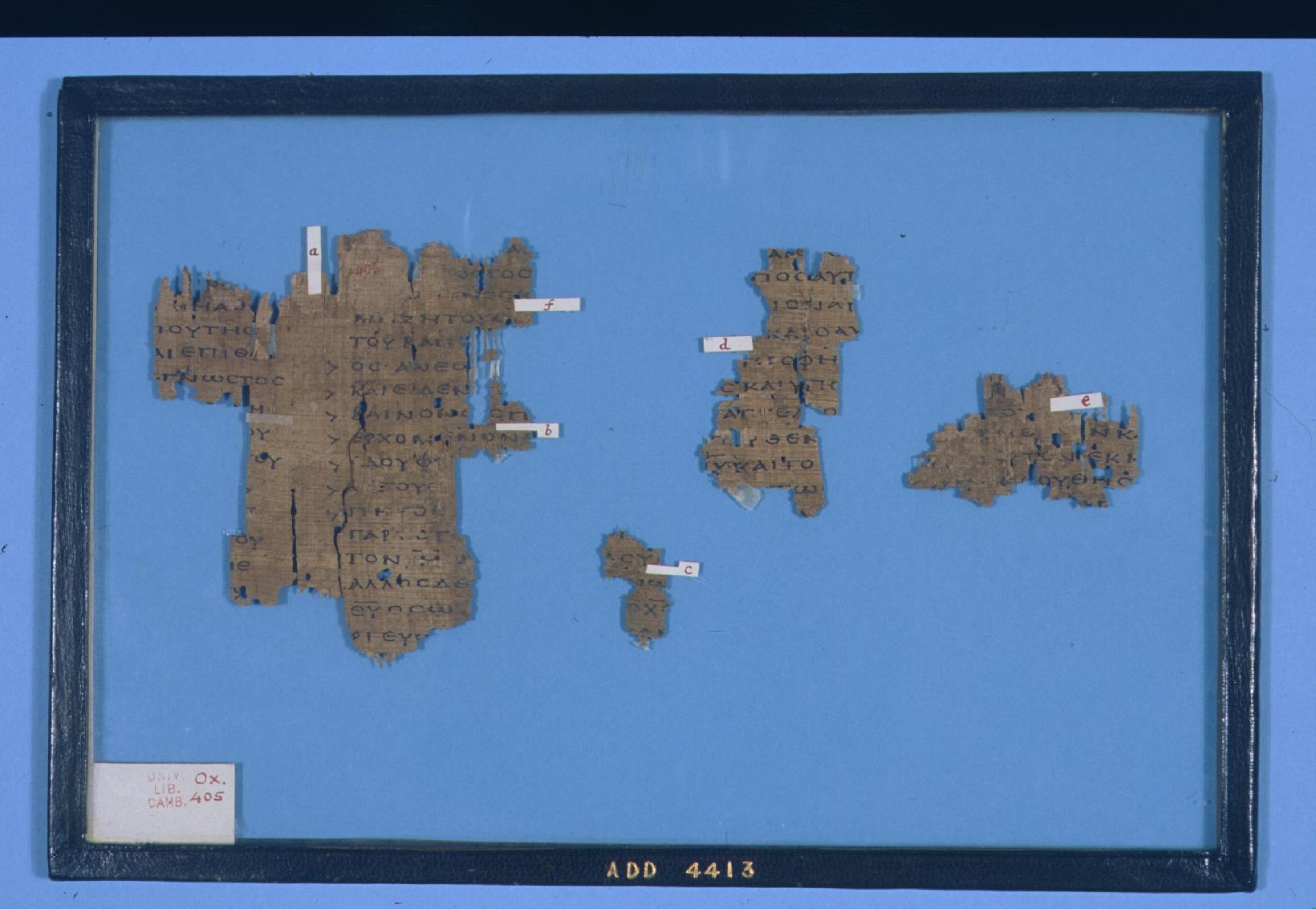
- Commons: POxy405.jpg — the separate rights record for the displayed illustration.
A worked example: P.Oxy. I 1
The Oxford exhibition introduction traces a useful change in interpretation. Grenfell and Hunt found P.Oxy. I 1 during their 1897 excavations and issued it in an advance booklet that year; the first full Oxyrhynchus volume followed in 1898. The editors initially interpreted its sayings as an independent collection. Later research identified the surviving text with the Gospel of Thomas. A catalogue number therefore does not freeze an interpretation at the moment of discovery.
| Evidence layer | What to record |
|---|---|
| Object | P.Oxy. I 1; Bodleian shelfmark MS. Gr. th. e. 7 (P). |
| Publication | 1897 advance booklet versus the 1898 first volume. |
| Identification | Initial reading versus later identification with the Gospel of Thomas. |
| Limit | A surviving manuscript’s proposed date is not automatically the date when its text was composed. |
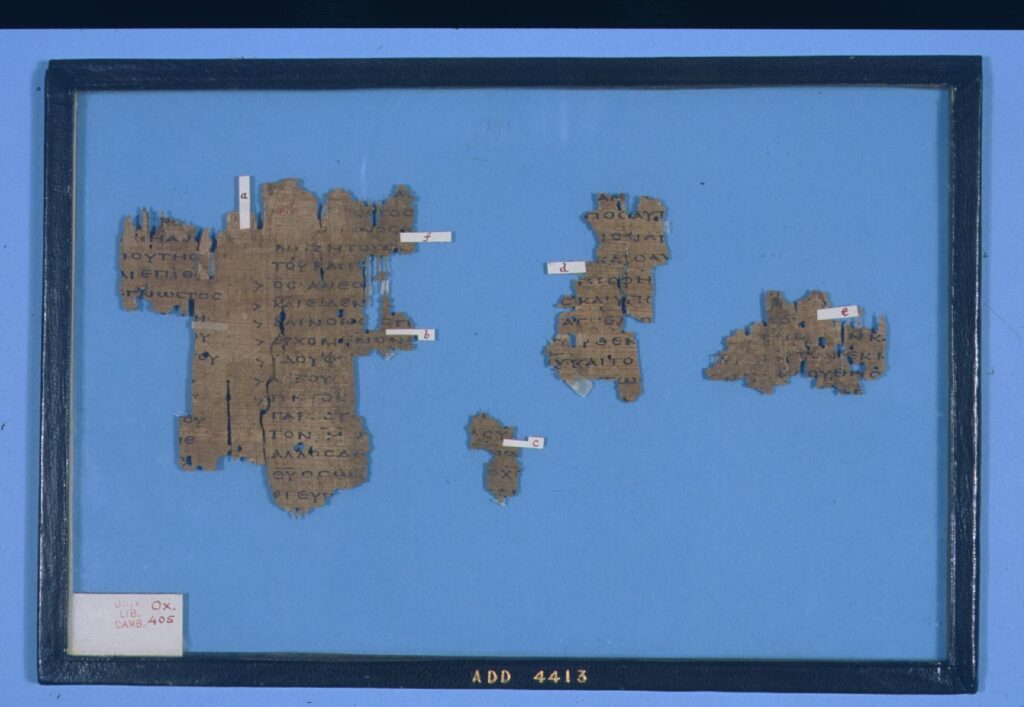
This example concerns P.Oxy. I 1, not P.Oxy. 405 pictured above. Readers should not substitute one fragment’s image, catalogue entry or interpretation for another.
Where the collection is kept
The project’s management statement identifies the Egypt Exploration Society as the main owner and Oxford’s Art, Archaeology and Ancient World Library as the collection’s home. Its modern image-reproduction policy requires permission requests; an ancient text is not a blanket licence to copy a modern institutional photograph. The existing illustration’s separate Commons rights record is linked in its caption.
Sources and research collection
- University of Oxford: The Oxyrhynchus Papyri project — the collection and its research context.
- Project publications — published editions for checking a text against its scholarly reference.
- Project images — visual access to published papyri where available.
For a particular document, record the published papyrus number, edition, proposed date and the surviving text. A damaged fragment can illuminate one transaction without describing every household in the city.