
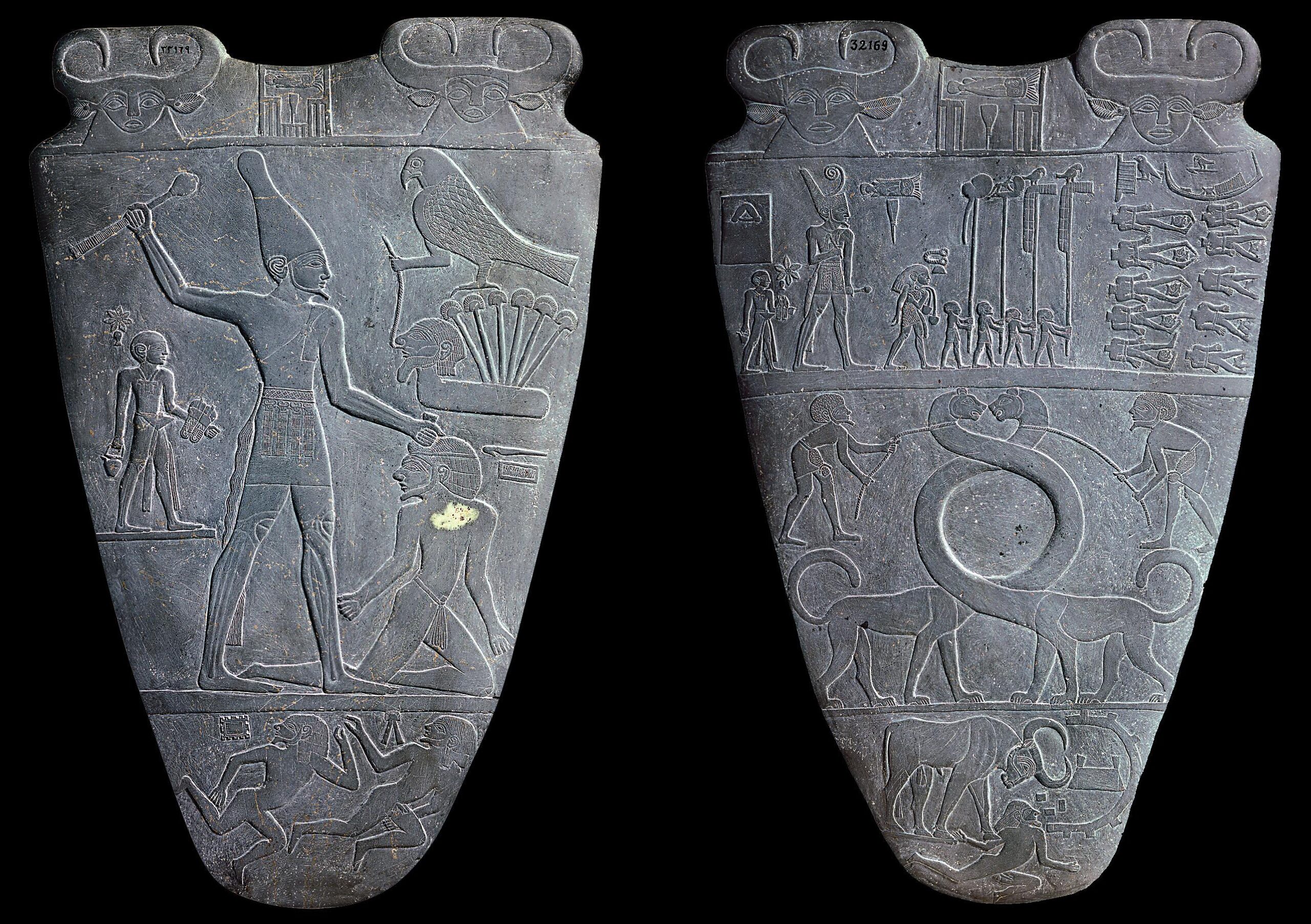

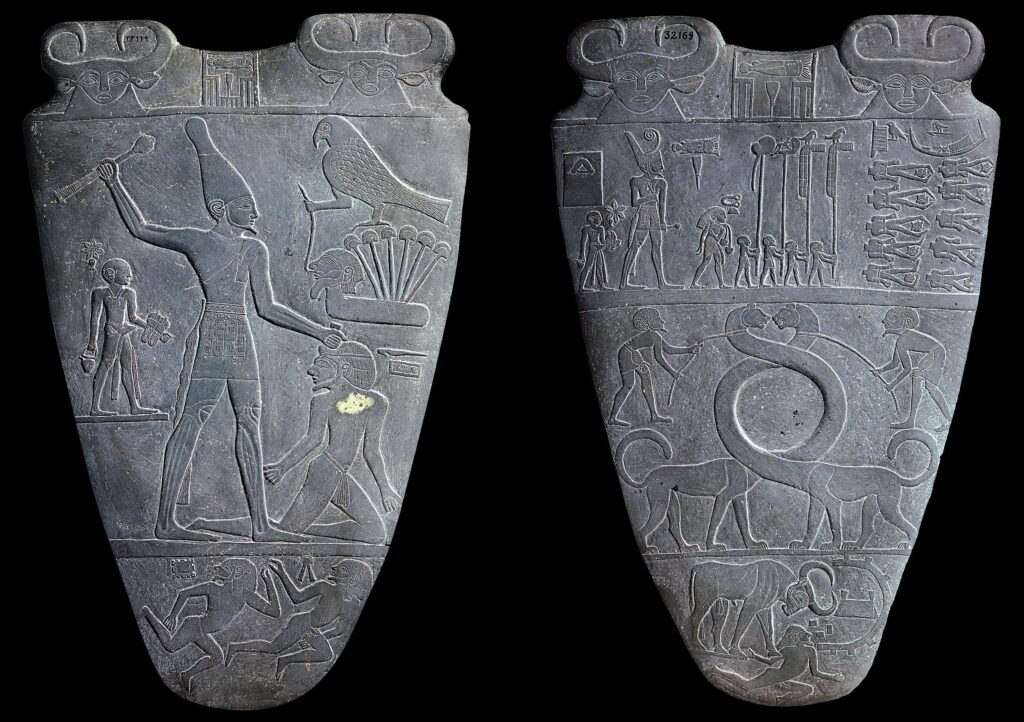
Two crowns, a raised weapon and a pair of intertwined animals make the Narmer Palette an unusually persuasive image of royal power. They also make it easy to ask the object to do too much. Reading it closely means distinguishing a visible detail from an interpretation—and distinguishing both from a dated account of a conquest.
Start with the object record
The Egyptian Ministry of Tourism and Antiquities identifies the palette as green schist from Hierakonpolis, dating to Narmer’s reign in the First Dynasty, around 3100 BCE. Its catalogue describes a Red Crown procession on one side and a White Crown smiting scene on the other. It presents the intertwined serpopards as a possible representation of Upper and Lower Egypt brought under royal control.
Those statements have different evidential weights. Material, provenance and catalogue dating describe the object; identifying crowns describes its imagery; connecting a motif to political unification interprets that imagery. A useful account does not blur those categories into a single certainty.
Three details, three limits
| Detail | What the record supports | What remains unresolved |
|---|---|---|
| Red and White Crowns | The king appears with symbols associated with Lower and Upper Egypt. | The scenes do not supply a dated sequence of administrative integration. |
| Intertwined animal necks | The ministry offers unification as an interpretation of this motif. | An interpretation is not an inscription naming a particular treaty or battle. |
| Smiting scene | Royal violence is part of the represented authority. | A pose alone does not establish the location, date or full course of a campaign. |
Why an origin story needs more than one object
Imagine two captions beneath the same photograph. One says that the palette represents a ruler’s authority over the two regions. The other says that it records the precise battle in which Egypt became a unified state. The second makes several additional claims: that a particular event occurred, that the scenes depict it directly, and that its outcome completed political unification. Each step requires evidence beyond the photograph.
This is not an argument for dismissing the palette as meaningless propaganda. Representation is historical evidence in its own right. The choice to show an imposing ruler, ordered followers and subdued enemies tells us something different from a tax record or a settlement map. The mistake is not taking symbolism seriously; it is treating symbolism as if it supplied every missing date and causal link.
A practical way to read the photograph
First describe what you can see without assigning a story to it: a crown, a figure, an animal, a gesture. Next compare that description with the museum record. Finally label the conclusion you draw from the comparison as an inference. If your conclusion requires knowing what happened before or after the represented scene, identify the additional archaeological or textual evidence you would need.
That three-step reading keeps the palette’s significance intact. It allows a strong conclusion about the visual construction of kingship while leaving a narrower conclusion about a single founding event unproven. The uncertainty belongs to the claim, not to the object’s importance.
Source and image record
- Egyptian Ministry: Narmer Palette — material, provenance, dating and catalogue interpretation.
- Wikimedia Commons photograph record — the displayed image’s attribution and public-domain record, separate from the historical interpretation.