

HistoryZ evidence guide
A small object with an unusually large reputation
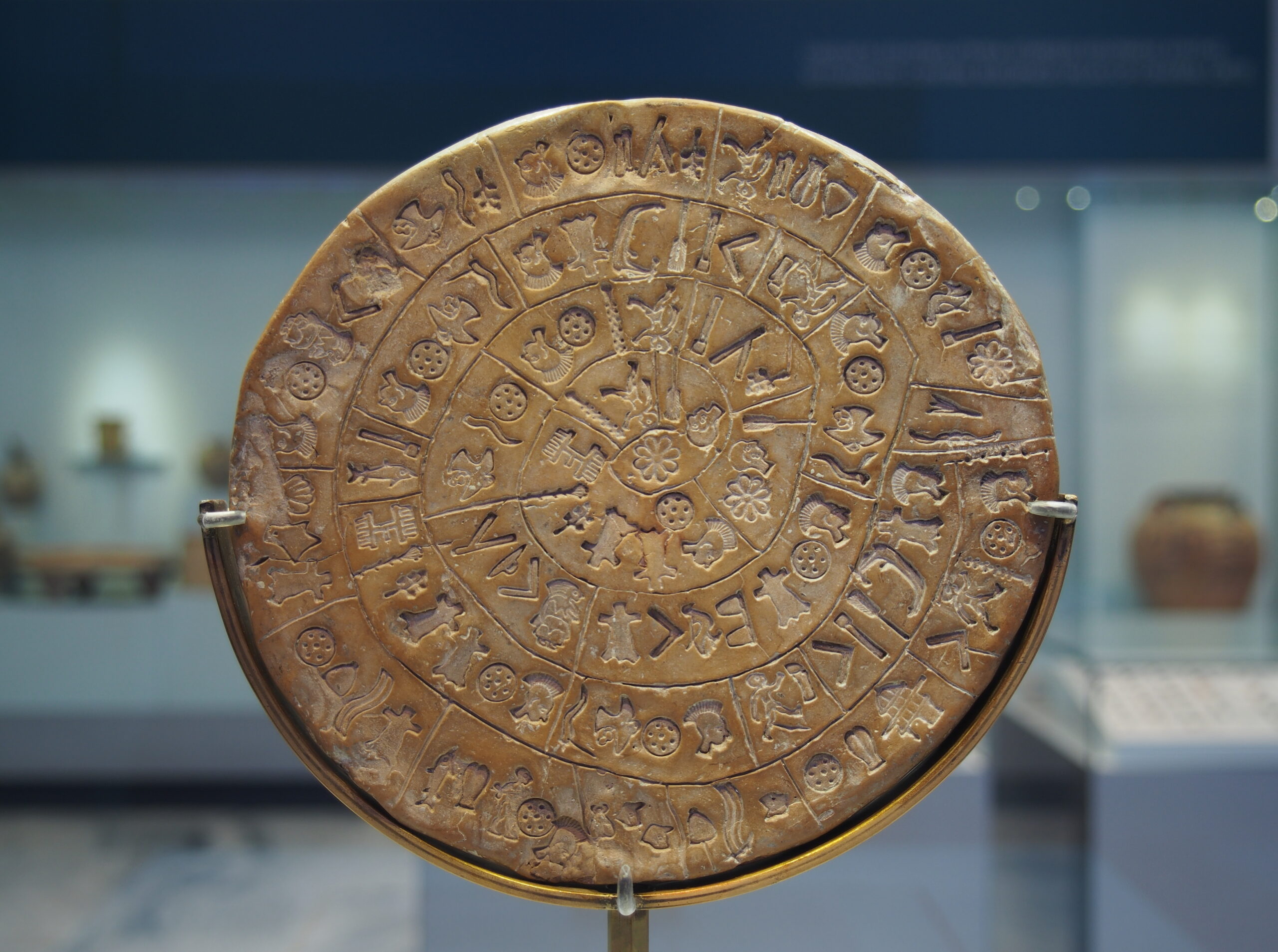
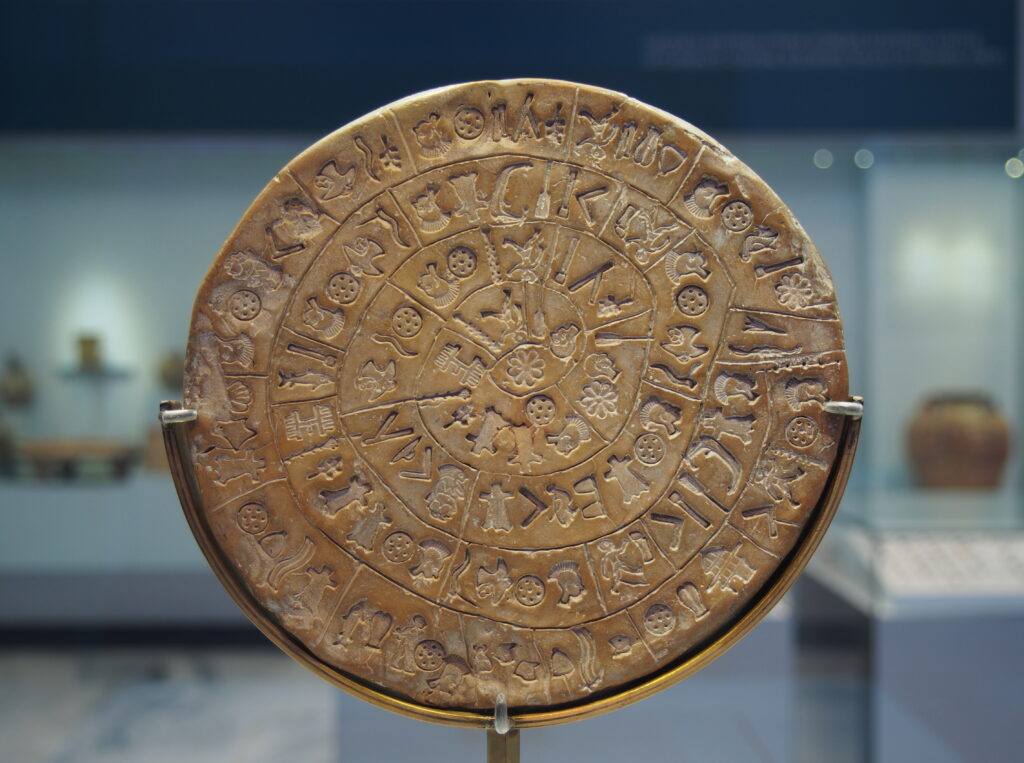
The Phaistos Disc is a fired-clay object from the Minoan palace at Phaistos on Crete. Luigi Pernier found it during excavation on 3 July 1908. The Heraklion Archaeological Museum dates the object to about 1700–1650 BCE and records 241 impressed signs arranged on both faces in spirals. Those statements are secure starting points. Claims that the disc preserves a particular prayer, language or historical event are not.
Its fame comes from a rare combination: repeated pictorial signs, an apparently deliberate layout and no close parallel long enough to provide a dependable key. The disc is therefore best approached as an evidence problem rather than a puzzle whose newest proposed solution must be correct.
What can be counted and observed
The signs were pressed into wet clay before firing rather than incised one by one afterward. Museum documentation describes 61 sign groups separated by lines. Repeated groups and sign sequences suggest structure, but structure alone does not identify a language. Researchers can count signs, compare their order, inspect the direction marks and study manufacturing traces without pretending to translate the text.
The museum notes that a line with five dots on each outer edge indicates a reading direction from rim toward centre. Even this useful physical observation does not tell us whether the groups are words, names, ritual formulas or something else. Calling the separators ‘word dividers’ is a practical convention, not proof of grammar.
Why decipherment remains difficult
Successful decipherments normally depend on a sizeable corpus, known related languages, repeated names, bilingual texts or several of those aids together. The Phaistos Disc offers only one short text in its own sign system. Linear B could be tested against many tablets and patterns; the disc cannot be checked in the same way. A proposal may produce a fluent sentence because its author has assigned values that make that sentence possible, not because the values are independently demonstrated.
A careful reader should ask whether a proposed reading predicts anything beyond the disc, whether sign values are applied consistently and whether another scholar can test the method without choosing the answer in advance. No published solution has produced broad specialist agreement. The responsible conclusion is not that the object is meaningless, but that current evidence is insufficient for a secure translation.
Context, date and authenticity
The archaeological context links the disc to Phaistos, while style and associated material inform its museum date. Contextual dating is different from a date printed on the object, and the disc itself does not name Pernier or a ruler. Modern forgery allegations have attracted attention because the object is unique, yet uniqueness is not itself proof of forgery. Institutional and scholarly treatment continues to regard it as an ancient Minoan artefact.
The safest account separates three questions: whether the object is ancient, when it entered the excavated deposit, and what its signs mean. Evidence can support the first two more strongly than the third. Combining them into a single dramatic claim hides the different standards of proof.
How to read new ‘solutions’
When a headline announces that the disc has finally been translated, look for peer review, explicit sign tables, treatment of repeated groups and independent response from Aegean epigraphers. Be wary of readings that depend on freely switching languages or assigning several convenient sounds to the same sign. Also distinguish an interpretation—such as hymn, list or game—from a decipherment with reproducible phonetic values.
The Phaistos Disc remains useful precisely because it teaches restraint. Archaeology can document discovery, material, technique and pattern while still leaving content unresolved. Saying ‘undeciphered’ is not a failure of imagination; it is an accurate report on the present evidence.