
HistoryZ manuscript evidence
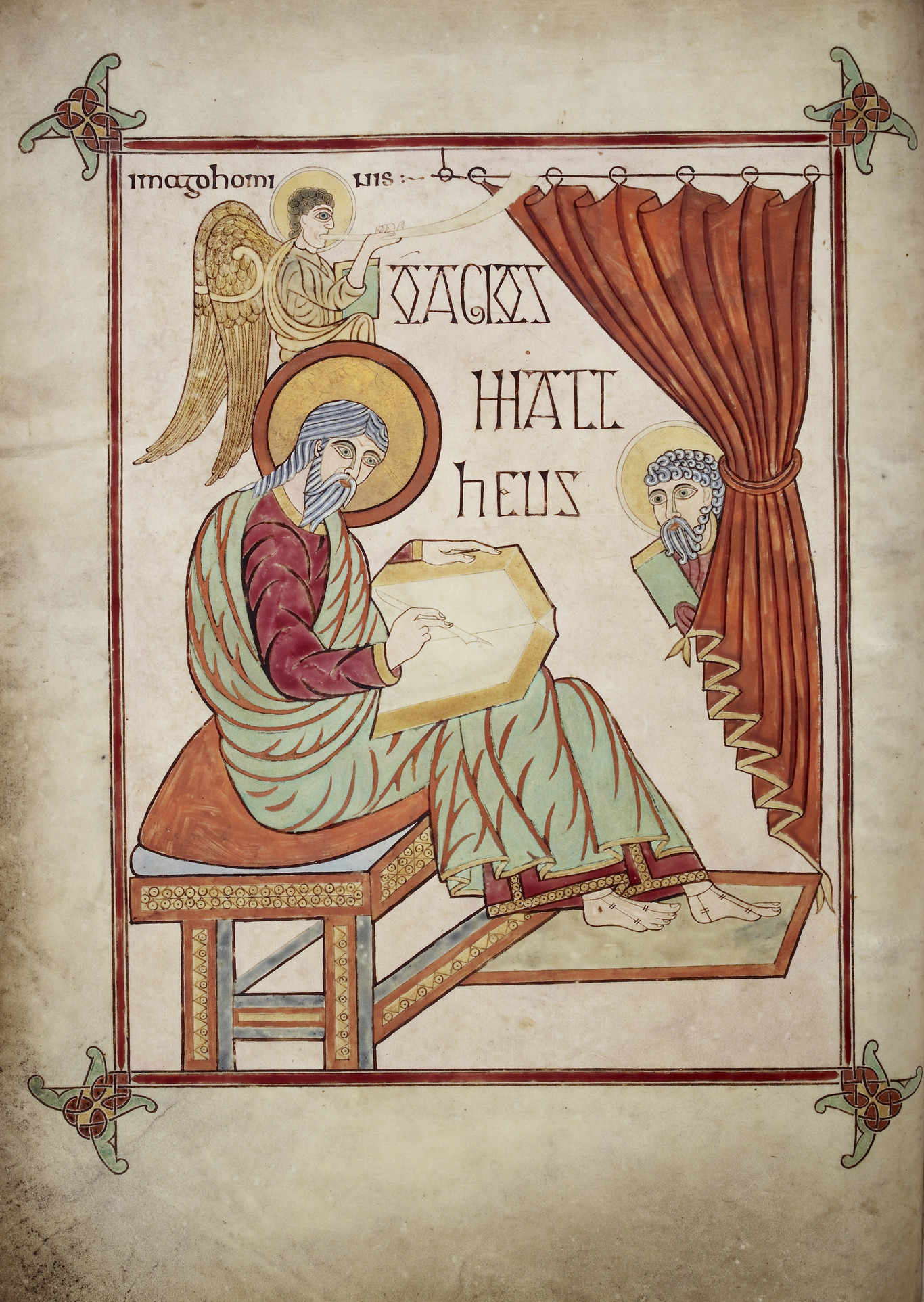
A book made in a particular place
The Lindisfarne Gospels are usually dated to the early eighth century and associated with the monastery on Lindisfarne, the tidal island off Northumberland. The manuscript is Cotton MS Nero D IV, now held by the British Library. Its four Gospel texts are written in Latin, but the pages are not only containers for words: carpet pages, evangelist portraits and decorated initials turn reading into a carefully staged visual experience.
What the manuscript can show
The surviving pages give unusually direct evidence for scribal practice, parchment preparation, Insular script and the movement of artistic ideas across the Irish Sea and Anglo-Saxon Northumbria. The ornament combines interlace, animal forms and Mediterranean-derived Christian imagery. That combination is evidence of a connected artistic world, not proof that a single modern label such as “Celtic” explains every source or workshop involved.
Eadfrith and the problem of a named maker
The manuscript is traditionally attributed to Eadfrith, bishop of Lindisfarne, on the basis of a later colophon naming the people associated with making and binding it. Attribution is strong but should still be described as a scholarly conclusion rather than a signed artist’s statement. The pages do not preserve a production diary, and the surviving object cannot answer every question about assistants, planning or the time spent on unfinished details.
Later additions change the record
Around the tenth century, Aldred added an Old English gloss between the lines of the Latin text. That intervention makes the manuscript important for language history as well as art history, but it also means the object is layered: the original early-medieval book and the later reader’s intervention are different moments in its evidence chain. The replacement jewelled cover, made in the nineteenth century, is another reminder that present appearance is not identical to the medieval original.
A careful conclusion
The Lindisfarne Gospels support precise claims about early-medieval book culture, visual design and later use. They do not by themselves establish a complete map of cultural identity, nor do they let us reconstruct every individual involved. The most useful reading keeps the splendour of the pages together with the ordinary archival limits: missing context, uncertain attribution and layers added after the first production.
How to read the visual programme
The decorated pages should be treated as evidence with different levels of certainty. A carpet page can be described directly: its geometry, pigments, interlace and layout are visible. Interpreting why a particular motif was chosen is more provisional. Comparisons with metalwork, stone sculpture and other manuscripts can suggest relationships, but resemblance is not a dated transmission record. A responsible account therefore distinguishes description, comparison and interpretation instead of turning visual similarity into proof of a single origin.
Preservation is part of the history
The manuscript’s survival is not passive. Binding changes, the loss and replacement of the jewelled cover, later glossing, cataloguing and modern digitisation all shape what readers can see. Digital images widen access but cannot reproduce every physical clue: page thickness, pigment texture, sewing structure and the experience of turning a codex. The best evidence chain combines the digital facsimile with the British Library catalogue and scholarship that records uncertainty.
Questions the object can still answer
Future pigment analysis, multispectral imaging and binding study may refine how individual stages of work are understood. Such techniques are most persuasive when their results are tied to a documented folio and a reproducible method. They may clarify materials or erased marks, but they cannot automatically identify every craftsperson or recover an unrecorded intention. New technology expands the observable evidence; it does not remove the need to state what remains inferred.
Sources and further reading
- British Library, Lindisfarne Gospels
- Wikimedia Commons file record
- Wikipedia, Lindisfarne Gospels overview
