
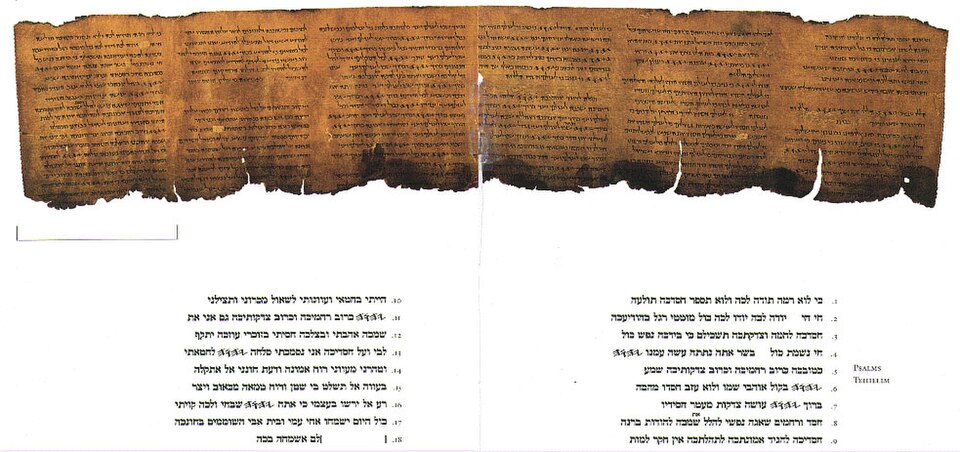

The Dead Sea Scrolls are often introduced as a spectacular archaeological discovery, but their historical value is easier to understand when the evidence is separated into layers. The manuscripts are not one book and not a single archive with a single voice. They are a large group of texts and fragments found in caves in the Judaean Desert, with different dates, languages, physical conditions and histories of recovery. What they can show is substantial; what they can show about the people who placed them there is narrower.
What was actually found?
The Israel Museum describes the scrolls as manuscripts discovered between 1947 and 1956 in eleven caves near Khirbet Qumran, on the northwestern shore of the Dead Sea. Their dates are generally placed between the third century BCE and the first century CE. Hebrew predominates, but Aramaic and Greek also appear. Parchment is common, while some pieces were written on papyrus. This range matters: “the Dead Sea Scrolls” is a modern umbrella for materials produced across centuries rather than a document created at one moment.
The first seven scrolls were found in 1947 by Bedouin in a cave near Qumran. Later discoveries expanded the corpus, but the physical record is uneven. Some scrolls survive in comparatively large pieces; others are tiny fragments whose original position, sequence or wording must be reconstructed. The official Digital Dead Sea Scrolls archive is therefore more than a display case: its images and catalogue information let readers distinguish a visible fragment from a proposed reconstruction.
Texts are evidence, not transparent testimony
The manuscripts include biblical texts, prayers, hymns, legal material, interpretations and other writings. The presence of a text in the caves demonstrates that someone copied, stored or deposited it there. It does not by itself identify every writer, reader or community connected with it. The caves and the nearby settlement provide archaeological context, but context is not a confession. Linking the entire collection to one named group can make a useful hypothesis sound like a proven fact.
This is especially important for the relationship between the manuscripts and the site of Qumran. The Israel Museum’s account presents a library associated with people deeply concerned with scripture, interpretation, law and prayer. That is a strong description of themes visible in parts of the collection. It is not evidence that every manuscript shared the same author, institutional owner or theological programme. A careful account keeps the manuscript-level evidence and the wider social interpretation in view at the same time.
One named witness: the Great Isaiah Scroll
The Israel Museum’s digital collection identifies the Great Isaiah Scroll as 1QIsaa, one of the seven scrolls discovered in 1947. Its exhibition introduction records 54 columns containing the 66 chapters of Isaiah. A column is a physical division of writing; a chapter is a division of the text. Those counts describe different things.
| Reference | Conclusion supported | Conclusion not established |
|---|---|---|
| 1QIsaa | One particular surviving witness to Isaiah can be identified. | Every scroll in the caves contains Isaiah, or shares this manuscript’s date. |
| 54 columns / 66 chapters | The physical layout and the book’s textual divisions have different counts. | The manuscript is a complete collection of all biblical books. |
| Discovery in 1947 | The manuscript entered the modern discovery story at that time. | The text was composed or the parchment written in 1947. |
The Psalms illustration above is not the Great Isaiah Scroll. Its separate credit remains attached to that photograph; the Isaiah example is supported by the museum records linked here. This avoids letting one manuscript’s picture stand in for another manuscript’s identity.
The historical payoff is specific: a surviving witness allows the transmission of one book to be investigated, while the wider cave collection remains a diverse body of evidence. It does not establish a single author or owner for every document in the desert archive.
What the archive can—and cannot—prove
The strongest conclusions are modest and cumulative: manuscripts were produced in the Judaean Desert’s wider cultural world over several centuries; many were hidden or deposited in caves; their languages and genres reveal a rich literary environment; and the surviving physical evidence allows careful comparison of texts, hands and materials. The weaker conclusions are sweeping claims about a single “lost community,” a complete library, or the motives of every depositor. Those claims require arguments that go beyond any one fragment.
Reading the Dead Sea Scrolls well means keeping the object, the catalogue and the interpretation in separate columns. The scroll fragment pictured here is a useful entry point, but its image cannot answer every question about provenance or meaning. The archive becomes most informative when visible evidence, archaeological context and scholarly reconstruction remain connected without being collapsed into one story.
Sources
- Israel Antiquities Authority, Digital Dead Sea Scrolls archive — catalogue and digitised manuscript access.
- Israel Museum, “The Dead Sea Scrolls” — discovery, dates, languages and collection context.
- Wikimedia Commons, “Psalms Scroll.jpg” — image file, source credit and public-domain status.