

The Archimedes Palimpsest is not an original manuscript written by Archimedes. Open the surviving book and the most obvious writing belongs to a medieval prayer book. The mathematical text lies underneath, on parchment that was reused. That distinction changes both what a photograph shows and what a recovered reading can claim.
Three dates, three different events
The project’s description identifies the underlying Archimedes copy as a tenth-century manuscript and the overlying prayer book as completed by April 1229. Neither date is the date when Archimedes composed his works. The surviving volume has 174 parchment folios and incorporates material from several earlier books.
Its reuse was physical as well as textual. Leaves were scraped, divided, rotated and refolded; the prayer writing runs at right angles to the older text. That helps explain why a page layout can look confusing even before damage and faint ink are considered. A modern sequence of prayer-book pages need not reproduce the older mathematical book’s reading order.
Imaging is a measurement, not a translation
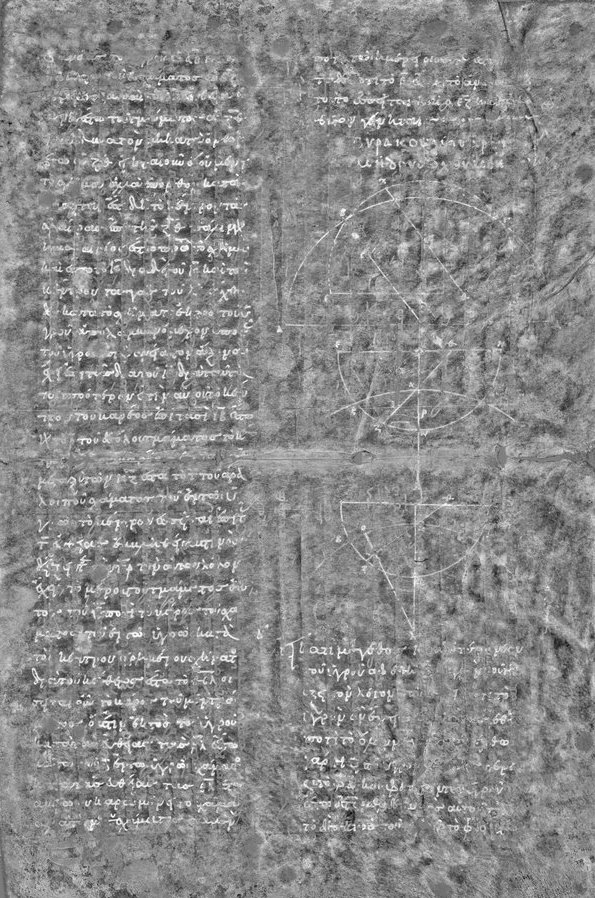
The multispectral imaging account explains that photographs made at different wavelengths are combined to separate the spectral responses of parchment and inks. On folio 70v, processed images make portions of the underlying text and diagrams easier to distinguish from the prayer writing.
The project also describes X-ray fluorescence work that maps elements in the leaf, including iron associated with ink. This is different from an ordinary X-ray image made by transmission through an object. The resulting map assists reading; it does not independently supply a Greek word or settle its meaning.
| Record | What to keep distinct |
|---|---|
| Visible-light photograph | The page’s present appearance. |
| Processed spectral image | Enhanced contrast and the processing method. |
| Transcription | Letters a scholar reads, including uncertain ones. |
| Translation | An interpretation of the recovered Greek. |
Why the distinction matters
A bright line in a processed image can help locate a stroke without establishing an entire sentence. When quoting a passage, identify the folio and the scholarly reading, not just an impressive image. If a transcription supplies a missing letter, preserve that uncertainty in discussion.
The book is valuable precisely because conservation, imaging and textual scholarship answer different questions together. Its history explains how the writings survived; measurements help make them visible; interpretation explains what can be read. None of those stages should disappear behind a claim that a machine simply revealed Archimedes’s own handwriting.
Sources and image license
- https://en.wikipedia.org/wiki/Archimedes_Palimpsest
- https://commons.wikimedia.org/wiki/File:ArPalimTyp2.jpg
- https://www.thewalters.org/about/archimedes/
- https://archimedespalimpsest.org/