
Ancient technology · evidence review
The Antikythera mechanism: brilliant evidence, careful limits
The ancient bronze fragments are often called the world’s first computer. That phrase is useful only if it is followed by the harder question: what exactly does the surviving evidence prove, and where should a careful reader stop?
What is firmly supported
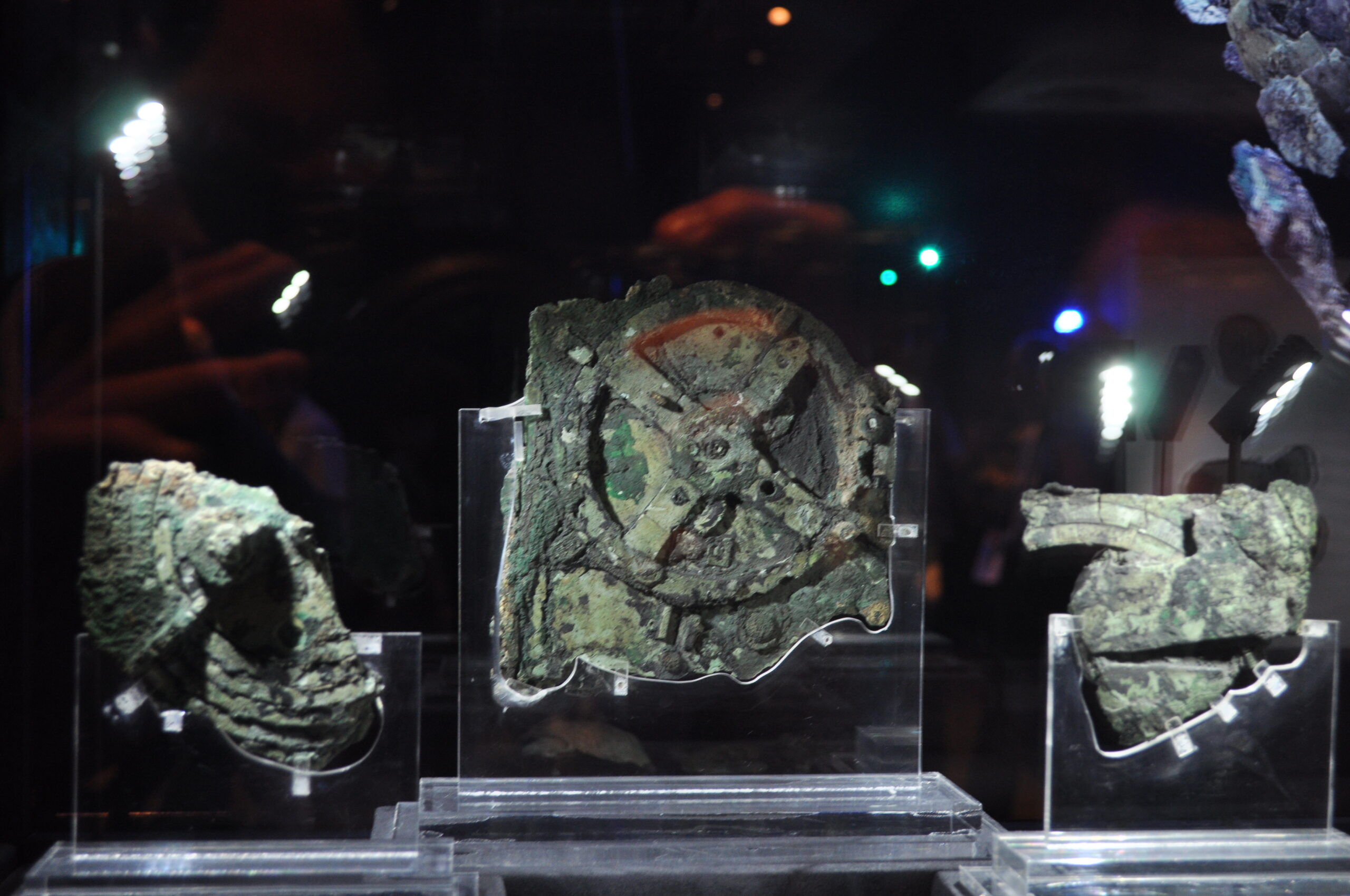
The fragments were recovered from a shipwreck near Antikythera in 1901 and are held in the National Archaeological Museum in Athens.
The device calculated and displayed cycles connected with the Sun, Moon, calendar months, lunar phases, and eclipse prediction.
Modern radiographic work revealed dozens of interlocking bronze gears, with a sophistication not matched in surviving evidence for many centuries.
The useful meaning of “ancient computer”
Calling the mechanism an ancient computer is not wrong, but it can mislead. It was not a general-purpose electronic machine. It was a hand-powered analogue calculating device: turn the input, and the gearing translated that motion into predicted astronomical positions and cycles. The phrase is best read as a shorthand for calculation by mechanism, not as a claim that Greek engineers had modern computing.
What the fragments do not prove by themselves
The mechanism does not give us a complete workshop history, a named maker, or a proven production line of similar devices. Nature’s 2006 account emphasizes one of the central puzzles: no earlier geared mechanism of this sophistication has been found, and nothing close survives again until much later astronomical clocks. That absence is not proof that the device was unique. It is a warning about survival bias: bronze was recyclable, ships sank unevenly, and ancient technical objects were rarely preserved intact.
How historians connect the machine to its world
The ship’s cargo and the intellectual geography of the eastern Mediterranean matter. Rhodes is often discussed because it was an important center for astronomy in the second and first centuries BCE, associated with figures such as Hipparchus and later Posidonius. But this is circumstantial context, not a maker’s signature. A responsible account separates a plausible Rhodian intellectual setting from a proven workshop attribution.
A reader’s checklist for future claims
- Does the claim distinguish the physical fragments from later reconstructions?
- Does it cite scans, inscriptions, gear counts, or museum records rather than only repeating a viral phrase?
- Does it use “known surviving evidence” when discussing technological firsts?
- Does it avoid turning a plausible historical context into a certain biography of the maker?
- Does the image credit include author, license, museum context, and any production download record?
Bottom line
The Antikythera mechanism is more impressive when its limits are stated plainly. It shows that at least one ancient Greek workshop could combine astronomy, inscriptions, and precision gearing into a compact predictive instrument. It also shows how fragile our map of ancient technology is: one shipwreck can preserve a level of craft that otherwise nearly disappeared from the record.

