A railway timetable only helps if the person reading it knows which clock its times refer to. A clock can be carefully regulated and still disagree with another company’s clock. That distinction explains the railway time change of November 18, 1883: the problem was not simply inaccurate instruments, but incompatible operating references.
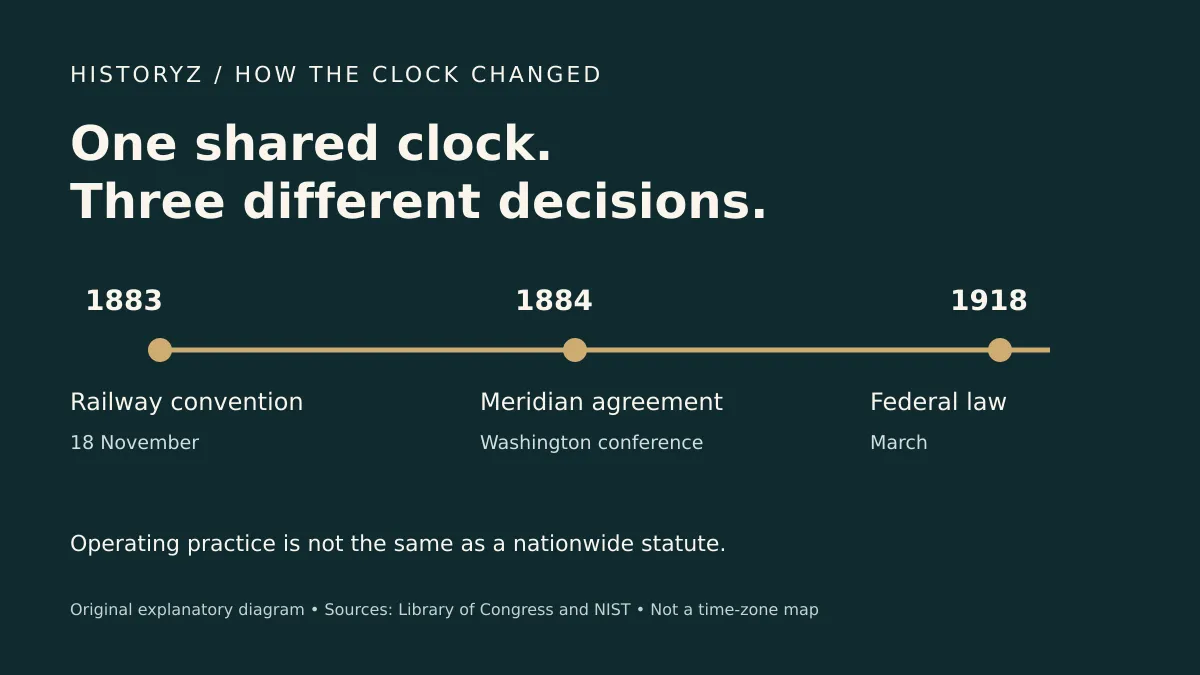
It is tempting to tell this as the day America acquired modern time zones. A more useful account separates three decisions: a railway convention in 1883, an international meridian agreement in 1884, and federal legislation in 1918. They were connected, but they were not interchangeable.
The operating problem: correct clocks, incompatible instructions
The Library of Congress guide to the Day of Two Noons describes railway companies using different clocks and local mean solar time. As routes multiplied, a shared operating reference became more urgent. It dates the coordinated station-clock change to November 18, 1883.
Consider a deliberately hypothetical transfer. One company’s departure notice uses Clock A; the connecting company’s notice uses Clock B. If a traveler compares the printed numbers without checking the reference, the apparent interval between trains may not be the interval the companies intended. This is an explanation of the coordination problem, not a recovered timetable or a reconstruction of a particular journey.
Making either clock more precise would not, by itself, resolve that mismatch. The missing instruction is which reference both schedules should use. Once the reference is explicit, a timetable can communicate more than a number: it can communicate the same number to people operating in different places.
Three dates, three kinds of authority
| Date | Decision | What to keep separate |
|---|---|---|
| November 18, 1883 | Railway standard-time change | An operating convention is not automatically a federal statute. |
| 1884 | Washington conference selected Greenwich as the prime meridian. | A common longitude reference does not establish every local clock boundary. |
| March 19, 1918 | United States federal standard-time law | Later legislation should not be projected backward onto the railway decision. |
The date for the federal law comes from the Library of Congress guide. NIST’s historical account of world time scales supplies the international sequence and describes local controversy after railway time arrived. NIST labels this account as an archive accurate as of 2004; it is not a current guide to civil-time rules.
The sequence matters when someone attributes a change to the wrong institution. Before explaining why an event happened, identify what the event actually was. A company agreeing to a schedule, a conference choosing a reference, and a legislature passing a law are different actions even when later accounts place them in the same paragraph.
Why the zone count needs a geographic label
The Library of Congress names five zones in the arrangement associated with William F. Allen: Intercolonial, Eastern, Central, Mountain and Pacific. The wider railway arrangement should not be described as five zones within the contiguous United States.
A zone count without a geographic label is easy to misread. In a classroom note or exhibition caption, write the system’s scope beside the number. Do the same for a map: ask whether it represents a railway arrangement, a national jurisdiction or a particular date. A familiar zone name is not proof that a historical map has today’s boundaries.
NIST also explains that actual boundaries are adjusted rather than following perfectly straight meridian strips. Keep the coordinate reference and the boundary drawing in separate columns. The first answers where longitude starts; the second answers which reference a locality uses.
A short worksheet for reading a clock-change claim
| Question | What to record | Stop if this is missing |
|---|---|---|
| Who made the decision? | Railway organization, conference or legislature | Do not substitute an institution named elsewhere in the narrative. |
| What changed? | Operating reference, meridian or legal rule | Do not call all three a single clock reset. |
| Where did it apply? | The geographic scope stated in the record | A count or map without scope needs further checking. |
| What establishes the date? | The described action and its dated evidence | An article’s publication date is not necessarily the action date. |
| What remains unknown? | Local implementation, exceptions or later adjustments | Leave the uncertainty visible rather than filling it with a guess. |
Use the worksheet on one claim at a time. If a paragraph says that time was standardized in 1883, ask whether it means railway operations or federal law. Then check the evidence for that narrower proposition. If another paragraph discusses Greenwich, ask whether it concerns the longitude reference or a specific city’s practice. This keeps a broad summary from doing work its evidence cannot support.
For a station-level account, the next research step would be to locate that station’s dated instructions or local reporting and identify the clock reference used. Neither institutional overview cited here establishes every station’s exact adjustment. Do not turn the hypothetical transfer above into evidence of a real accident, a particular offset or a company’s actual timetable.
What the Day of Two Noons does—and does not—tell us
The clock-reset name makes the event memorable. The institutional distinctions make it intelligible. An operating network needed a common reference; a later international agreement supplied a meridian; a still later federal law established a legal framework. Reading those actions separately avoids a surprisingly common error: treating the first coordinated practice as if every subsequent rule had already arrived.
This article offers a chronology and a reading method, not newly discovered railway records. It does not estimate accident reductions, settle local adoption dates or describe today’s daylight-saving arrangements. The accompanying diagram is an original explanatory timeline, not a period map or an archival artifact.