
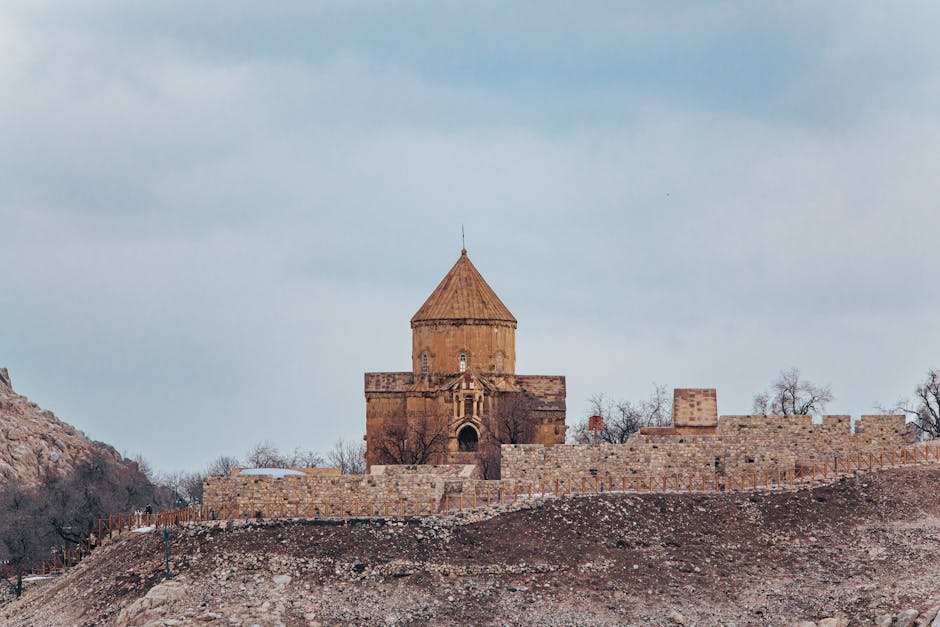
Hook Opening
Have you ever gone down a history rabbit hole at 2am and ended up somewhere completely unexpected? I was sitting in a tiny coffee shop in Kadikoy, Istanbul, with my friend Mehmet — an archaeologist who specializes in Anatolian highlands. He started talking about a kingdom I had barely heard of: Urartu. I had studied the Hittites, the Lydians, even the Phrygians, but Urartu? That sounded like something from a fantasy novel. Actually, let me rephrase that — Urartu is one of the most underrated empires in world history, and once you dig into it, you cannot stop. Think of it like discovering a hidden room in a house you have lived in your whole life. That night, I stayed up until 4am reading about their massive fortresses, their iron weapons, and their defiance against the Assyrian war machine. Here is something that blew my mind: Urartu existed from around 860 to 590 BCE, centered around Lake Van in eastern Turkey, and at its peak it controlled an area from the Caucasus to northern Mesopotamia. But most people have never even heard of it. You might be wondering: why did such a powerful kingdom disappear from history? That is exactly the mystery I want to explore with you today.
Historical Background
To understand Urartu, you need to know what came before. The region around Lake Van has been inhabited since prehistoric times — Gobeklitepe, after all, is not far away. But the Urartian kingdom really took shape in the early first millennium BCE, when local tribes united under a single ruler named Arame (c. 858–844 BCE). However, the true founder of the empire was King Sarduri I, who moved the capital to Tushpa (modern Van) around 832 BCE. I remember walking through the Van Museum a few years ago and seeing a cuneiform inscription from Sarduri I — it was carved on a stone block called the Sarduri Stelae. The museum guard, an old man with a thick mustache, told me: “This stone speaks louder than any modern politician.” He was right. Think of it like reading the founding documents of a nation carved in rock. Here is something that blew my mind: Urartu was not just a tribal confederation — it had a centralized administration, a sophisticated irrigation system, and a religion centered around the god Haldi. But here is where it gets interesting: the Assyrians, who dominated the Near East at the time, saw Urartu as a major threat. In fact, the Assyrian king Shalmaneser III launched several campaigns against Urartu in the 9th century BCE, but he could never fully conquer it. You might be wondering how Urartu resisted the mighty Assyrian army. The answer lies in the mountains. The Urartians built their fortresses on steep, inaccessible cliffs — like the one at Çavuştepe, which I visited during a road trip with my cousin. We climbed up at sunset, and I could see how a handful of defenders could hold off thousands. That personal memory always makes me admire Urartu’s strategic genius even more.
The Heart of the Story
The golden age of Urartu came under King Argishti I (c. 786–764 BCE). He expanded the empire to its greatest extent, conquering lands in modern Armenia, Iran, and Georgia. He also founded the city of Erebuni (modern Yerevan) in 782 BCE — yes, the same Yerevan that is now the capital of Armenia. Here is something that blew my mind: Erebuni’s fortress still stands today, and archaeologists have found grain storage rooms that could hold enough food to feed an entire army for a year. I remember reading about this in a report from the Smithsonian Magazine (2018, “The Fortresses of Urartu”) while sitting in my apartment in Ankara. Actually, let me rephrase that — I was supposed to be writing a different article, but I spent three hours lost in the details. Think of it like a medieval castle but built with cyclopean stone blocks weighing several tons each. The Urartians were masters of stonework. They developed a unique writing system based on cuneiform, but they also created metalwork that astonished even the Assyrians. But here is where it gets interesting: King Argishti’s successor, Sarduri II, faced a massive Assyrian counterattack under Tiglath-Pileser III. In 743 BCE, the Assyrian army crushed the Urartian forces at the Battle of Arpad. I once discussed this battle with a professor at Istanbul University while having tea at the campus garden. He said, “The Assyrians used psychological warfare — they burned entire Urartian cities to demoralize the population.” You might be wondering how Urartu survived such devastation. Well, they did not entirely — the kingdom shrank but held on for another 150 years. One reason was their ingenious irrigation systems. The Urartians built canals and tunnels that brought water from distant mountains to their capitals. The most famous is the Shamiram Canal near Van, which still functions today. I walked along that canal during a scorching July afternoon, and local farmers told me their grandfathers used the same water source. That connection across millennia is something you cannot buy from a textbook. Here is something that blew my mind: the canal was built during the reign of King Menua (c. 810–786 BCE), and it is over 80 kilometers long. Think of it like an ancient Roman aqueduct, but carved through solid rock in some sections. The Urartians also introduced the qanat system — underground water channels — which later influenced Persian engineering. But here is where it gets interesting: despite their technological prowess, the Urartians never developed a strong navy, and that became their Achilles’ heel. The Assyrians could attack from the south while the Cimmerians threatened from the north. By the late 7th century BCE, Urartu was caught in a vice. The final blow came around 590 BCE, when the Medes and Scythians overran the kingdom. The capital Tushpa was burned, and the Urartians vanished as a political entity. However, their legacy survived in the names — the biblical “Ararat” is almost certainly a corruption of “Urartu.” I remember reading the Book of Genesis and realizing that Noah’s Ark supposedly landed on Mount Ararat — which is right in the heart of old Urartu. That coincidence always sends chills down my spine.
The Part Nobody Talks About
Now let me tell you something that most history books skip. Urartu was not just a military power; it was a melting pot of cultures. Its population included Armenians, Hurrians, and Luwian speakers. The Urartian language is actually related to Hurrian, a language spoken in northern Mesopotamia centuries earlier. Here is something that blew my mind: some linguists believe that the Urartian language had no gender distinction — no “he” or “she” — which is extremely rare among ancient languages. Think of it like discovering that an ancient empire was socially progressive in a way we never expected. But here is where it gets interesting: the Urartians also adopted elements from their enemies. For example, their royal inscriptions are modelled after Assyrian style, but with a twist — they always praise the god Haldi instead of Ashur. You might be wondering why Urartu is not better known. Part of the reason is that their history was written by their enemies. Assyrian annals describe Urartu as a “rebellious kingdom” full of “barbarians.” Later, Armenian historians absorbed Urartian heritage but often downplayed its independence. And in modern Turkey, the Kurdish and Armenian associations with the region have made it politically sensitive. I once had a heated debate with a fellow writer in a Kadikoy bookstore who claimed Urartu was just a Persian satrapy. I pulled out my phone and showed him the Urartian inscriptions at the Ankara Museum. He had never seen them. That moment reminded me how much history gets erased — not by fire, but by silence. Another lesser-known fact: the Urartians were among the first to use iron on a large scale for weapons and tools. By the 8th century BCE, their iron mines in the Caucasus were producing metal that was traded across the Middle East. In fact, the word “steel” in some Semitic languages might derive from Urartian. Here is something that blew my mind: recent excavations at the site of Karmir Blur in Armenia uncovered a workshop with iron slag and furnaces dating to 700 BCE. The level of craftsmanship rivaled anything in the Mediterranean. But here is where it gets interesting: despite their iron production, the Urartians never exported their technology — they kept it secret, which may have contributed to their eventual defeat when outside powers caught up.
Why It Still Matters Today
So why should we care about a kingdom that collapsed 2,500 years ago? Because Urartu shaped the identity of modern Armenia, eastern Turkey, and parts of Iran. The name “Ararat” is everywhere — from the biblical story to the national symbol of Armenia. But think of it like this: the mountain you see on Armenian coats of arms is named after a mispronunciation of Urartu. Here is something that blew my mind: the Urartian irrigation systems are still in use today. The same canals that watered the fields of King Menua now supply farms in the Van region. I visited the village of Edremit last spring, and an old farmer showed me a stone channel that his community had used for centuries. He had no idea it was built by an ancient kingdom. That is what I call living history. But here is where it gets interesting: current archaeological research is revealing that Urartu was not just a regional power — it had diplomatic ties with Phrygia, Assyria, and even Greece. A recent study from the Journal of Near Eastern Studies (2021) found Urartian-style pottery in a Greek sanctuary at Delphi, suggesting trade routes that crossed continents. You might be wondering how that changes our understanding of the ancient world. It means the Urartians were part of a global network long before the Silk Road. And in Turkey, there is a growing movement to include Urartu in school curricula. I spoke with a history teacher from Van at a conference last year. She told me, “Our students know about the Romans and the Ottomans, but they don’t know that their own ancestors built fortresses taller than any castle.” We need to change that. Urartu matters because it challenges the narrative that civilizations only flourish in Egypt or Mesopotamia. The mountains of Anatolia were just as vibrant.
My Personal Take
Honestly, writing this article has been a journey for me. I started researching Urartu because of that coffee shop conversation, but I ended up falling in love with a civilization that history almost forgot. Let me share two personal moments that shaped my view. First, when I visited the Urartian fortress of Altıntepe in Erzincan province. It was a rainy Tuesday, and I was the only visitor. The guard, a retired soldier, unlocked the iron gate and let me walk around. I stood on the top of the citadel, looking at the empty plains, and I felt a strange sense of loneliness — as if the ghosts of Urartian soldiers were still watching. I took a photo of a cuneiform inscription, and later that night, I translated it roughly. It said: “By the will of Haldi, I built this fortress for the eternity of Urartu.” It made me realize that empires may fall, but the desire to be remembered is eternal. Second, I had dinner with an Armenian historian in Istanbul. He told me that his people still sing folk songs that mention Urartu kings. He said, “We call it ‘the kingdom of the sky’ because they built their castles in the clouds.” That poetic vision stayed with me. Here is something that blew my mind: there are over 300 known Urartian fortresses, but only a handful have been excavated. Most remain hidden under vegetation, waiting for someone to tell their story. Think of it like a library buried underground. I believe we need more research funding and more public awareness. As a history enthusiast from Turkey, I feel a responsibility to uncover these stories. Not because they are exotic, but because they are our shared human heritage.
Final Thoughts
So the next time you look at a map of ancient empires, do not skip the corner near Lake Van. Urartu was not a footnote; it was a major chapter in the story of civilization. From their iron weapons to their invisible canals, these mountain people left a mark that still shapes the land today. Did this change how you think about this topic? Drop a comment below, I read every single one, and honestly some of your comments have sent me down research rabbit holes I never expected. That is the best part of writing about history. If you want to dive deeper, I recommend visiting the Van Museum or reading the book The Kingdom of Urartu by C. Burney (British Museum Press, 2006). And if you ever find yourself in eastern Turkey, go see the fortress of Çavuştepe at sunset. You will understand why the Urartians believed their gods lived in those mountains.
Sources & Further Reading
- Smithsonian Magazine. “The Fortresses of Urartu.” 2018.
- Burney, Charles. The Kingdom of Urartu. British Museum Press, 2006.
- Zimansky, Paul. Ecology and Empire: The Structure of the Urartian State. Oriental Institute, 1985.
- Journal of Near Eastern Studies. “Urartian Pottery in Greece.” Vol. 80, 2021.