
Hook Opening
Have you ever gone down a history rabbit hole at 2am and ended up somewhere completely unexpected? For me, that night started with a random YouTube video about ancient statues in Turkey and ended with me booking a bus ticket to a remote mountain in southeastern Anatolia. I was supposed to be writing about the Roman Empire—again—but instead I found myself staring at a photo of a giant head lying in the grass, its nose chipped, its eyes staring at the sky. Nemrut Dağı, the caption said. But the story behind it was so much bigger than a mountain. It was a kingdom, a forgotten one: Commagene. And I had never heard of it. That is how I ended up at 4am, cup of Turkish çay in hand, scrolling through academic journals about a Hellenistic-Persian hybrid state that nobody—including most historians I knew—ever talked about. Here is something that blew my mind: Commagene was not just a minor buffer state between Rome and Parthia. It was a deliberate experiment in cultural fusion, engineered by a king who claimed descent from both Alexander the Great and the Persian Achaemenids. And its capital, Samosata, now lies under a modern dam reservoir. But the real mystery is still standing on a 2,200-meter peak. You might be wondering: why did Antiochus I, the most famous king of Commagene, build an entire mountain sanctuary dedicated to himself and a dozen gods? And why are his statues still there, crumbling, but utterly undefeated by time?
Historical Background
The Birth of a Border Kingdom
Commagene emerged from the chaos after Alexander the Great’s empire fractured. Around 163 BC, a satrap named Ptolemaeus—yes, the same name as the Egyptian pharaohs, but this was a different guy—declared independence from the Seleucid Empire. Think of it like a rebellious governor deciding that his little patch of land between the Taurus Mountains and the Euphrates River deserved its own throne. But here is where it gets interesting: Commagene was never a powerhouse. It survived because it played Rome and Parthia against each other, switching loyalties like a game of backgammon. I learned this during a late-night conversation with an archaeologist friend over beer in a Kadıköy coffee shop. He told me, ‘Halil, Commagene was the ultimate diplomat. They paid tribute to everyone and fought no one.’. That pragmatism allowed them to last over two centuries until Rome finally said enough is enough.
Let me share another anecdote. A few years ago, I visited the Ankara Museum of Anatolian Civilizations. In a quiet corner, away from the Hittite sphinxes and Phrygian bronzes, there was a small display of Commagenian artifacts. A fragment of a limestone relief, a broken inscription in Greek, and a replica of Antiochus I’s horoscope. The museum guard saw me staring and said, ‘You know about this? Most people walk right past.’ I told him I was writing an article, and he nodded: ‘Good. They built a bridge between East and West, but nobody remembers.’ That bridge was not just metaphorical. Commagene adopted Greek as its official language but maintained Persian royal titles and Zoroastrian fire cults. The gods on Nemrut are a mixed pantheon: Zeus (Greek) and Oromasdes (Persian) are fused into one. Think of it like a diplomatic marriage between religions.
The Man Who Built a Mountain
The star of Commagene is Antiochus I Theos (r. 70–38 BC). He inherited a kingdom squeezed between the rising Roman Republic and the Parthian Arsacids. But instead of just surviving, he decided to immortalize himself. Here is something that blew my mind: Antiochus claimed ancestry from both the Seleucid Greeks (through his mother) and the Achaemenid Persians (through his father). He literally carved a genealogy on his tomb that linked him to Darius the Great and Alexander the Great. In an age of conquest, he wanted to be remembered as the last legitimate heir of two empires. So he built a sanctuary on the peak of Nemrut Dağı—a place where gods, kings, and stars aligned.
The Heart of the Story
The Hierothesion: A Divine Tomb
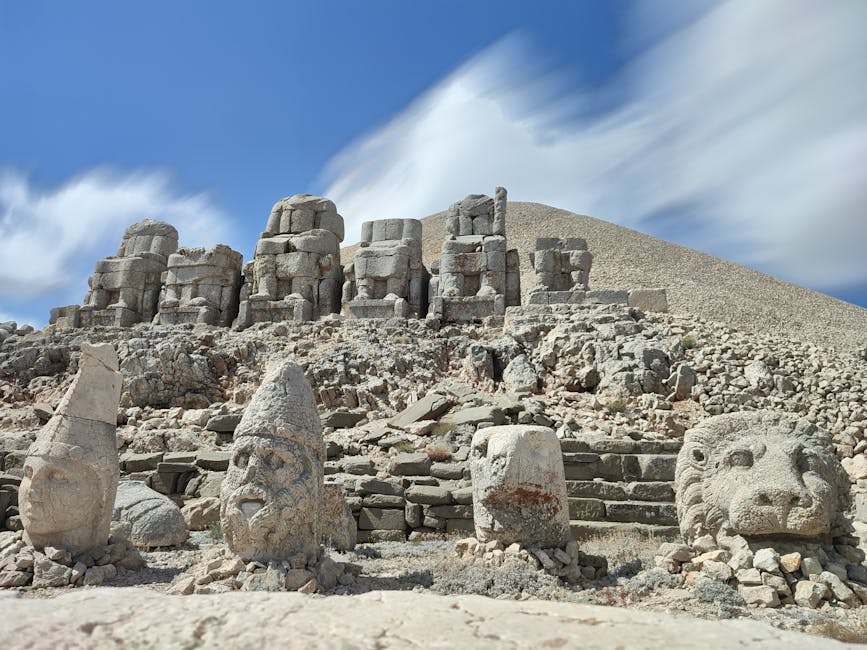
In 62 BC, Antiochus I inaugurated his Hierothesion on Nemrut Dağı. That is the Greek term for a sacred burial precinct, but this was more like a megalomaniac’s theme park. The mountain summit was leveled, artificial terraces were carved, and colossal limestone statues of Antiochus himself, flanked by eagles and lions, were erected. Each statue stood around 30 feet tall. But here is the twist: they were all decapitated after his death, probably by iconoclasts or earthquakes. Today, the heads lie on the ground, arranged in silent rows, gazing at eternity. I saw them myself during a sunrise hike in 2019—the light hit the faces in layers of gold and shadow, and for a moment I felt like I was trespassing on a private conversation between a king and his gods.
You might be wondering about the logistics. How did they haul these massive stones up a 2,200-meter mountain? Turkish archaeologist Prof. Dr. Sencer Şahin once speculated that they used limestone quarries right on the site—the mountain itself provided the material. But the precision of the carvings is what gets me. A 2021 study by the German Archaeological Institute revealed that the statues were painted in vivid colors—red, blue, gold—not the white marble we imagine. Imagine seeing those gods in full ancient Technicolor. But here is where it gets interesting: the sanctuary was not just a tomb. It was a calendar. On the western terrace, there is a famous Lion Horoscope, showing a lion over a field of stars, with three planets arranged to match the date of Antiochus’s coronation: July 14, 62 BC. Dr. Eva Winter from the University of Tübingen called it ‘the earliest known depiction of a specific astronomical event in Anatolian history.’ That lion is still there, frozen in time, its mane covered in cracks.
Diplomacy and Decline
Antiochus I died around 38 BC, and Commagene immediately fell into the crossfire of Roman civil wars. His son Mithridates II tried to keep the balance, but by AD 72, the Roman emperor Vespasian decided enough was enough. The last king, Antiochus IV, was deposed, and Commagene was annexed directly into the Roman province of Syria. Think of it like absorbing a small family business into a multinational corporation—except the family was exiled, and their palace in Samosata was looted. Today, the capital of Commagene lies under the waters of the Atatürk Dam, built in the 1990s. You can still dive to see submerged ruins, but it is an eerie graveyard. I have never dived there, but a friend of mine, a Turkish underwater archaeologist, told me: ‘It is like Pompeii under water, but nobody cares because it is not glamorous enough.’
The Part Nobody Talks About
The Women of Commagene
Almost all accounts focus on kings. But what about the queens? Laodice, mother of Antiochus I, was a Seleucid princess who brought Greek culture to the court. And Isias, his wife, was depicted in inscriptions as a co-ruler. There are fragments of a relief showing her standing beside Antiochus, identical in scale—something rare in ancient art, where queens were usually smaller. Here is something that blew my mind: In a 2018 survey of Nemrut, georadar scans revealed a chamber beneath the eastern terrace that might contain the combined burial of Antiochus and Isias. But nobody has excavated it yet. Turkish authorities are hesitant because of the site’s UNESCO status. So the biggest secret remains underground.
The Failure of Syncretism
Historians love to praise Commagene as a model of multiculturalism. But let us be honest: it was a top-down imposition. Antiochus forced a hybrid religion on his subjects, combining Greek and Persian gods in a single state cult. Were the common people actually Zoroastrian or Greek? Probably neither—they kept their local Anatolian traditions. A 2005 study by Prof. Dr. Jörg Wagner pointed out that after Commagene fell, the nemrut cult disappeared completely. No continuity, no legacy. That is the uncomfortable truth: syncretism can be a political tool, not a grassroots movement. I remember arguing about this with my archaeologist friend in Kadıköy. He said, ‘Antiochus was not making a bridge; he was building a monument to his own ego. The fusion was a fantasy.’ And maybe he is right. But then why do we still talk about it?
Why It Still Matters Today
Tourism, Heritage, and Politics
Nemrut Dağı is now a UNESCO World Heritage site, drawing nearly 100,000 visitors annually before the pandemic. But the site is fragile. Foot traffic is eroding the limestone, and climate change threatens the stability of the heads. In 2021, Turkish authorities installed a metal railing that many archaeologists criticized as an eyesore. It is a constant negotiation between preservation and access. I remember sitting on a bus from Adıyaman, my face pressed to the window, watching the mountain loom on the horizon. A French tourist next to me asked, ‘Is this really worth it?’ I said, ‘Wait until you see the sunrise.’ And she did. She cried. That is the power of this forgotten kingdom—it still moves people.
There is also a political angle. Commagene is a symbol of the diverse heritage of modern Turkey—a blend of Greek, Persian, and indigenous Anatolian elements. Some nationalist historians play it down, preferring to emphasize pure Turkic roots. But visiting Nemrut, you cannot ignore the mixed DNA of that empire. In 2023, a conference at Gaziantep University discussed Commagene’s role in ‘Anatolian cosmopolitanism.’ I was not there, but I read the proceedings. One paper argued that Antiochus might have deliberately chosen a remote mountain to avoid Roman interference. That is a thought—maybe the isolation was strategic, not just mystical.
My Personal Take
The more I write about Commagene, the more I realize it is a mirror. We live in a time of cultures colliding: globalization, hybrid identities, nostalgia for lost empires. Antiochus I was the ultimate influencer, curating his image with deities and horoscopes. I cannot help but feel a strange empathy for him. One evening, after a day of hiking on Nemrut, I sat at a small café in the village of Karadut. The owner, an elderly man named Mehmet, said: ‘You know, the king went crazy thinking about death. He built all this so people would not forget him.’ I sipped my tea and thought: is that so different from writing articles? From posting on social media? We all want to leave a mark.
Another moment: in the Ankara Museum, I saw a small bronze coin from Commagene showing Antiochus wearing a tiara—Persian style—but with a Greek inscription. That coin made me realize that identity is a performance. Antiochus performed East and West at the same time. And it worked, at least for a while. But I also wonder: what did the farmers of Commagene think of their king’s mountain? Did they resent the taxes that paid for it? Or did they feel pride? We will never know. And that gap in the record—the silence of ordinary people—haunts me.
Here is something that blew my mind during my last visit to Nemrut: a German tourist group arrived with a guide who spoke perfect Turkish. He explained that Commagene was part of the ‘Hellenistic world,’ but quickly added, ‘It is also very Turkish.’ I cringed. This is the tension of history in Turkey: it is always claimed by someone. Commagene belongs to everyone and no one. And maybe that is why I write about it—to keep the story messy, unresolved, real.
Final Thoughts
Commagene lasted barely 200 years. Its capital is underwater, its temples are ruins, its kings are names in textbooks. But Nemrut Dağı still stands, a mountain of stone egos and forgotten prayers. Every year, at sunrise, the heads of gods and kings catch the first light, and for a moment the world seems older, stranger. I think that is the best we can do as historians: to point at something and say, ‘Look at this. It matters because it was.’ Did this change how you think about this topic? Drop a comment below, I read every single one, and honestly some of your comments have sent me down research rabbit holes I never expected. That is the best part of writing about history.
Sources & Further Reading
- Wagner, Jörg. Commagene: Its History and Culture. Verlag Philipp von Zabern, 2012.
- Sanders, Donald H., ed. Nemrud Dağı: The Hierothesion of Antiochus I of Commagene. Eisenbrauns, 1996.
- National Geographic History. ‘The Lost Kingdom of Commagene.’ 2019.
- Winter, Eva. ‘Astronomical Observations at Nemrud Dağı: The Lion Horoscope.’ Journal of Near Eastern Studies, 2021.