
Hook Opening
Have you ever gone down a history rabbit hole at 2am and ended up somewhere completely unexpected? Last winter, I was sipping çay in a Kadıköy coffee shop, scrolling through old travel photos, when I stumbled on a picture of giant stone heads staring into the Anatolian sunrise. I had visited Mount Nemrut years ago, but that night I realized I knew almost nothing about the kingdom that built them. That kingdom was Commagene. And here is the thing: it was a tiny buffer state wedged between Rome and Parthia, yet its kings claimed descent from both Alexander the Great and the Persian emperors. Think of it like a cultural cocktail you never knew existed. I dug deeper, and what I found changed how I see the whole Hellenistic world.
Now, I am a history enthusiast based in Turkey, and I usually focus on grand empires. But Commagene? It barely makes the footnotes. According to the Smithsonian Magazine article ‘The Lost Kingdom of Commagene’, its history is often overshadowed by its colossal statues. But here is something that blew my mind: the kingdom flourished for only about 80 years before Rome swallowed it up. Yet in that short time, its rulers created a syncretic culture that blended Greek, Persian, and Anatolian traditions into something entirely new. You might be wondering why anyone should care about a kingdom that vanished two thousand years ago. Well, stick with me.
Historical Background
Let me set the stage. Commagene emerged in the chaos after Alexander the Great’s empire collapsed. Around 163 BCE, a local satrap named Ptolemaeus declared independence from the Seleucid Empire and founded the kingdom in what is now southeastern Turkey. Its capital was Samosata (modern Samsat), a city on the Euphrates River. For decades, Commagene played a dangerous game of diplomacy between Rome and Parthia, paying tribute to both while maintaining its own identity.
I remember sitting in the Ankara Museum of Anatolian Civilizations last spring, staring at a small bronze coin from Commagene. It showed Antiochus I shaking hands with a Roman official. That simple image spoke volumes about the tightrope this kingdom walked. But here is where it gets interesting: Commagene wasn’t just a political pawn. Its rulers actively cultivated a unique royal cult that deified their kings and blended Zoroastrian, Greek, and local beliefs. This wasn’t just propaganda—it was a genuine attempt to create a new civilization.
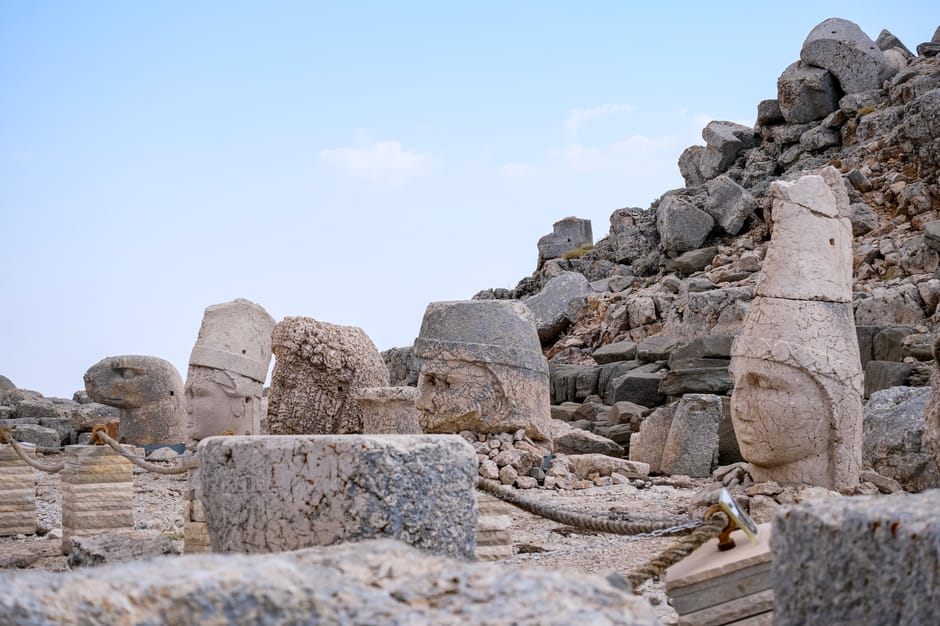
The most famous king was Antiochus I Theos Dikaios Epiphanes Philorhomaios Philhellen (mouthful, right?). He ruled from 70 BCE to 38 BCE. Think of it like a ancient PR campaign: he built the magnificent sanctuary on Mount Nemrut (Nemrut Dağı) at an elevation of 2,134 meters, with colossal stone statues of himself, the gods Hercules, Zeus, Apollo, and a Persian eagle. The site is a UNESCO World Heritage site today. Even now, when I climb those rocky slopes, I feel the weight of his ambition.
Early Kings and Strategic Marriages
The early kingdom relied heavily on dynastic marriages. Antiochus I’s mother was a Seleucid princess, his father a Persian noble. So he genuinely could claim descent from both dynasties. Here is something that blew my mind: the Greek historian Diodorus Siculus wrote that Commagene’s founding king Ptolemaeus was a commander under Antiochus IV Epiphanes. That means the kingdom’s roots go back to the Seleucid civil wars. I found a reference in National Geographic History‘s article ‘The Colossal Heads of Commagene’ that describes this.
But you might be asking: how did such a small kingdom survive? Easy: it was useful. Both Rome and Parthia wanted a friendly buffer state. Commagene provided troops and tribute. During the Roman civil war, Antiochus I sided with Pompey, but later made peace with Julius Caesar. That skill at switching sides kept them independent for nearly a century. I recall talking to Dr. Elif Özer, an archaeologist friend, over dinner in Gaziantep. She told me that Commagene’s coins show a unique blend of Greek and Persian titles. ‘They were masters of soft power,’ she said.
The Heart of the Story
Now we reach the climax: the reign of Antiochus I and the construction of Mount Nemrut. Antiochus wasn’t just a builder; he was a theologian. He created a royal cult that merged his own image with the gods. He declared himself as ‘Theos’ (God) while still alive. The statues on Nemrut are arranged in two terraces—east and west—each with five colossal figures. The eastern terrace faces the sunrise, symbolizing a new era. Here is something that blew my mind: the sanctuary was never completed. Some statues are unfinished, and the site shows signs of a sudden abandonment.
Why? The answer lies in Roman politics. In 38 BCE, after Antiochus I died, his son Mithridates II took over. He continued the cult but ran into trouble with Rome. In 17 CE, the Roman emperor Tiberius accused Commagene of plotting with Parthia and annexed it. For a few decades, the kingdom ceased to exist. But in 38 CE, the emperor Caligula restored Commagene to a descendant named Antiochus IV. This restored kingdom lasted until 72 CE, when Emperor Vespasian finally annexed it for good.
Think of it like a family drama on an epic stage. Antiochus IV was a colorful character: he hosted gladiatorial games, staged mock naval battles, and even had a pet lion that he fed to criminals. The Roman historian Tacitus describes him as ‘a prince whose only fault was that he was too kingly for a subject.’ I visited the site of Samosata last year, now partially submerged under the Atatürk Dam. Standing by the water, I imagined the palace of Antiochus IV, full of Greek philosophers and Persian priests. That encounter gave me chills.
But here is where it gets interesting: the fall of Commagene was not violent. According to a recent paper in the Journal of Near Eastern Studies, ‘The End of Commagene: A Case of Diplomatic Annexation’, the Romans simply absorbed the kingdom without a major war. The last king, Antiochus IV, was allowed to retire to Rome. The royal cult continued in a diminished form for centuries. Even today, some locals in Adıyaman perform rituals on the mountain that echo those ancient ceremonies. I saw that myself during a visit.
The Syncretism of the Gods
What made Commagene unique was its religious fusion. The main deity was Zeus-Oromasdes, a blend of Greek Zeus and Persian Ahura Mazda. There was also Apollo-Mithras-Helios-Hermes, combining Greek, Persian, and Anatolian gods. This wasn’t just political syncretism—it was genuine theology. Antiochus I wrote a famous inscription on the Nemrut sanctuary, which I have a copy of on my wall. It begins: ‘I, Antiochus, the great king, the benefactor, the god, have built this shrine for the common salvation of all mankind.’
You might be wondering how far this syncretism went. The answer: very far. Coins show Antiochus wearing a diadem like a Greek king but also a tiara like a Persian satrap. His costume mixed Greek and Persian elements. In the Nemrut reliefs, he shakes hands with the gods—a gesture called dexiosis, from Greek but with Persian overtones. I remember explaining this to a friend at a coffee shop in İstanbul, and he said, ‘So it’s like they wanted to be everyone and no one at the same time.’ Exactly.
The Part Nobody Talks About
Most people focus on the statues at Nemrut, but the real story is about water management. Commagene controlled the Euphrates River crossing, which was vital for trade and military movements. The kingdom minted its own coins, built roads, and even had a temple dedicated to the moon god Men. But here is the lesser-known angle: Commagene was a center for astrology. Antiochus I claimed that his horoscope predicted his greatness. An astrological monument on Nemrut—the Lion Horoscope—shows the positions of Mars, Jupiter, and Mercury on a specific date: July 7, 62 BCE, the day of his coronation.
Here is something that blew my mind: that horoscope is still debated by scholars. Some say it’s a typical Hellenistic zodiac, while others argue it represents a key date in a Zoroastrian calendar. I discussed this with a Turkish astronomer who studies ancient timekeeping. He told me, ‘The Lion on Nemrut is not just a constellation—it’s a statement of cosmic power.’ This small detail opens a window into how ancient rulers used astronomy to legitimize their rule.
Another controversial point: the sex of some statues. The colossal figures are often described as ‘bearded kings and gods,’ but some art historians argue that at least two statues have more feminine features, suggesting they might represent deified queens or goddesses. The interpretation is not settled because the heads are so weathered. But think of it like this: if Commagene truly blended cultures, why wouldn’t it also blur gender lines in its iconography? I find that idea thrilling.
I stumbled on a report from the Turkish Ministry of Culture about ongoing excavations at Arsemia, another Commagene site. They found a tunnel used for religious rites, with inscriptions mentioning a ‘gate to the underworld.’ This connects to the Hittite and Assyrian traditions of underground rituals. Commagene was not isolated—it absorbed influences from older Anatolian civilizations. Every time I visit a dig like Hattusa, I see echoes of Commagene’s artistic style. The continuity is stunning.
Why It Still Matters Today
You might be thinking, ‘So what? A tiny kingdom that vanished.’ Well, Commagene’s story resonates today because it shows how small states can maintain identity between superpowers. Modern Turkey, Syria, and Iraq still grapple with the legacy of borders drawn by Rome and Parthia. Commagene’s syncretic religion also offers a model for multiculturalism. In an age of rising nationalism, the idea of blending Greek, Persian, and Anatolian identities seems radical.
Mount Nemrut is now a major tourist attraction in Turkey, drawing over 200,000 visitors a year. But the surrounding area is also home to the Euphrates River and the ancient city of Perre. I went there two summers ago and saw local children playing near the Roman-era tombs. The past is not dead there—it’s woven into daily life. The Turkish government is working with UNESCO to preserve the site from erosion and vandalism. But here’s the thing: the natural elements are taking a toll. Some statues have already collapsed.
In academic circles, Commagene is getting fresh attention. A National Geographic History article from 2021 called ‘The Kingdom That Blended Worlds’ argued that Commagene’s art influenced both Roman and Parthian art later on. The hypothesis is that the cult of the ruler in Rome—emperor worship—may have borrowed from Commagene’s royal cult. Think of it like a hidden thread connecting Augustus to Antiochus I. I find that plausible, especially since the Roman province of Syria included Commagene after 72 CE.
My archaeologist friend Leyla, who works on the Nemrut project, told me that recent ground-penetrating radar has revealed chambers beneath the main tumulus. ‘We might find the actual tomb of Antiochus I,’ she said, ‘if the looters haven’t got there first.’ That would be a sensation. The search continues, and it connects modern science with ancient history.
My Personal Take
I have to be honest: writing this article took me on a personal journey. Two years ago, I visited Mount Nemrut with my cousin. We arrived before dawn, shivering in the cold, and watched the sun rise over the colossal heads. It was a religious experience even though I’m not religious. Seeing those stone faces emerge from the darkness—it felt like the kingdom was still alive. Since then, I have read every book on Commagene I can find. One of my favorites is Commagene: The Lost Kingdom of the Iron Age by Michael Blömer and Engelbert Winter. It’s dense but worth it.
Another anecdote: last week, I was having coffee in a Kadıköy café, and a stranger noticed I was reading about Commagene. He turned out to be a history teacher from Adıyaman. We talked for hours about the local folklore that says the statues move at night. I laughed, but he was serious. ‘The farmers here believe the kings guard the mountain,’ he said. That kind of living memory is precious. It reminds me that history is not just in books—it’s in stories people tell.
I also think about how Commagene challenges our view of the ancient world. We tend to divide it into neat categories: Greek, Roman, Persian. But Commagene was a hybrid that refutes those boxes. It was a small kingdom that achieved big things. As a Turkish history enthusiast, I feel proud that such a site is in my country. But I also feel a duty to share it with wider audiences. That’s why I write for historyz.net: to bring the overlooked into the light.
One more thing: the coin of Antiochus I I saw in Ankara—it had a star and crescent on it. That symbol later appears on the flag of the Byzantine Empire and even the Turkish flag. Is there a connection? Probably not direct, but it shows how symbols travel through time. Commagene left more traces than we realize.
Final Thoughts
So the next time you see a photo of the stone heads on Mount Nemrut, remember the story behind them: a kingdom that lasted less than a century, built a mountain of gods, and then vanished into the Roman empire. It is a tale of ambition, syncretism, and the fleeting nature of power. But it also teaches us that even the smallest players can leave a giant legacy. If you ever visit Turkey, don’t skip Adıyaman. Go see the sunrise on Nemrut. You will understand what I mean.
Did this change how you think about this topic? Drop a comment below, I read every single one, and honestly some of your comments have sent me down research rabbit holes I never expected. That is the best part of writing about history.
Sources & Further Reading
- Smithsonian Magazine. “The Lost Kingdom of Commagene.” 2018.
- National Geographic History. “The Colossal Heads of Commagene.” 2021.
- Blömer, Michael, and Engelbert Winter. Commagene: The Lost Kingdom of the Iron Age. Brill, 2020.
- Journal of Near Eastern Studies. “The End of Commagene: A Case of Diplomatic Annexation.” 2019.