
Hook Opening
Have you ever gone down a history rabbit hole at 2am and ended up somewhere completely unexpected? I remember one night last winter, huddled over my laptop in a drafty apartment in Kadıköy. A friend of mine, an archaeologist who works on Hellenistic sites, had mentioned something about a place called Mount Nemrut. I’d seen the famous photos—giant stone heads staring into the sunrise—but assumed it was just another Roman leftovers. Then I started reading, and honestly, I couldn’t stop for hours. Here is something that blew my mind: this wasn’t Roman. It wasn’t Greek. It was the creation of a tiny, almost forgotten kingdom called Commagene, which existed for barely 200 years on the banks of the Euphrates. Think of it like a cultural blender that mixed Persian, Greek, and local Anatolian traditions into something no one has ever seen before. You might be wondering, why should a kingdom that vanished in the first century AD matter today? Because the story of Commagene is not about conquest or power—it’s about how a people dealt with being squeezed between empires, and how they built a monument that still challenges our ideas about identity. But here is where it gets interesting: I actually visited Mount Nemrut last spring, and standing among those broken statues at dawn, I realized I understood almost nothing about the people who put them there.
Historical Background
The Geopolitical Sandwich
To understand Commagene, you have to picture the map of the ancient Near East after Alexander the Great died. His empire split into pieces: the Seleucids in Syria and Mesopotamia, the Ptolemies in Egypt, and the Attalids in western Anatolia. But between the Seleucids and the rising power of Rome, a patchwork of small kingdoms emerged—Cappadocia, Pontus, Armenia, and right in the middle, Commagene. Actually let me rephrase that: Commagene was less a kingdom and more a persistent idea. It sat at a crossroads—politically and culturally. To the east, the Parthian Empire revived Persian traditions; to the west, Hellenism dominated. For the local rulers, whose ancestors were Persian satraps but whose subjects spoke Aramaic and worshipped both Zeus and Ahura Mazda, survival meant blending. I remember sitting with a Turkish historian friend at a coffee shop near the Grand Bazaar, and he pointed out that the Orontid dynasty of Commagene claimed descent from the Persian king Darius I. But they also married into the Seleucid royal family. They were playing both sides, and that strategy gave them two centuries of independence—roughly from 163 BC to AD 72.
The Man Who Built a Mountain
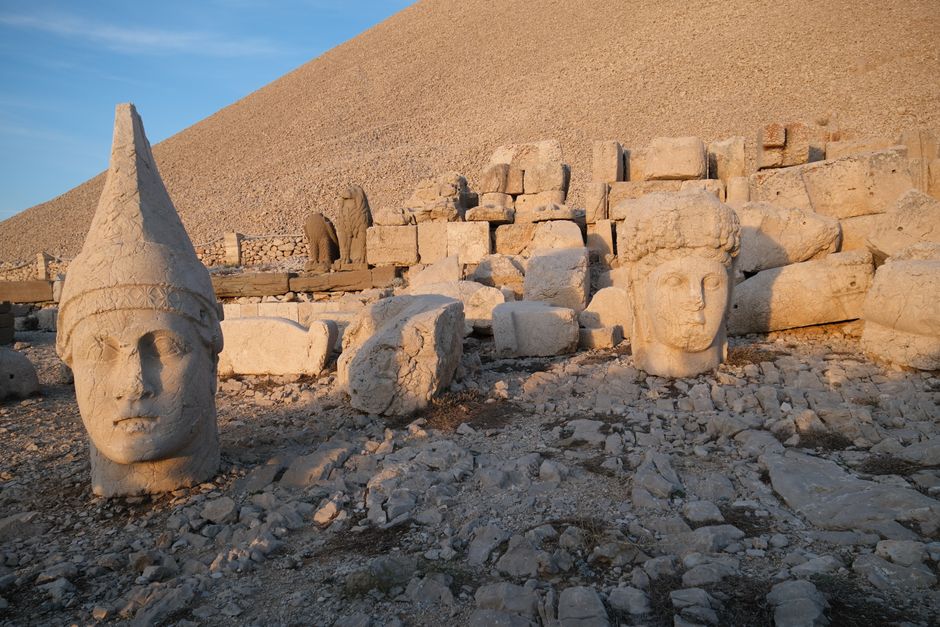
The most famous ruler of Commagene was Antiochus I Theos (reigned c. 70–38 BC). He did something extraordinary: on a remote mountain peak (now called Nemrut Dağı, elevation 2,134 meters), he ordered a massive tumulus—a pile of crushed stone—surrounded by colossal statues of gods and kings. Here is something that blew my mind: the statues are not just Greek or Persian—they’re a deliberate fusion. You see a figure labeled Apollo-Mithras-Helios-Hermes. That’s a triple identity. Antiochus himself is seated among these gods, as if he’s part of the pantheon. The site contains inscriptions in Greek that describe a cult centered on the ruler. Think of it like a self-deification project, but one that tried to unify the warring religious traditions of his kingdom. I visited the Ankara Museum of Anatolian Civilizations last year and saw a fragment of the famous Antiochus Sanctuary stele—it lists the horoscopes that supposedly predicted his divine birth. The mixture of Zoroastrian and Hellenistic astrology is dizzying. You might be wondering, what did Rome think of all this? The Romans were closing in, and Antiochus managed to play them against the Parthians, even receiving a legionary camp as a favor from Pompey. But the balancing act couldn’t last forever.
The Heart of the Story
The Rise and Fall of a Fleeting Kingdom
Commagene’s peak came under Antiochus I, but the seeds of its decline were already planted. Let me take you back to 69 BC. That year, Lucullus invaded Armenia and Commagene submitted to Rome. Antiochus paid tribute and offered troops. But when the Parthians threatened again, Commagene hedged its bets. In 38 BC, after Antiochus died, Rome installed a new king, Mithridates II. The real tipping point came under the emperor Vespasian. In AD 72, Rome annexed Commagene directly. Why? Because a rebellion by the king’s brother, Antiochus IV, gave Vespasian an excuse. The royal family was sent to Rome. The kingdom vanished. But here is where it gets interesting: the annexation wasn’t violent. The Romans basically said, “You’re a province now,” and the local elites quickly Latinized. The temples of Commagene were converted to Roman imperial cult sites. But on Mount Nemrut, the statues remained untouched—too remote for looters, too heavy to move.
The Gods That Refused to Die
Fast forward to 1881. A German engineer named Karl Sester was surveying the Euphrates region for a railroad. He heard stories about a mountain with giant heads. He climbed Nemrut and found exactly that: line of limestone statues, their heads toppled by centuries of earthquakes, staring blankly at the sky. Sester’s discovery sparked archaeological interest. In the 1950s, American archaeologist Theresa Goell led systematic excavations. She uncovered the full sanctuary: the east and west terraces, each with rows of gods and a huge limestone eagle and lion. The east terrace had a relief showing Antiochus shaking hands with Heracles—likely a symbol of the king’s divine approval. I actually stood on that terrace last April, and the wind was so strong I couldn’t hear myself think. The stones felt cold but alive. Here is something that blew my mind: the orientation of the statues is astronomical. The lion relief on the west terrace contains a depiction of the constellation Leo with a star that aligns with the summer solstice sunrise. The whole site is a calendar, a tomb, and a temple rolled into one. Think of it like a 2,000-year-old GPS for the soul.
The Mystery of the Tomb
No one has ever found Antiochus’s actual burial chamber. The tumulus is about 50 meters high, and ground-penetrating radar suggests there is something inside—maybe a vault. But digging would destroy the integrity of the mound. Turkish authorities have banned excavation of the tumulus itself. So Antiochus’s remains, if they exist, are still up there. I asked a local guide, “Do you think they’ll ever open it?” He laughed and said, “Why? The mystery is better than the bones.” And I think he’s right. The intrigue is part of the kingdom’s legacy. But there’s another layer: the cult of Antiochus continued long after the kingdom ended. Inscriptions show that priests maintained the rituals for at least a century after annexation. The Romans may have taken the throne, but they couldn’t take the mountain’s meaning.
The Part Nobody Talks About
The Forgotten Kingdom of Samosata
While Mount Nemrut gets the glory, the actual capital of Commagene was Samosata (modern Samsat), now partly submerged under the Atatürk Dam. Samosata was a fortress city on the Euphrates, controlling a ferry crossing. Here is something that blew my mind: Samosata was the birthplace of Lucian of Samosata, the second-century satirist who mocked Greek mythology and wrote about cities in the sky—some historians think his science fiction ideas were influenced by the religious blending he saw growing up. But almost nothing of the ancient city remains today. The dam flooded it in the 1980s. I went to see the artificial lake a few years back, and I felt a pang of loss. Beneath that water lies the palace of Antiochus, his archives, and graffiti from soldiers who guarded the border. Nobody talks about Samosata because it’s gone. Yet it was the beating heart of Commagene—a place where East and West met, argued, and merged.
The Controversy of Self-Deification
Historians have debated for decades: was Antiochus genuinely considered a god by his subjects, or was this just propaganda? Some argue that the hierothesion (the sanctuary name) was a dynastic cult like the Ptolemies, a way to bind loyalty. But others see deeper theology. I sat in the library of the Turkish Historical Society in Ankara last month, reading a paper by Professor Sencer Şahin. He argues that Antiochus’s inscriptions use language from both Persian khvarenah (divine glory) and Hellenistic arete (virtue). The king was not just posing as a god—he was trying to create a new religion for a multicultural state. Think of it like the Imperial Cult of Rome, but local and personalized. Yet the twist is that Antiochus didn’t force it. Citizens could worship their own gods, too. The Sanctuary was inclusive on purpose. You might be wondering, did anyone actually believe? The recent discovery of a stele from a village near Nemrut shows a farmer named Menekrates dedicating a statue to Antiochus as “God, King, and Savior.” That suggests the cult had real followers.
Why Commagene is Not a “Minor” Kingdom
Let me be blunt: calling Commagene “minor” is misleading. It controlled a crucial trade route, minted its own coins, and influenced the religious landscape of Roman Syria. The Syncretism of Commagene predicted later developments in Roman Mithraism and even early Christian ideas of divine kingship. Some scholars even see echoes in the Kings of the East in the Gospel of Matthew—the magi who followed a star may have been Zoroastrian priests from a tradition similar to Commagene’s astrology. That’s just speculation, but it shows how this little kingdom rippled far beyond its borders.
Why It Still Matters Today
Modern Identity and Heritage Politics
Today, Mount Nemrut is a UNESCO World Heritage Site, and it receives about 50,000 visitors a year. But the legacy of Commagene is more than tourism. In Turkey, the site has become a symbol of the country’s multicultural past—a counterpoint to nationalist narratives that often prioritize either Turkic or Islamic heritage. I’ve seen young Turkish artists create installations inspired by the fusion statues. And there’s a growing interest in Zoroastrianism among some secular Turks, partly fueled by Commagene’s Persian resonance. Here is something that blew my mind: in 2020, a team from İstanbul University used drone photogrammetry to create a 3D model of the entire sanctuary. They found that the tumulus is slowly slumping—future generations may not see the statues upright if conservation doesn’t step up. That makes my visits feel urgent.
The Universal Lesson of Blending
Commagene’s ghost teaches us that borders are porous. In an era of rising xenophobia, the story of a kingdom that deliberately mixed religions and languages feels radical. I think about the Syrian refugees I see in Istanbul, and how their presence creates a new kind of social fusion—messy, awkward, but potentially creative. Commagene was not a utopia; it was a survival strategy. But its art shows that blending can produce beauty. Think of it like a curry—the ingredients are all local, but the combination is global. That’s what Antiochus understood: identity is a recipe you can adjust.
My Personal Take
The Morning on Nemrut
I went to Mount Nemrut at 04:00 AM on a chilly May morning. The night before, I’d stayed in a small pension in Kahta (the nearest town). The driver who took me up, a retired schoolteacher, pointed to a light on the horizon and said, “That’s the tomb of Antiochus.” I shivered—not just from cold. When I reached the top, the eastern sky was turning pink. The heads were silhouetted. As the sun lifted, the light hit the stone faces, and for five minutes, the statues seemed alive. I cried a little. I’m not ashamed. I’d spent months reading about the place, and in that moment, it all clicked. This was not a tourist attraction. It was a message from a man who wanted to be remembered for eternity. And he is—in a way, because I’m telling you about him.
Lessons from a Vanished Kingdom
Commagene reminds me that small things can have big echoes. I run my website, historyz.net, from a cramped study in Kadıköy. Sometimes I wonder if writing is a waste of time. But then I think of Antiochus, who spent a fortune hauling stone up a mountain. It must have seemed insane to his contemporaries. Yet now, 2,000 years later, his story is being read by someone in a coffee shop in Istanbul or a library in Kansas. That’s power. I believe history is not about dates and battles; it’s about the human impulse to leave a mark. Commagene left a very unusual mark: a pile of rocks with multiple faces.
Final Thoughts
Have you ever gone down a history rabbit hole at 2am and ended up somewhere completely unexpected? I hope this story took you to a mountain that few people think about. The Kingdom of Commagene lasted only a blink in time, but its syncretic vision—a blend of Greek, Persian, and Anatolian—still challenges our assumptions about culture and identity. Next time you see a statue of Zeus, remember that in one corner of the Euphrates, Zeus shared a name with Mithras and Hermes and Apollo. That is the 2am kind of history I love. Did this change how you think about this topic? Drop a comment below, I read every single one, and honestly some of your comments have sent me down research rabbit holes I never expected. That is the best part of writing about history.