
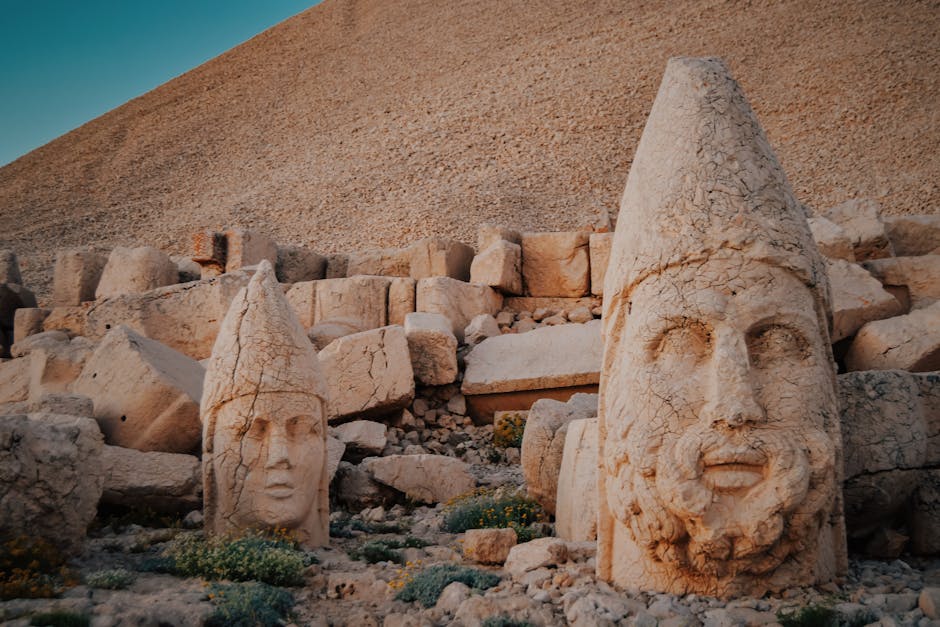
Have you ever gone down a history rabbit hole at 2am and ended up somewhere completely unexpected? I have. It was a humid night last July, and I was wide awake in my Istanbul apartment, scrolling through old travel photos. One photo stopped me cold: a selfie I took at Mount Nemrut back in 2015, with those enormous stone heads scattered like abandoned gods. That image pulled me into the story of a kingdom so obscure, most people have never heard of it. The Kingdom of Commagene is where the sun rises over a giant tomb that blends two worlds – and few know about it.
Hook Opening
I still remember the chill at 3:30 am when I drove up to Nemrut Dağı. The road twists for hours from Adıyaman, and the only sound is the crunch of gravel under the tires. At the summit, before dawn, the silence is heavy. Then the first rays hit the colossal limestone heads – Apollo, Hercules, a lion, an eagle – all toppled from their thrones, staring eastward. Nobody else was there. I sat down on the east terrace, and I thought, How did this tiny kingdom ever pull this off? You might be wondering, what exactly is the Kingdom of Commagene? It was a small Hellenistic state that existed from 163 BCE until 72 CE, tucked between the rival superpowers of Rome and Parthia. Its capital was Samosata (modern Samsat, Turkey), and its most famous ruler, Antiochus I Theos, built what is now a UNESCO World Heritage site on that mountain. But for most history buffs, Commagene is just a footnote – if that. Here is something that blew my mind: Antiochus claimed descent from both Alexander the Great through the Macedonian line and from Darius the Great through the Persian royal dynasty. Think of it like a family reunion that would have made both sides groan. But here is where it gets interesting: he used this dual lineage to create a religion that blended Greek, Persian, and local Anatolian gods. The result? A uniquely syncretic state that survived mainly by playing its neighbors off each other. I remember sipping çay at a Kadıköy coffee shop, reading inscriptions from Commagene, and realizing that this kingdom’s whole identity was a deliberate mash-up.
Historical Background
The Birth of a Buffer State
When Alexander the Great died in 323 BCE, his empire splintered. The Seleucids took over Anatolia, but by the second century BCE, their grip was loosening. In 163 BCE, a local satrap named Ptolemaeus – no relation to the Egyptian Ptolemies – declared himself independent and founded the Kingdom of Commagene. He was a Persian noble from the Orontid dynasty, but he also molded his kingdom to fit Hellenistic norms. Commagene sat on the Euphrates, a natural border between east and west. Its location made it both a prize and a buffer. For 200 years, rulers alternated between bowing to Rome and flirting with Parthia. I once discussed this balancing act with my archaeologist friend Dr. Ahmet at the Ankara Museum of Anatolian Civilizations. He pointed to a relief of Antiochus shaking hands with a Roman officer and said, ‘This was no submissive handshake. It was a pact between equals, at least in Antiochus’s mind.’ And indeed, that relief, now in the museum, shows Antiochus and the Roman represented at the same height – a rare visual equality. Here is something that blew my mind: Commagene’s coinage shows Greek legends but Persian motifs, like the eagle and the lotus. Think of it like a brand logo designed to say, ‘We are both sides of the coin.’ But here is where it gets interesting: the kingdom sent troops to support both armies at different times, yet never lost its sovereignty until a final misstep. You might be wondering, why would Rome tolerate this tiny kingdom? Because a friendly Commagene was a cheap buffer against Parthian incursions.
Antiochus I Theos – The Sun King
The most famous ruler, Antiochus I Theos (ruled 70 – 38 BCE), inherited a stable state and decided to leave his mark. He began the immense project on Mount Nemrut (Nemrut Dağı) around 50 BCE. The mountain rises over 2,000 meters, and the engineering alone is staggering. The hierothesion (tomb-sanctuary) includes a 50-meter tumulus of crushed stone, three terraces, and dozens of colossal statues. I remember a late night session reading translations of his inscriptions – they call his kingship ‘a gift from the gods’ and demand eternal reverence for his new cult. He created a pantheon of twelve gods, mixing Zeus with the Persian Ahura Mazda, Apollo with Mithra, and adding the local goddess Commagene. Antiochus put himself as the thirteenth god. Think of it like a cosmic VIP list where the host gets a spot. Here is something that blew my mind: the lion horoscope on the west terrace depicts a conjunction of planets that modern astronomers date to exactly July 7, 62 BCE – a once-in-a-millennium alignment that Antiochus likely used to legitimize his rule. I visited the site again with Dr. Ahmet, and he said, ‘This was political astronomy. The king claimed the heavens were on his side.’ But here is where it gets interesting: despite this grand display, the actual tomb shaft has never been found. Georadar surveys suggest an empty chamber or a collapsed tunnel – maybe the body was never placed there, or it was robbed in antiquity. No one knows for sure. That mystery keeps me awake some nights.
The Heart of the Story
The Construction on the Mountain
Building on Mount Nemrut was a logistical nightmare. The summit had to be flattened, huge limestone blocks quarried from miles away, and dozens of colossal statues (some 9 meters tall) assembled. Workers needed to create the tumulus – a pile of fist-sized stones weighing millions of tons. How they did it with iron tools and human muscle is still debated. During a trip to the nearby Karakuş Tumulus (another Commagene monument), I talked to a local guide who claimed his grandfather heard stories of ancient spirits haunting the mountain. I didn’t believe it, but standing there alone at dawn, I felt the weight of centuries. Here is something that blew my mind: the heads of the statues were deliberately left separate from the bodies and now lie scattered on the terraces. Some say an earthquake toppled them, but others argue that it was a ritual act – the gods were ‘killed’ after the king died. Think of it like a divine version of a royal mausoleum vandalism. But here is where it gets interesting: the inscriptions explicitly state that the sanctuary should be ‘undisturbed for eternity.’ Obviously, it was disturbed. You might be wondering, what happened to Commagene after Antiochus died? Under his son Mithridates II and later rulers, the kingdom remained independent but increasingly leaned toward Rome. In 72 CE, during the reign of Emperor Vespasian, Commagene was annexed as a Roman province, ending 200 years of autonomy. The reason: the last king, Antiochus IV, was accused of conspiring with the Parthians. The Romans did not just annex – they dismantled the dynasty. The tombs were looted, the cults abolished, and the kingdom erased from official maps. I once read a heartbreaking inscription at the Istanbul Archaeology Museums that records a Commagene noble begging for his family’s life. It is a reminder that even clever diplomacy cannot always survive brute force.
The Lion Horoscope and the Comet
One of the most debated artifacts is the Lion Horoscope on the west terrace. It shows a lion with glowing symbols on its chest, representing the planets Jupiter, Mercury, and Mars, plus a crescent moon and a star-shaped comet. In 2005, NASA astronomer John Dobbins matched the configuration to a close pass of Halley’s Comet in 62 BCE – the same year Antiochus began work on Nemrut. Here is something that blew my mind: the comet is the same one depicted on the Bayeux Tapestry (1066 AD), but this is the oldest known depiction of any comet. Think of it like a celestial signature. But here is where it gets interesting: the horoscope might also commemorate the birth or accession of Antiochus, despite the date discrepancy. Controversially, some scholars argue that the horoscope is a fake – a ‘post-event’ invention to justify his reign. I lean toward genuine – why go to such trouble for a lie? You might be wondering, what does this say about Commagene’s science? They clearly had sophisticated astronomy, possibly from Babylonian traditions mixed with Greek. Now that is a fusion worth celebrating.
The Part Nobody Talks About
The Role of Royal Women
Most books focus on Antiochus, but his mother Laodice and his wife Isias played key roles. Laodice was a Seleucid princess, which gave Antiochus Macedonian lineage. Isias was a sister-wife, common in Persian royal houses. Their portraits appear on coins and reliefs, but their political influence is underreported. I visited the Adıyaman Museum, where a local curator showed me a terracotta figurine of a woman in a diadem – ‘A queen, probably Isias,’ she said. ‘You can see they were powerful, but history writes only kings.’ Here is something that blew my mind: a relief from the west terrace shows Isias shaking hands with Antiochus – an equal gesture. That is rare in any ancient art. Think of it like a feminist statement carved in stone. But here is where it gets interesting: after annexation, the Romans might have deliberately destroyed many depictions of Commagene’s women to erase their dual-queen power. You might be wondering, were there other independent states like Commagene? Yes, many – but few left such a physical legacy. The Part Nobody Talks About is that Commagene managed to stay independent for so long partly through intermarriage and family alliances that spanned both Rome and Parthia. Sounds like a soap opera, but it worked.
The Mystery of the Missing Tomb
You might be wondering, where is the actual king buried? Despite careful excavation since the 1880s (when German engineer Karl Sester rediscovered the site), no tomb chamber has been found. The pile of crushed stone (the tumulus) is so steep that a grave shaft would have to be at its center. Early explorers dug tunnels, but they just hit rubble. In 1987, a Turkish-German team used georadar and thought they found a void, but drilling yielded nothing. Here is something that blew my mind: some researchers now believe the tomb is actually located on a different peak nearby – perhaps Antiochus faked his burial to protect his body. Think of it like a decoy pyramid. But here is where it gets interesting: the cult required monthly sacrifices, and the wikel (temple staff) maintained the site for decades after his death. Eventually, the Romans stopped the rituals. I imagine the last priest leaving, looking back at those heads, and knowing that centuries of ritual would end. That image haunts me.
Why It Still Matters Today
Cultural Heritage in Modern Turkey
Today, Mount Nemrut is a top tourist destination in southeastern Turkey. The Turkish government promotes it as a symbol of Anatolia’s multicultural past. But there is tension: some nationalist narratives want to emphasize Turkish or Islamic heritage, while Commagene is proudly Greek-Persian-Anatolian. I attended a lecture at Istanbul University where archaeologist Prof. Nezih Başgelen argued that the site should be a model for cross-cultural understanding. ‘Commagene shows that identity can be chosen, not just inherited,’ he said. Here is something that blew my mind: the UNESCO designation in 1987 specifically praised its ‘unique synthesis’ – a rare acknowledgment of hybridity. Think of it like a global seal of approval for blending cultures. But here is where it gets interesting: current conservation challenges include erosion, visitor traffic, and even vandalism. In 2018, a drone crashed into one of the statues. That is a 2,000-year-old holy image damaged by a modern toy. You might be wondering, what can we learn from Commagene today? That political survival sometimes requires building a story that everyone can buy into.
The Legacy of Syncretism
In an age of conflict between civilizations, Commagene stands as an example of peaceful fusion – at least for elites. The lower classes likely continued their own local practices. But the king’s project shows that you can unite diverse populations under a shared cult if you do it sincerely. I think of the modern US motto ‘E Pluribus Unum’ – out of many, one. Commagene was an ancient attempt at that. Here is something that blew my mind: Antiochus’s inscriptions command that ‘all men’ should honor the new gods – a quasi-universal religion before monotheism took hold. Of course, it failed. But the attempt is heroic.
My Personal Take
I have visited Mount Nemrut three times now. The last time, I took my cousin from Istanbul. He was skeptical at first – ‘Why are we driving six hours to see some broken statues?’ We reached the summit at sunset. The clouds were pink, the heads glowed orange, and my cousin fell silent. After a moment, he said, ‘I feel like I am in another world.’ That is exactly right. Commagene offers a portal into a forgotten vision of unity. Honestly, though, I struggle with one thing: was Antiochus sincere in his devotion, or was it pure propaganda? I lean toward a mix – he probably believed his own hype. I discussed this with Dr. Ahmet over tea at the Ankara Museum. He said, ‘History is not pure. It is always a blend of genuine faith and political calculation. That is what makes it human.’ I think he is right. Another memory: years ago, I sat in the Istanbul Archaeology Museums in front of a Commagene relief – a priest pouring a libation. The eyes were missing, but the posture was humble. I realized that despite the grandiosity, these were real people who feared death and wanted to be remembered. They succeeded, in a way. But the tomb is empty. That paradox – monumental effort for uncertain reward – is something I relate to. Every article I write is a little sanctuary. Maybe someone will read it centuries later. Or maybe not. Either way, building it is enough.
Final Thoughts
Commagene is not a major empire. It never controlled vast lands or armies. But it carved its story into a mountain, mixing gods and kings, east and west, into a message that still resonates today. When you stand on Nemrut Dağı, you feel that the ground is sacred – not because of any one god, but because human beings dared to think they could bridge entire worlds. If you ever get the chance to go, go at dawn. Stand on the east terrace. Let the sun hit those broken faces. And remember: we all build our own Commagenes, even if just in our dreams. Did this change how you think about this topic? Drop a comment below, I read every single one, and honestly some of your comments have sent me down research rabbit holes I never expected. That is the best part of writing about history.
Sources & Further Reading
- Blömer, Michael. The Kingdom of Commagene: A History of a Small Hellenistic Kingdom. Routledge, 2019.
- National Geographic History. “Mount Nemrut: The Tomb of Antiochus I Theos.” April 2017.
- Smithsonian Magazine. “The Lion Horoscope of Commagene.” March 2020.
- Academic Journal: Dobbins, John. “Astronomical Dating of the Commagene Lion Horoscope.” Journal of Near Eastern Studies 65, no. 2 (2006): 89–104.