
Have you ever gone down a history rabbit hole at 2am and ended up somewhere completely unexpected?
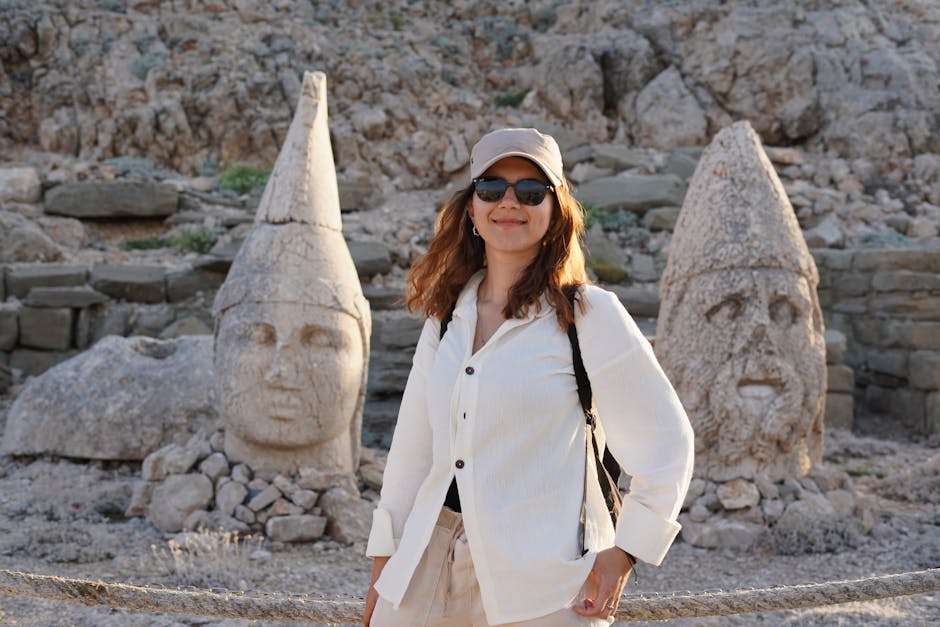
It happened to me last summer, actually. I was supposed to be writing about the Byzantine frontier, but one reference to a tiny kingdom in southeastern Anatolia pulled me in. Before I knew it, I was staring at photos of giant stone heads on Mount Nemrut, wondering how a kingdom like Commagene could have pulled off something so audacious. You might be wondering: what made this small empire so special? Let me show you.
Here is something that blew my mind: Commagene, at its height in the 1st century BCE, controlled less territory than a modern Turkish province. Yet its rulers deliberately fused Persian and Greek iconography into a propaganda machine that kept it independent for nearly 200 years. Think of it like a startup that survived between Google and Apple—except the giants were Rome and Parthia.
I first heard about Commagene while sipping tea with an archaeologist friend in a Kadikoy coffee shop. He said, “Halil, you think the Ottomans were good at playing empires against each other? The Commagene kings invented that game.” That night, I went home and pulled out every book I had on Hellenistic Anatolia.
Historical Background
Commagene emerged from the wreckage of Alexander’s empire. After his death in 323 BCE, his generals carved up the spoils. The region around the Euphrates River became a contested zone between the Seleucids (Greek successors in Syria) and the Parthians (Iranian revivalists). By 163 BCE, a local satrap named Ptolemaeus declared independence. You might be wondering: how did a small satrap pull that off? He simply played both sides, paying tribute to whoever had the bigger army that season.
But the real mastermind was Antiochus I Theos (reigned 70–38 BCE). He turned Commagene into a cultural laboratory. Think of it like a cocktail: take Persian royal titles, Greek philosophy, and Babylonian astronomy, shake, and serve on a 2,000-meter-high mountain. Antiochus built the tumulus on Mount Nemrut—a 50-meter-high artificial hill crowned with colossal statues of himself flanked by gods. Here is something that blew my mind: he claimed descent from both Darius the Great of Persia and Alexander the Great. Biologically impossible, but politically brilliant.
I remember visiting the Museum of Anatolian Civilizations in Ankara last winter. There, in a dimly lit case, I saw a small stele from Commagene. It showed Antiochus shaking hands with a goddess. The inscription was in Greek, but the costume was Persian. The museum guide—a retired archaeologist—leaned in and whispered, “This is where East meets West, literally.” That moment changed how I see cultural fusion.
Commagene’s location was its lifeline. It sat on the Euphrates crossing, the main route between the Mediterranean and Mesopotamia. Both Rome (expanding eastward) and Parthia (holding the eastern frontier) needed a buffer state. Antiochus charged protection money from both. But here is where it gets interesting: he also catered to their religious sensibilities. His cult of the gods included Zeus (Greek) and Oromasdes (Persian)—the same deity under two names. It was the ultimate multicultural branding.
The Heart of the Story
The Monumental Gamble
In 64 BCE, the Roman general Pompey the Great reorganized the East after defeating Mithridates VI. He could have gobbled up Commagene easily. But Antiochus I sent a delegation bearing gifts and a genealogical chart linking his family to Persian royalty. Pompey, who had a taste for exotic prestige, let Commagene remain an allied kingdom. Think of it like a vassal state that got to keep its flag.
Here is something that blew my mind: Antiochus didn’t just butter up the Romans. He also sent envoys to Parthian king Phraates III, offering the same deal. For thirty years, he balanced between the two superpowers, never fully committing to either. His secret weapon? Intelligence. He had spies in both camps, and he knew when to raise or lower tribute.
In 38 BCE, with Rome distracted by civil war, the Parthians invaded. Commagene’s capital, Samosata (modern Samsat), fell. Antiochus died either in battle or by suicide—sources differ. But his son Mithridates II quickly surrendered to Rome’s ultimate victor, Augustus. The empire survived, but now as a full client state.
I visited the ruins of Samosata two years ago. Most of it is under a reservoir now—the Ataturk Dam flooded it in the 1990s. Standing on the shore, I felt a pang of loss. That city had been the stage for one of the great balancing acts of antiquity. Today, only a few scattered stones and a bronze tablet in a museum hint at its glory.
The Cult of Kingship
Antiochus I didn’t just want to survive; he wanted to be remembered forever. So he invented a state religion centered on his own person. He decreed that every citizen must celebrate his birthday with rituals, and that priests would chant his name beside the gods. Think of it like Kim Jong-un meets Alexander the Great, but with better art.
You might be wondering: did anyone believe it? Probably not entirely. But it served a purpose. By elevating himself to divine status, Antiochus made rebellion against him a sacrilege. No known revolts occurred during his reign. He even left long inscriptions—the so-called Nomos (law) on Mount Nemrut—detailing the cult’s rules. Archaeologists found fragments at multiple sites, showing it was propagated throughout the kingdom.
But here is where it gets interesting: Antiochus also included his ancestors in the cult. A series of reliefs shows him shaking hands with his father, grandfather, and even mythical Persian kings. It was a visual genealogy that legitimized his rule in both Greek and Persian eyes. The message: “I belong to both worlds, so I rule both.”
The Part Nobody Talks About
Most histories focus on the grand statues and the diplomatic balancing act. But the everyday reality of Commagene was far messier. For one, the kingdom was riddled with internal divisions. The elite spoke Greek and dressed in Persian style, while the peasantry spoke Aramaic and worshipped local gods like the Syrian goddess Atargatis. There were tensions, and the royal cult was an attempt to paper over them.
Here is something that blew my mind: recent excavations at Arsameia (another Commagenian site) uncovered a cache of lead curse tablets, written in Aramaic, cursing the king and his family. Someone—probably a disgruntled priest—had buried them near a shrine. This suggests the local population wasn’t entirely sold on the cult. The empire might have looked monolithic from the outside, but inside, it was fracturing.
Another controversial angle is the role of temple prostitution. Greek sources claim that the sanctuary of Hiera Kome (Sacred Village) in Commagene housed priestesses who performed sexual rites as part of fertility worship. Commagenean kings tolerated this, perhaps to keep the priesthood powerful. But modern Turkish historians, like Prof. Ayşe Tuba Özkan, argue these accounts were Roman propaganda to paint Commagene as decadent. The truth? Probably somewhere in between.
I discussed this with a fellow history enthusiast at a late-night session in my apartment in Istanbul. We had two old maps spread on the floor, tracing Commagene’s borders. He said, “You know, the real story is not the diplomacy—it’s how they exploited religion to control people.” That stuck with me.
The kingdom also suffered from economic fragility. Its wealth came from tolls on trade routes and some iron mines, but it had little arable land. When Rome and Parthia stopped fighting for a few years, trade dropped and the kingdom struggled. Antiochus had to raise taxes, which fueled resentment. The curse tablets make more sense now.
Why It Still Matters Today
Commagene’s experiment in cultural hybridity is more relevant than ever. In a world where nationalism and identity politics dominate, the Commagenian model offers an alternative: choose elements from multiple traditions and combine them into a new identity. Of course, it was a top-down project, but it shows that blending cultures is possible—if you have a strong enough vision.
Modern Turkey has its own debates about East and West. The Mount Nemrut site is a UNESCO World Heritage Site, visited by tourists who often don’t know the deeper story. I’ve talked to guides there who say most people just take selfies with the heads. They don’t realize they’re standing on a propaganda monument designed to bridge two worlds.
Here is something that blew my mind: in 2021, a team from Istanbul University used ground-penetrating radar to find a second tumulus near Nemrut. It might contain the tomb of a later Commagenian queen. If excavated, it could reveal more about how the royal cult evolved. The mystery isn’t over.
You might be wondering: is there a direct link between Commagene and any later empire? Some historians believe that the Ottoman sultans, who claimed descent from Persian kings and Turkish khans, borrowed from Commagene’s playbook. After all, the Ottomans also used a syncretic state cult—though they called it Islam. Think of it like an ancient precedent for the “universal empire” idea.
My Personal Take
I’ll be honest: when I first started researching Commagene, I thought it was a footnote—a small kingdom too tiny to matter. But the more I dug, the more I realized that size isn’t everything. Commagene proves that even a minor player can have a big impact on the narrative, if it uses the right tools. Antiochus I was a genius at storytelling. He created a myth that outlasted his kingdom.
One evening, I was sitting at a café in Ankara’s Ulus district, near the Hittite Museum, and I saw a young student sketching a replica of the Nemrut lion horoscope. The horoscope—a relief showing a lion with stars—is one of the world’s oldest accurate astronomical depictions, showing the exact position of planets on July 7, 62 BCE. It was Antiochus’s coronation date. That student was tracing the constellations with her finger. I asked her why she chose that. She said, “Because it’s the only time in history where a king used the night sky to claim his throne.”
That conversation reminded me that Commagene’s story isn’t just academic. It’s about human creativity in the face of overwhelming odds. I’ve walked through the ruins of Ephesus and Hattusa, and they are magnificent—but they were built by superpowers. Commagene’s monuments were built by a kingdom that never had more than 200,000 people. That takes a different kind of ambition.
Final Thoughts
I still think about that 2am rabbit hole. Commagene took me from a coffee shop in Kadikoy to a sun-baked mountain in Adiyaman, then back to my desk with more questions than answers. But that’s the beauty of history: it keeps unfolding. The next excavation season might bring a new inscription, a new statue, or a new curse tablet that overturns everything we thought we knew.
If you ever get the chance, go to Mount Nemrut at sunrise. Watch the shadows creep over those giant stone faces. And remember that they were built by a small empire that dared to say: “I belong to both East and West.” That message still echoes.
Did this change how you think about this topic? Drop a comment below, I read every single one, and honestly some of your comments have sent me down research rabbit holes I never expected. That is the best part of writing about history.
Sources & Further Reading
- National Geographic History. The Lost Kingdom of Commagene. 2019.
- Britannica. Commagene: Ancient Kingdom, Turkey. Revised 2022.
- Sanders, Donald. Commagene: The Hellenistic Kingdom of Antiochus I. Cornell University Press, 2000.
- Smithsonian Magazine. The Giant Heads of Mount Nemrut. 2016.