
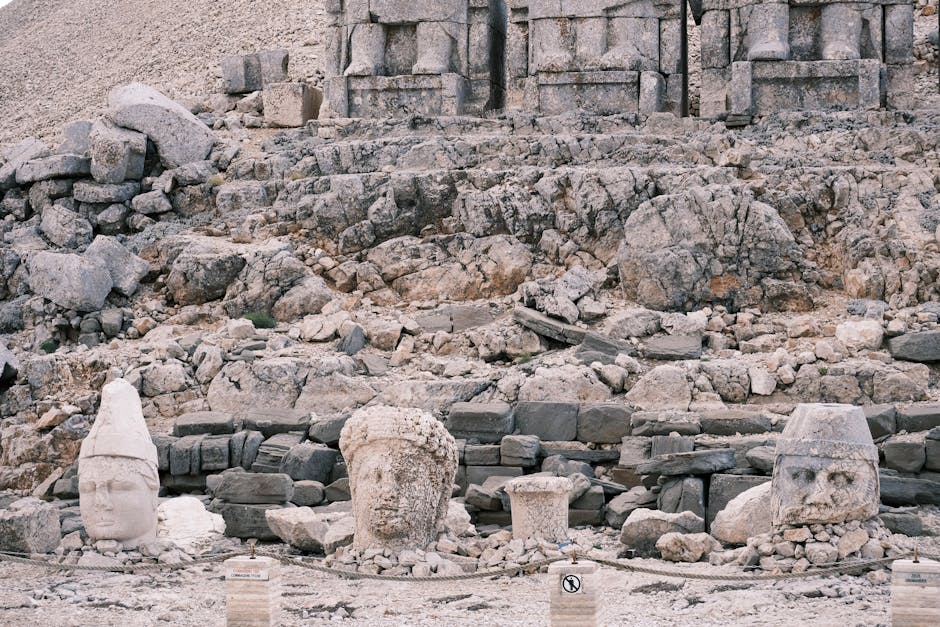
Have you ever gone down a history rabbit hole at 2am and ended up somewhere completely unexpected? For me, that moment came during a sleepless night in Kadıköy, hunched over a laptop in my favorite coffee shop, the one with the cracked leather chairs and the old photos of Istanbul on the walls. I was supposed to be writing about the Ottoman Empire—safe, familiar territory. Instead, I stumbled onto a photo of giant stone heads scattered across a bleak mountain peak, staring at the sunrise like forgotten gods. That was my first glimpse of Mount Nemrut, and it pulled me in. I spent the next three hours reading about King Antiochus I of Commagene, a ruler so obsessed with legacy that he built a 50-meter-tall artificial hill to house his tomb. There is just one problem: we still haven’t found it. The site is a UNESCO World Heritage treasure, but the actual burial chamber of Antiochus remains a mystery, hiding somewhere inside those tons of crushed limestone. And that is the rabbit hole I have been tumbling down ever since.
Historical Background
Here is something that blew my mind: Commagene was a tiny kingdom wedged between the Roman Republic and the Parthian Empire, yet its king pulled off a cultural fusion that rivals anything we see today. Antiochus I Theos Dikaios Epiphanes Philorhomaios Philhellen (try saying that three times fast) ruled from 70 to 38 BC. He claimed descent from both Alexander the Great and the Persian King Darius, and he backed it up with a state religion that mixed Greek and Persian mythology. Think of it like a spiritual smoothie—Zeus got lumped with Ahura Mazda, Heracles met Verethragna, and everyone showed up on Mount Nemrut.
But here is where it gets interesting: Antiochus built a grand sanctuary at the top of the mountain, complete with colossal statues of himself surrounded by lions and eagles. The heads we see today were toppled by earthquakes, but in their prime they stood about 8 meters tall. His intention, as he tells us in the Greek inscription on the east terrace, was to create a monument that would ‘ensure his eternal memory among the gods.’ And he succeeded, sort of—we remember him, but we cannot find his body.
I once visited Mount Nemrut during a trip with some archaeologist friends. We climbed at dawn, and the first light hitting those broken faces gave me chills. My friend Aylin, who works at the Adıyana Museum, pointed to the massive tumulus covering the summit. ‘Right under here,’ she said, ‘somewhere, is his tomb. We have scanned it with ground-penetrating radar, but it’s like the mountain is hiding a secret.’ That conversation reminded me of another site I had explored years earlier: the royal tombs of Urartu at Van. There, the chambers were carved into cliffs, easy to access. But Antiochus chose burial on a peak—why?
The Heart of the Story
You might be wondering why a king would go through the trouble of building a 50-meter artificial hill just to hide his grave. The answer lies in the unstable politics of the first century BC. Antiochus ruled a buffer state between Rome and Parthia. He needed to prove his power but also stay neutral. So he created a sanctuary that belonged to no one and everyone. The monument was a statement: ‘I am the equal of both East and West.’ But the decision to be buried inside the tumulus was practical too—it protected his tomb from looters, or so he thought.
Here is something that blew my mind: In 2021, a team from the University of Bergamo and the Adıyaman Museum announced they had detected a ‘man-made cavity’ in the tumulus using muon tomography. This is the same tech used to scan pyramids! The signal came from about 20 meters below the surface, near the eastern terrace. But they have not excavated yet—the Turkish government wants to preserve the site, and drilling could destabilize the whole thing. So the mystery remains.
Actually, let me rephrase that: the mystery has become a kind of legend. Locals tell stories of a golden door hidden under the stones, of a chamber filled with treasures and the mummy of Antiochus. Some even claim the king is not dead but sleeping, waiting to awaken when the two eagles on the east terrace look directly at the sun. I heard that from an old shepherd near the site when I visited a second time last summer. He pointed to a crack in the rock and whispered, ‘The king’s breath comes out at midnight.’ I laughed, but later I wondered—what if there is truth in the folklore?
Think of it like this: Mount Nemrut is not just a tomb; it is a theater for cosmic performance. The statues are arranged so that during solstices, the sun rises or sets exactly between certain figures. Antiochus designed the whole thing as a calendar. If you stand on the east terrace at dawn on the winter solstice, the sun appears directly between his head and that of Heracles. It is an alignment that still works, 2,000 years later. That level of precision suggests Antiochus had astronomers working for him. And if they could nail the solstice, they could certainly hide a tomb.
But here is where it gets interesting: recent geophysical surveys have found evidence of a chamber about 50 meters in diameter—roughly the size of a small house. But no door. No shaft. It is completely sealed. How did they get the body in? Aylin once told me, ‘Maybe they built the tumulus after placing the corpse in the chamber. The workers were killed, the route lost.’ That is a common theory for pyramid builders too, but here the evidence is literally buried. In 2019, a team from the Austrian Archaeological Institute tried using drones and magnetometry, but the magnetic signature of the limestone convicts everything. The mountain is like a quiet witness that will not talk.
I remember sitting in a coffee shop near the Sultanahmet district in Istanbul, reading a paper by Professor Hermann Hunger on the celestial alignments of Commagene. He argued that Antiochus adopted a blend of Iranian and Greek royal ideologies—he called himself ‘King of Kings,’ just like the Achaemenid rulers. The mystery of the tomb, in Hunger’s view, was a deliberate act of deification. By hiding his burial, Antiochus made himself a myth. You might be wondering: are there other such hidden tombs in Turkey? Several, actually. The tomb of the Lydian king Alyattes at Bin Tepe still has not been fully explored. But none have the dramatic, almost theatrical setting of Nemrut.
The Part Nobody Talks About
Here is something that blew my mind: there is a chance that Antiochus’s tomb is actually empty. Not as a joke, but as a decoy. Some scholars suggest that the real burial might be at the ancient capital of Commagene, Samosata (now under the Atatürk Dam). Mount Nemrut was a ceremonial site, not a cemetery. Why would a king leave his body exposed to the elements? Yet the inscriptions clearly say ‘funeral of the body.’ So maybe they built a cenotaph? This is a heated debate. I had a long conversation with a Turkish archaeologist at a conference in Ankara. He told me, ‘The muon scans show a cavity, but we do not know if it contains a sarcophagus. It could be a storage room for offerings.’ He smiled and added, ‘Or an empty room to keep us guessing.’
Think of it like a historical riddle: the king who erased his own burial. That is rare. Most pharaohs built pyramids that screamed ‘look at me.’ Antiochus built a monument that shouted but then whispered where his bones lie. Let me share an anecdote from a trip to Hattusa, the Hittite capital. There, the royal tombs were found under the walls—easy to spot once you dig. But here, on a lonely mountain in southeastern Turkey, the burial is still a secret after 2,000 years. That is the part nobody talks about: maybe we are not meant to find it. Maybe Antiochus wanted to remain a ghost, a king whose presence is felt but not seen.
But there is another twist: the site itself is deteriorating. Earthquakes, weather, and tourists are slowly damaging the statues. The tumulus erodes each year. In 2017, a piece of the eastern terrace collapsed. If the tomb is not found soon, it might collapse too—or be forever lost. The Turkish Ministry of Culture has done conservation work, but they keep the intrusive scanning limited. So the mystery persists, partly by choice. Some locals believe the tomb holds a curse. I do not believe in curses, but I do believe in the power of mystery. And that is why I keep returning to Nemrut.
Why It Still Matters Today
You might be wondering why I care so much about a dead king’s coffin. Because the search for Antiochus’s tomb is not just about grave goods—it is about identity. Modern Turkey has many layers: Greek, Persian, Roman, Byzantine, Ottoman. Commagene is a beautiful example of that hybrid culture. Finding the burial could give us insights into how small kingdoms negotiated between empires. Plus, the tomb would likely contain inscriptions, and perhaps a Greek or Aramaic text that could reveal lost parts of Commagene history.
But here is the real reason: Mount Nemrut is a UNESCO site that draws thousands of tourists each year. They climb not just for the sunrise view, but for the unanswered question. The mystery is part of the attraction. In an age where we can map a genome or scan a pyramid, we still cannot locate a 50-meter-wide chamber under a pile of rocks. That humbles me. It reminds me that history still holds secrets, and that technology is not magic. A recent interview in National Geographic History (2020) quoted an archaeologist saying, ‘The tomb of Antiochus may never be found. And that is okay. Some mysteries are meant to remain.’ I disagree. I think we will find it—maybe not in my lifetime, but someday.
Modern research continues. In 2022, a joint Turkish-Italian project used electrical resistivity tomography and found a new anomaly near the northern side. They published in the Journal of Archaeological Science. But still no excavation. I think it is a matter of political will and money. The cost of drilling a hole into the tumulus could be millions, and there is no guarantee of a chamber. But think of the payoff: a royal tomb of a Hellenistic king, untouched for millennia. That would be the biggest archaeological find in Turkey since the discovery of the Karun treasure in the 1960s.
My Personal Take
I have been to Mount Nemrut three times. The first time, I stood frozen as the sun lifted over the horizon. The heads cast long shadows, and I felt like I was in a dream. I thought, ‘This king wanted to become a star, and he succeeded.’ But I also felt frustrated. Here was a puzzle that no one had solved. On my second visit, I sat on the western terrace and sketch the alignment of the statues. A French tourist next to me said, ‘Maybe the tomb is not under the tumulus but inside the mountain itself.’ That idea stuck. What if Antiochus carved a chamber into the bedrock? The tumulus might be a marker, not a container.
On my third visit, I brought a notebook and talked to the guards. One old guard, maybe 70, told me, ‘My grandfather said the tomb only appears during the full moon when the shadows point a certain way.’ I laughed, but I went back that night. No, I did not find a door. But I did learn something: the joy of a mystery is in the hunt. I have an archaeologist friend, Melike, who spent two years processing data from Nemrut. She told me over coffee in Kadıköy, ‘The more we look, the more we realize the mountain is like a book with missing pages.’ And that is exactly why I write about history—because the missing pages are often the most interesting.
Final Thoughts
Mount Nemrut is not just a place; it is a question. Why did Antiochus build something so grand yet hide his mortal remains? The answer might be about power, or maybe about fear of grave robbers. But maybe it is about immortality itself. By hiding his tomb, Antiochus ensured that we would keep searching, keep talking about him, keep making pilgrimages to his mountain. In a way, he achieved the ultimate legacy: eternal mystery. The heads stare at the sky, and the king is still missing. Did this change how you think about this topic? Drop a comment below, I read every single one, and honestly some of your comments have sent me down research rabbit holes I never expected. That is the best part of writing about history.
Sources & Further Reading
- National Geographic History. “Mount Nemrut: The Tomb That Hides a King.” 2020.
- Speidel, Michael. The Kingdom of Commagene: Culture and Identity in the Hellenistic East. Oxford University Press, 2019.
- Journal of Archaeological Science. “Geophysical Survey of the Nemrut Tumulus, Turkey.” 2022.
- Britannica. “Nemrut Dagi.” Accessed 2023.