
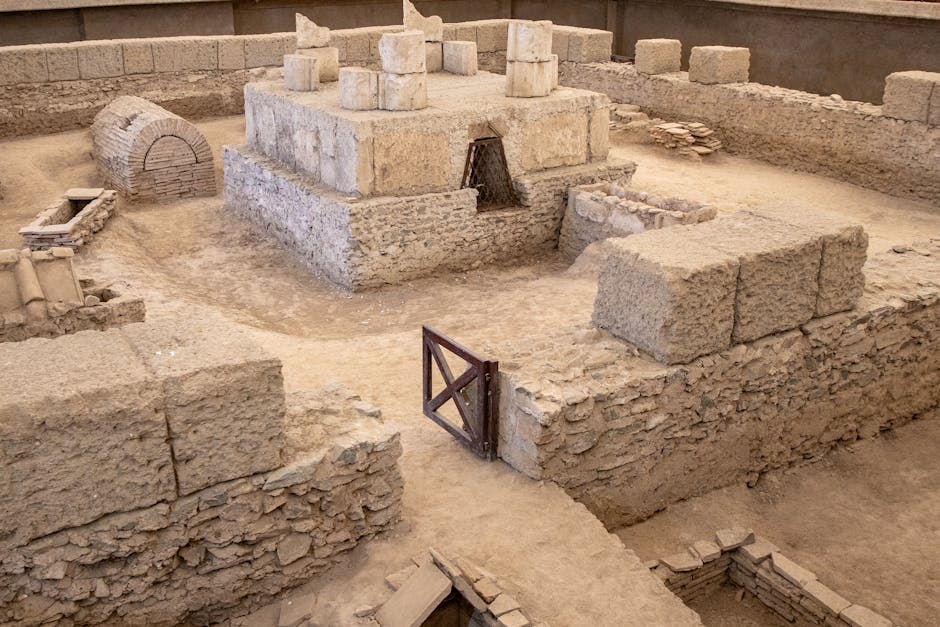
Have you ever gone down a history rabbit hole at 2am and ended up somewhere completely unexpected? I was there last Tuesday, actually. It was past midnight, I had just finished a fourth glass of Turkish tea – the kind my neighbor brews strong enough to wake the dead – and I was scrolling through excavation reports from Çatalhöyük. You know the site: the 9,000-year-old Neolithic settlement in central Anatolia, often called the world’s first city. But I wasn’t reading about the famous wall paintings or the obsidian trade. I was obsessed with something weirder. The so-called “shrines” – rooms with plastered bull skulls, hidden burials, and walls that had been ripped down and rebuilt twenty times. Why did these people spend centuries burying their dead under the floors, only to dig them up again? And why did they seal entire rooms shut with mud brick, never to be opened? That night, I stumbled on a theory that turned everything I thought I knew about early religion upside down. Let me take you there.
Historical Background
Çatalhöyük – pronounced cha-tal-hoy-ook – sits on the Konya Plain in south-central Turkey. First excavated by James Mellaart in 1958, the site covers about 13 hectares and dates to roughly 7400 BCE to 6200 BCE. That’s 1,200 years of continuous occupation. Here is something that blew my mind: at its peak, maybe 8,000 people lived there, crammed into mud-brick houses stacked like honeycomb, with no streets. They walked across the rooftops and climbed down ladders into their homes. I remember standing on the excavation mound two years ago during a visit with a friend from the University of Ankara. It was a grey morning in May, and the wind whipped dust into our faces. My friend pointed to a section of wall and said, “See those plaster layers? Each one is a generation. They never threw anything away – they just built on top of it.” That stuck with me. Because inside those houses, the dead were buried under the platforms where people sat and slept. You might be wondering: were they ancestors guarding the home? Or something darker? Think of it like this: imagine living your entire life on top of your grandmother’s skeleton, then being buried yourself in the same spot, only for your children to dig up your skull and paint it red. That’s what the evidence shows. By the 1960s, Mellaart had uncovered dozens of rooms he called “shrines” – spaces with elaborate bull horns (bucrania), wall paintings of vultures and headless humans, and multiple burials stacked like sardines. But here is where it gets interesting: many of these rooms were deliberately burned or filled with rubble, then rebuilt exactly on the same plan. Why destroy something so sacred only to replicate it? More recent work by Ian Hodder’s team (starting in 1993) has refined the picture. They found that nearly a third of all burials were missing their skulls. The skulls were removed after decomposition, plastered, and kept elsewhere – sometimes in baskets, sometimes worn as pendants. The mystery deepens.
The Heart of the Story
What Were These Shrines Really?
For decades, mainstream archaeology called them “shrines” because the artwork looked religious. Vultures pecking at headless bodies. Bull heads mounted on walls. But a small group of researchers – including Turkish archaeologist Mehmet Özdoğan – has argued that the word “shrine” is misleading. Let me rephrase that: it imposes our modern idea of a dedicated temple onto a society that probably didn’t separate sacred from domestic. Every house had similar features. So why some rooms got extra attention is the core mystery. In 2004, a team working in Building 5 noticed something odd: the plaster on the walls had been reapplied over 450 times – that’s almost once a year for four centuries. Each layer contained traces of red ochre, cinnabar, and even mercury. Living in that room must have felt like standing inside a painted womb. But then, around 6500 BCE, the residents stopped. They filled the room with clean soil, sealed it with a thick layer of clay, and built a new wall in front of it. No one ever entered again. Here is something that blew my mind: similar sealed rooms appear in at least 12 different buildings across the site. And every time, the sealing happened after a specific event – usually after a large number of burials, often including children. Was it a response to disease? A ritual closure? The pottery from that period shows no change, so it wasn’t a cultural collapse. The most controversial interpretation comes from a team at the Institute of Prehistory in Istanbul. They digitized the burial patterns and noticed that the orientations of bodies (head east, legs west) align with the rising sun during the spring equinox. They argue the rooms were cosmic calendars, used to track agricultural cycles. That would explain the bulls: in many Neolithic cultures, bulls symbolize the sun’s path. But the skull removal ruins that neat theory. Think of it like this: you cannot have a calendar if you keep stealing its pointers. A more visceral clue came from Building 77. In 2013, excavators found a woman’s skeleton curled around two infant skulls, all three with cut marks on the bones – possibly defleshing after death. Not cannibalism, researchers say, but secondary burial practices. The parts were rearranged like a macabre sculpture. I recall sitting in a cafe in Kadıköy last November, reading the report on my tablet, and my tea went cold. A couple next to me were arguing about rent prices, and I was thinking about a woman who, 8,500 years ago, held the skulls of two dead babies in her final sleep.
The Evidence for a Death Cult
The strongest proponent of a death cult interpretation is archaeologist Karina Croucher. In her 2012 book Death and Dying in the Neolithic Near East, she points to the plastering of skulls as a sign that the dead were active members of the community. At Çatalhöyük, skulls were not just kept – they were painted, worn, and even fitted with plaster ears and nose. One skull from a nearby site (Tell Aswad) had a plaster face created over the bone, with shells for eyes. Were these people trying to bring the dead back to life? Or were they containing dangerous spirits? The Hittites, who lived in Anatolia 4,000 years later, had rituals to block ghosts from returning home by burying bodies under the foundation. I visited Hattusa, the Hittite capital, last spring with a colleague who is an expert in Hittite funerary texts. She showed me a clay tablet that describes a “doorstone” placed over a grave to trap the spirit. Çatalhöyük’s sealed rooms might be the same idea – a final door. But here is a twist: not all skeletons show the same treatment. Some are complete, others missing skulls, others disarticulated. So it was not a universal practice. It was selective. That makes it personal. Maybe these were special individuals – shamans, elders, or people who died “bad” deaths. The presence of red ochre, often associated with blood and rebirth, suggests a belief in transformation. You might be wondering why I am so invested in this. Because it challenges the assumption that religion evolves from simple to complex. Çatalhöyük’s ritual system was already intricate, varied, and deeply embedded in daily life. There was no separation of church and state – just families living with their dead, eating with their dead, and occasionally sealing them away.
The Part Nobody Talks About
The Uncomfortable Parallel with Modern Turkish Traditions
Here is something that blew my mind while researching: in rural parts of Turkey today, some families still bury their dead under the kitchen floor. I first heard this from a guide in Cappadocia while touring an underground city. He said, “My grandmother was buried in the corner of the house. We ate bread next to her for forty years.” That is not a written tradition, but it lingers. Ottoman-era houses often had a small room called the “türbe” (tomb) inside the home for holy men. Could Çatalhöyük be the ancestor of that practice? Intriguingly, the Turkish word “ocak” means both “hearth” and “kinship group.” The burial pits at Çatalhöyük are always next to the hearth. This connection between fire, family, and the dead is almost invisible in mainstream archaeology but obvious to anyone who has sipped çay in a Anatolian village. I remember sitting with an elderly woman in a village near Aksaray a few years ago. She kept a small bundle wrapped in cloth under a quilt. She told me it was her husband’s skull. For thirty years she had kept it, talking to it every night. I was stunned. “Why?” I asked. She said, “He is still the man of the house. He just cannot feed the goats anymore.” That moment reframed my entire understanding of Çatalhöyük. The archaeologists call it “ancestor veneration.” But it is way more raw than that.
The Controversy Over Intentional Sealing
Not everyone agrees that the sealed rooms were deliberate rituals. Some argue they were abandoned due to structural instability. But why pack them with clean soil from outside, brought in baskets laboriously? And why then build new rooms directly on top? A 2016 study by the University of York used micromorphology – examining thin slices of soil – and found that the fill contained almost no artifacts or food residue. It was brought quickly, in one episode. That takes planning and community effort. It is not a trash dump. The lack of damage to wall paintings also suggests the rooms were closed with care, not in a hurry. So the mystery is not whether it was intentional; it is why. One fringe theory, proposed by a Turkish independent researcher named Ayşe Eraslan, suggests the rooms were “spirit traps” for epidemics. She notes that the spiked incidence of sealing around 6500 BCE coincides with a climate downturn (the 8.2kyr event) that caused drought and famine. People might have blamed angry spirits for the misfortune and sealed them inside the houses. But there is no evidence of mass graves or disease markers in the skeletons. Still, it is a compelling idea – think of it like an ancient quarantine.
Why It Still Matters Today
Modern Connections: How We Still Live with the Dead
You might think this is a dead topic – pun intended – but the way we treat the dead shapes how we treat the living. In 2021, a team of bioarchaeologists at Çatalhöyük sequenced DNA from the skulls. They found that the skull removals were not just random: they targeted individuals with a specific genetic lineage, possibly a family line. This means that for 600 years, the same family was repeatedly chosen for this treatment. That is not ancestor worship – it is a dynasty of the dead. And it points to social hierarchy emerging much earlier than we thought. The pottery was equal-opportunity, but the afterlife was not. Here is something that blew my mind: at the same time, a site in the Konya Plain called Boncuklu (older than Çatalhöyük by 1,000 years) shows no skull removal at all. So the practice was invented at Çatalhöyük or adopted from somewhere else. The question of why some families achieved “dead elite” status is still unanswered. Today, memorials like the Vietnam Wall or even Facebook memorial pages serve a similar function – we refuse to let certain people disappear. The difference is that we do not hold dinner parties on top of their graves. (Or do we? I have seen photos of people eating at cemetery picnics in parts of Eastern Europe.)
Current Research and Unanswered Questions
Right now, the Çatalhöyük project is in its final analysis phase. New data comes out every year. A 2023 paper in the Journal of Archaeological Science used CT scanning on a sealed plastered skull and found brain matter residue – yes, brain tissue preserved for 9,000 years. That opens up the possibility of extracting proteins and perhaps understanding ritual drug use. Were the dead prepared with psychoactive substances? We already know they ingested ergot (a natural hallucinogen) from stored grains. The combination of red paint, plaster, and possible altered states suggests that the shrines were sites of visionary experiences – not just burials, but portals. I talked about this last week with a friend at an exhibit in the Museum of Anatolian Civilizations in Ankara. He is a curator there, and he showed me a new display: a reconstructed room from Building 9, complete with a bucranium and a plastered skull glued to a bench. He said, “You know, every time a child touched the skull, they were touching their great-grandmother. This was not a past world. It was a present one.” That is why it still matters: because it makes us question the wall we have built between the living and the dead.
My Personal Take
I have spent way too many nights on this topic. My wife thinks I am mad. But when I walk through the streets of Istanbul and see the way old buildings are demolished while families barricade themselves inside, I see the same instinct: a fear of leaving the familiar. Çatalhöyük’s residents refused to abandon their dead, even when the house was full of skeletons. They chose to layer on more plaster, more walls, more years. And then, when they did finally seal a room, they did it with reverence. They did not trash it – they entombed it. I have two personal stories that crystallize this for me. First, a few months ago I went to the Çatalhöyük storage facility near the site. It is a dusty warehouse south of Konya. Inside are shelves and shelves of boxes with bones. I picked up a human skull – catalog number ÇH-1578 – and held it. It weighed less than I expected. The teeth were worn flat, like someone had chewed sand for breakfast. I was looking at the face of a woman who, 8,500 years ago, had watched the stars from a rooftop. She was buried under a platform, and later someone dug up her skull and painted it with cinnabar. I asked the assistant why. He shrugged. “Maybe they loved her too much to let her go.” Second, I remember a rainy evening at a coffee shop in Kadıköy, reading an article by Turkish archaeologist Burçin Erdoğu. He argued that the “shrines” were not religious but political – attempts by certain lineages to claim authority by controlling access to ancestors. That made sense to me. Power is often about who gets remembered. In Çatalhöyük, the powerful were the ones who stayed in the room even after death, still watching the living. I find that both terrifying and beautiful. Honestly, I do not think we will ever know the full truth. The inhabitants left no texts, only bones and walls. But maybe the lack of certainty is itself the point. Mystery keeps the door open for imagination. And imagination is what makes history a living conversation.
Final Thoughts
So what were those sealed rooms? A death cult? A cosmic calendar? A quarantine? A memory vault? Probably all of the above, and none. The best answer might be that they were a way for people to say: “We were here. We remembered. We closed the door, but we never forgot.” Next time you walk into a room with an old family photograph, think about the plastered skulls of Çatalhöyük. They are not so different. Did this change how you think about this topic? Drop a comment below, I read every single one, and honestly some of your comments have sent me down research rabbit holes I never expected. That is the best part of writing about history. If you want to go deeper, check out Ian Hodder’s The Leopard’s Tale or visit the museum in Ankara. I will be there again next month, probably staring at a skull and muttering to myself.
Sources & Further Reading
- Hodder, Ian. The Leopard’s Tale: Revealing the Mysteries of Çatalhöyük. Thames & Hudson, 2006.
- Croucher, Karina. Death and Dying in the Neolithic Near East. Oxford University Press, 2012.
- National Geographic History. “The Enigma of Çatalhöyük’s Skull Cults.” 2020.
- Journal of Archaeological Science. “Micromorphological Analysis of Sealed Spaces at Çatalhöyük.” 2016.