
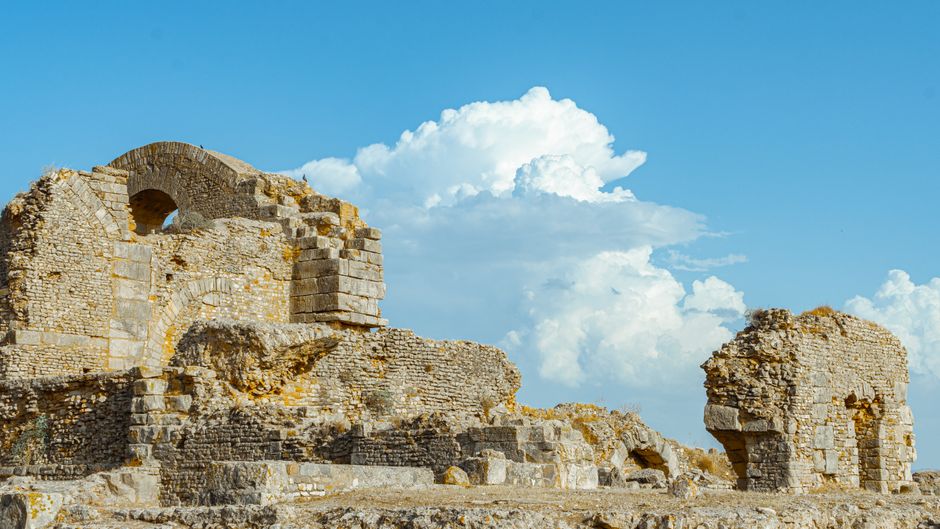
When I first stumbled upon the Garamantes in an obscure footnote of Roman history, I thought it was a typo. A desert empire? In the Sahara? That couldn’t be right. But as I dug deeper, I found not just a kingdom, but a civilization that thrived for centuries where no one was supposed to live. The **Garamantes**—a name that barely rings a bell even among history buffs—built a sophisticated state in what is now southern Libya, between roughly 500 BCE and 500 CE. They mastered deserts, built underground cities, and connected worlds. And yet, until a few decades ago, they were barely a footnote. Today, archaeology is rewriting their story, and it’s a story that challenges everything we think we know about ancient Africa and the so-called ’empty’ Sahara.
The Land That Shouldn’t Be
Imagine a place where rain falls maybe once a decade. Where the sun bakes rock into sand. Where the wind whistles over endless dunes. That’s the Fezzan region of southwestern Libya. Most historians, even just fifty years ago, assumed that such an environment could never support a complex society. Nomads, sure. Traders passing through, perhaps. But an empire with fortified towns, a writing system, and a population in the tens of thousands? Impossible.
Then came the satellite images. In the 1960s and 1970s, aerial photography and later satellite imagery revealed hundreds of sites across the Fezzan—stone-built structures, linear patterns that looked like ancient fields, and mysterious lines running underground. Archaeologists like David Mattingly of the University of Leicester, who led the Fezzan Project in the 1990s and 2000s, showed that these were the remains of the Garamantian civilization. Their capital, Garama (modern Germa), had palaces, temples, and a population of several thousand. The Garamantes were not just a kingdom; they were a centralized state that exerted control over an area larger than modern France.
Personal Anecdote: A Map That Changed My Perspective
I remember sitting in a dusty library in Ankara, flipping through a forgotten volume of Libyan Studies from 2003, when I saw a satellite photo of the Fezzan with red dots marking Garamantian settlements. There were hundreds of them, spread across an area that looked completely barren. I traced the dotted lines of their underground water channels—called foggaras—and realized that these people had basically hacked the Sahara. They didn’t just survive; they thrived. That moment made me rethink the entire concept of ‘civilization’ and what it takes to build one.
The Foggara Revolution
The secret of the Garamantes was water—or rather, their ability to get it from under the desert. They built extensive networks of underground irrigation canals known as foggaras (similar to the qanats of Persia and Anatolia). These channels, dug by hand through solid rock and sand, carried water from aquifers beneath the Sahara to their fields and settlements. It was an engineering marvel. Some foggaras stretched for over 10 kilometers, and they were dug with incredible precision, maintaining a gentle slope to keep water flowing without pumps.
Recent archaeological surveys have mapped over 500 foggaras in the Fezzan, with a combined length of more than 2,000 kilometers. That’s like digging a water tunnel from Istanbul to Madrid, by hand, with iron picks and baskets, under a brutal sun. The Garamantes were not just farmers; they were hydraulic engineers on a massive scale. Their fields grew wheat, barley, dates, olives, and grapes. They raised horses, goats, and sheep. They built stone-walled towns with population densities that rivaled some Roman cities.
Connection to Turkish and Anatolian History
When I first learned about foggaras, I couldn’t help but think of the qanat systems of Turkey’s Cappadocia region, built by the Persians and later expanded by the Ottomans. The technology is almost identical: an underground channel tapping into groundwater. It’s a reminder that ancient people across the world—from Iran to Libya to China—independently or through trade, solved the same problem of water scarcity in arid lands. The Garamantes, however, took it to an extreme. They lived in one of the driest places on Earth and made it wet.
Society, Trade, and Writing
The Garamantes were not isolated. They sat at the crossroads of trans-Saharan trade routes, linking the Mediterranean world with sub-Saharan Africa. They exported salt, dates, and slaves (a grim reality of many ancient empires) and imported Roman glassware, wine, and olive oil. Herodotus mentioned them in the 5th century BCE, calling them a ‘great nation’ that hunted the Ethiopian troglodytes—a confused reference, but evidence that they were known to the Greeks. Later, Roman sources describe the Garamantes as fierce warriors who raided the Roman province of Africa (modern Tunisia) and traded gold and ivory from deeper Africa.
They had their own script, called Old Libyan or Garamantian, which is related to the Tifinagh script still used by the Tuareg today. Inscriptions have been found on stone slabs and pottery, though they remain largely untranslated. This was a literate society, with a bureaucracy that could issue edicts and record taxes. They built monumental tombs, some shaped like pyramids, for their elite. The Royal Tombs of Germa include underground chambers with painted plaster walls, showing a level of artistic sophistication that once again clashes with the image of a ‘primitive’ desert people.
Conflict with Rome
Rome’s relationship with the Garamantes was complicated. At times, they were trading partners; at other times, enemies. The emperor Augustus sent an expedition against them in 19 BCE, led by the general Lucius Cornelius Balbus, who defeated them and captured their capital. Later, the Garamantes became Roman allies, providing troops and guides for expeditions southward. But they never fully submitted. They remained a thorn in Rome’s side, raiding the coastal cities when the legions were distracted.
Archaeologist Mario Liverani has argued that the Roman empire actually helped create the Garamantian state by demanding a stable partner for trade. Roman goods poured into Garama, stimulating the local economy and centralizing power. But Roman pressure also weakened them. When the empire collapsed in the west, the trade routes dried up. The Garamantes, dependent on imported goods and Roman markets, slowly declined.
The Fall: Climate, Desertification, and Collapse
By the 6th century CE, the Garamantian civilization was gone. The foggaras fell into disrepair, the fields turned back to sand, and the towns were abandoned. What happened? The usual suspects: climate change, overexploitation of resources, and shifting trade routes. The Sahara was drying out, and the Garamantes had already used up much of the fossil water that made their civilization possible. Without that water, their cities became uninhabitable.
But there’s also evidence that they were weakened by raids from growing nomadic groups, like the Sanhaja Berbers, who in later centuries would dominate the Sahara. The Garamantes didn’t vanish completely; their descendants likely became the Tuareg and other Berber peoples who still live in the region. But their empire—their written language, their monumental architecture, their centralized state—dissolved into the desert sands.
Why the Garamantes Matter
The story of the Garamantes is more than just a curiosity. It challenges the long-held assumption that the Sahara was a barrier rather than a bridge. They prove that complex societies can emerge in the most extreme environments, and that human ingenuity can overcome incredible odds. Their fall also serves as a warning about sustainability and the limits of resource exploitation. We live in a world facing water shortages and climate change. The Garamantes show us what happens when a society depends entirely on a finite resource.
I often think about that satellite image I saw in Ankara. Those red dots—like a constellation of lost worlds. They tell me that history isn’t just about the winners who write the books. It’s also about the people who dug tunnels under the sand, who built cities where no city should be, and who disappeared so completely that for centuries, no one even knew they existed.
Sources and Further Reading
- Mattingly, David. The Garamantes of the Fezzan: An Archaeological Study. Society for Libyan Studies, 2003.
- Liverani, Mario. The Garamantes: The Ancient Civilizations of the Sahara. Translated by E. Z. D. L. Brepols, 2006.
- Smith, R. L. “The Garamantes: A Forgotten Empire in the Sahara.” National Geographic, vol. 195, no. 4, April 1999, pp. 56–79.
- Wilson, Andrew. “The Garamantes and the Trans-Saharan Trade.” Journal of Roman Archaeology, vol. 18, 2005, pp. 365–380.
Did this change how you think about this topic? Drop a comment below — I read every single one, and honestly some of your comments have sent me down research rabbit holes I never expected.