
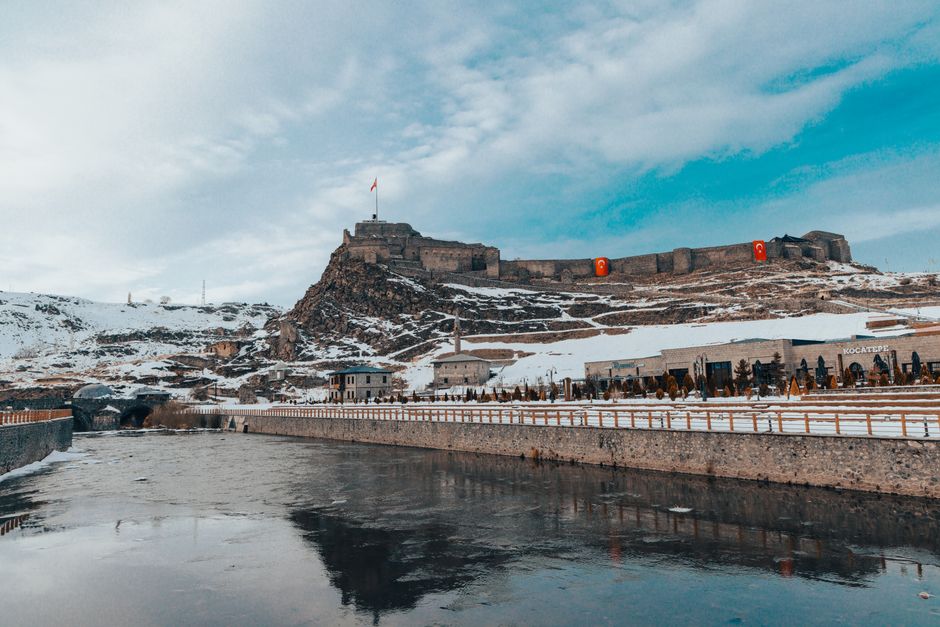
When Mountains Whispered of a Lost Empire
I first stumbled upon the name Urartu while hunched over a map in a dusty Ankara bookshop. It was 2015, and I was tracing the borders of ancient Anatolia. Assyrian inscriptions kept mentioning a fierce mountain kingdom that challenged their might. But where was it? The name felt alien. Yet, as I drove east toward Lake Van that summer, the land itself began to speak. The Urartu Kingdom (c. 860–590 BCE) was no footnote. It was a sophisticated empire of stone fortresses, aqueducts, and iron—a rival to Assyria that carved its legacy into the volcanic cliffs of eastern Turkey. This is the story of that forgotten kingdom.
Who Were the Urartians?
Urartu, known to the Assyrians as Uruaṭri, rose in the 9th century BCE around the basin of Lake Van. Its people called their land Biainili, and their capital was Tushpa (modern Van). Unlike the flat plains of Mesopotamia, Urartu thrived in rugged highlands, where winters buried citadels under snow. The kingdom controlled key trade routes for copper, iron, and obsidian. Their language, written in a cuneiform adapted from Assyria, remains partially undeciphered—but surviving inscriptions reveal a fiercely independent culture.
Archaeologist Boris Piotrovsky, who excavated the Urartian fortress of Teishebaini (modern Karmir Blur in Armenia), called them “the first unified state in the Armenian highlands.” In the 1930s, his team uncovered a treasure trove of bronze weapons, ivory carvings, and massive storage jars. One inscription boasted of King Argishti I (r. 786–764 BCE) building a canal over 50 kilometers long. That canal still irrigates Van today. I walked part of it three years ago—water still flows through carved rock channels, a silent testament to Urartian engineering.
The Fortress on the Rock
Urartian kings loved high places. At Çavuştepe, a fortress perched on a ridge above the Hoşap River, I climbed crumbling stairs worn by 2,700 years of rain. The Temple of Haldi (their chief god) stood at the summit, its walls still bearing faint red paint. The Urartians built with cyclopean masonry—blocks of basalt so precisely fitted that no mortar was needed. Walking through the gate, I felt the strategic genius: any invading army would be exhausted before reaching the walls.
Water: The Lifeline of an Empire
What truly sets Urartu apart is its water management. In a region where summer droughts alternate with spring floods, Urartian kings constructed an extensive network of canals, reservoirs, and cisterns. The Shamiram Canal, often misattributed to the legendary Queen Semiramis, was actually dug by King Menua (r. 810–785 BCE). It runs 56 kilometers from the Artos Mountains to the Van plain. I visited the canal near Gürpınar and saw locals still using its stone-lined channels.
Archaeologist Charles Burney compared Urartian irrigation to that of the Romans—but earlier by centuries. At the site of Karmir Blur, excavators found a sophisticated drainage system under the palace, with lead pipes and clay seals. One broken pipe bore the cuneiform inscription: “This water belongs to Argishti, son of Menua.” The attention to detail is staggering.
Rivalry with Assyria
Urartu’s greatest enemy was Assyria, which viewed the mountain kingdom as a persistent threat. Assyrian king Shalmaneser III (r. 859–824 BCE) launched campaign after campaign against Urartu. He boasted of slaughtering 3,000 Urartian soldiers and burning their crops. But Urartu adapted. Under King Sarduri II (r. 764–735 BCE), they expanded westward into modern-day Syria, briefly threatening Assyrian hegemony.
Yet the empire could not withstand the combined pressure of Assyrian retaliation and internal revolts. In 714 BCE, Assyrian king Sargon II launched a devastating raid deep into Urartian territory. He sacked the religious center of Musasir and carried off the statue of Haldi. An Assyrian letter describes the booty: six tons of gold, silver, bronze, and precious stones. Musasir was never rebuilt.
The Mysterious Collapse
After a brief revival under King Rusa II (r. 685–645 BCE), Urartu faded. By 590 BCE, the kingdom had vanished. Why? Climate change may have played a role. A 2017 study by Dr. Adam Schneider of the University of California analyzed tree rings and found a severe drought in the Caucasus around 600 BCE. The irrigation systems that sustained Urartu’s cities likely failed. Nomadic incursions from the Scythians and Cimmerians added pressure. One day, the great fortresses of Tushpa and Teishebaini simply stopped being inhabited. People left. The empire dissolved into memory.
I remember standing at Toprakkale (ancient Rusahinili) near Van, looking at collapsed walls overgrown with wild thyme. A shepherd told me his grandfather had found a bronze head of a bull there—probably part of a throne. He sold it to a dealer in Istanbul. It now sits in a museum basement, labeled “Urartian, 8th c. BCE.” That’s how forgotten this kingdom is: its treasures scattered, its name rarely spoken.
Why Urartu Matters
Urartu influenced later cultures: the Armenians (who claim descent from them), the Persian Achaemenids (who adopted Urartian irrigation techniques), and even the Byzantines, who used Urartian fortresses as border posts. The very name “Armenia” may derive from the Urartian word Arminiya.
Yet modern scholarship often relegates Urartu to a footnote between Assyria and Persia. That’s a mistake. This empire of stone and water deserves its own spotlight. Next time you’re near Lake Van, don’t just visit the cathedral—climb the ancient citadel. Listen to the wind. It carries echoes of a people who carved their defiance into the rock.
Sources and Further Reading
- Piotrovsky, Boris B. The Ancient Civilization of Urartu. London: Barrie & Rockliff, 1969.
- Burney, Charles, and David Lang. The Peoples of the Hills: Ancient Ararat and Caucasus. London: Phoenix Press, 2001.
- Schneider, Adam W., and Selim F. Adalı. “The Late Bronze Age–Iron Age Transition in the Lake Van Basin: An Integrated Approach.” Journal of Near Eastern Studies 79, no. 1 (2020): 75–96.
- Zimansky, Paul. Ecology and Empire: The Structure of the Urartian State. Chicago: Oriental Institute, 1985.
Did this change how you think about this topic? Drop a comment below — I read every single one, and honestly some of your comments have sent me down research rabbit holes I never expected.