
Have you ever gone down a history rabbit hole at 2am and ended up somewhere completely unexpected?
I remember it vividly: a cold night in Istanbul, rain drumming against my window, a cup of Turkish tea cooling beside me. I had just finished reading an old article about Pompeii when a footnote mentioned the Minoan eruption of Thera. I clicked. Four hours later, the sun was rising, and I was completely obsessed with a volcanic catastrophe that happened 3,600 years ago. Little did I know that this event – the explosion of the island of Santorini around 1600 BCE – didn’t just bury a city; it may have toppled an entire civilization and reshaped the ancient world. The Minoan eruption remains one of the most powerful volcanic events in recorded history, and yet most people have never heard of Akrotiri, the Minoan Pompeii.
The Island That Exploded
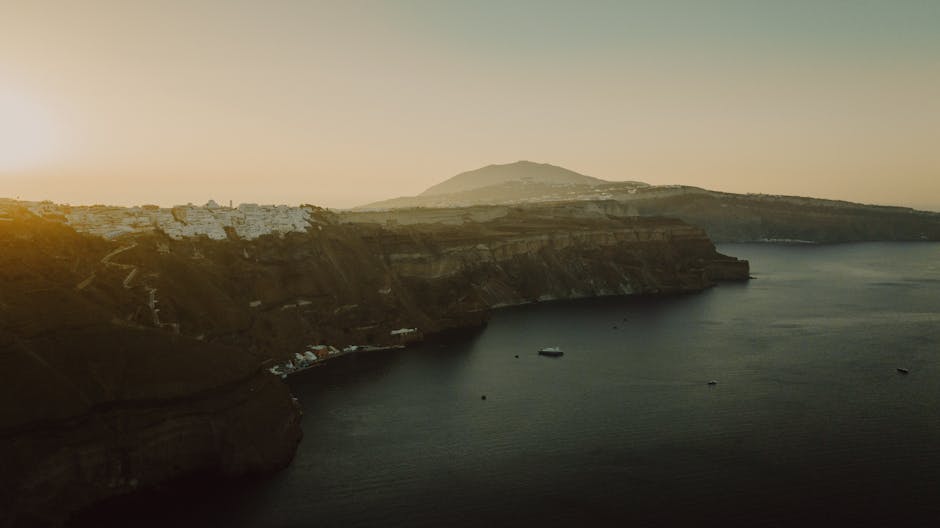
Let me paint the scene. Picture a thriving Bronze Age island in the Aegean Sea, part of the Minoan civilization – a sophisticated culture that built palaces, wrote in Linear A, and traded across the Mediterranean. Thera (modern Santorini) was a busy port city called Akrotiri, with multi-story buildings, advanced plumbing, and vibrant frescoes. People lived comfortably, unaware that beneath their feet, a volcanic system was building pressure.
Here is something that blew my mind: the Minoan eruption ejected roughly 30 cubic kilometers of material, about four times more than the 1883 Krakatoa eruption. It was a VEI 7 event – the scale goes to 8, so almost the maximum. The eruption column reached 36 kilometers into the atmosphere. Think of it like a nuclear bomb, but natural and sustained for days. The blast was heard as far away as Scandinavia, according to some theories.
But here is where it gets interesting: the Minoans didn’t just disappear overnight. The eruption happened around 1600 BCE (or maybe 1627 BCE, based on tree-ring dating – I remember reading a Smithsonian piece that changed how I saw this timeline). The people of Akrotiri had time to flee; archaeologists found no bodies, just abandoned buildings. They likely evacuated by ship. So the real question is: what happened next?
The Tsunami That Wiped Out Crete
The eruption triggered a massive tsunami. Waves up to 40 meters high slammed into the northern coast of Crete, just 110 kilometers away – the heart of Minoan power. Palaces at Knossos, Phaistos, and Malia were damaged. The Minoan fleet was likely destroyed, and the agricultural hinterland was salted by seawater. This wasn’t just a disaster; it was a strategic blow from which the Minoans never fully recovered.
I once visited Ephesus in western Turkey and stood near the harbor that later silted up. My archaeologist friend, Dr. Elif, said to me: ‘Imagine the Minoan harbors after that tsunami – choked with debris, ships shattered, trade routes severed.’ That stuck with me. The tsunami didn’t just kill people; it broke the economic backbone of a civilization.
The Part Nobody Talks About
Most accounts stop at the eruption and the fall of the Minoans. But there’s a lesser-known angle: the rise of the Mycenaeans. The Mycenaean Greeks on the mainland were rivals of the Minoans. After the eruption weakened Crete, they swooped in, conquered Knossos around 1450 BCE, and adopted Minoan writing (Linear B) and art. The eruption essentially cleared the stage for the Mycenaean civilization, which later gave us the Trojan War and Homer.
Here is something that blew my mind: some scholars link the Minoan eruption to the biblical plagues of Egypt. A few researchers suggest that the volcanic ash cloud and subsequent climatic shifts caused the darkness, hailstorms, and even the parting of the Red Sea (through a tidal wave effect). It’s controversial, but National Geographic History ran a feature exploring exactly that connection. I remember reading it in a coffee shop in Kadıköy and spilling my çay when I reached the part about the ‘Exodus date’ lining up with the eruption.
But let me correct myself – actually, let me rephrase that: the evidence is far from conclusive. The eruption date is still debated, and the Exodus narrative is complex. Still, the idea that a volcanic event in the Aegean sent shockwaves through ancient Egyptian and Hebrew traditions is tantalizing.
Think of it like this: the Minoan eruption was the first ‘global’ catastrophe in recorded history. Its effects were felt from Egypt to Mesopotamia to the Indus Valley. Ash layers have been found in Greenland ice cores, providing a precise chronological marker. That’s how powerful it was – a single explosion that synchronizes ancient chronologies.
Why It Still Matters Today
Modern volcanology owes a lot to the study of the Minoan eruption. It helped scientists understand caldera formation, pyroclastic flows, and tsunami generation. The site of Akrotiri, preserved under volcanic ash just like Pompeii, gives us a snapshot of Bronze Age life – frescoes of antelopes and blue monkeys, advanced drainage systems, and even a ship procession fresco that shows how the Minoans saw themselves.
I remember walking through the ruins of Akrotiri during a trip to Santorini. The roofs are modern metal sheeting, but the streets are ancient. My guide pointed to a small room: ‘This was a pottery workshop. They left everything behind.’ That moment, the scale of the evacuation hit me. Thousands of people abandoned their homes, belongings, their entire lives, because they sensed something wrong. The volcano gave them warning – minor earthquakes, perhaps – and they fled. That’s a lesson for today: early warning systems save lives. The Minoans had no monitoring stations, but they had intuition and a maritime escape plan.
Here is something that blew my mind: the eruption may have caused a ‘volcanic winter’ that disrupted agriculture across the northern hemisphere. Tree rings from Ireland and California show a narrow growth ring around 1628 BCE, consistent with a massive eruption. That means the Minoan eruption influenced harvests in China, maybe even contributed to the fall of the Xia dynasty. It’s a reminder that ancient history is interconnected in ways we’re still discovering.
My Personal Take
To be honest, what fascinates me most about the Minoan eruption is not the destruction but the resilience. The Minoans didn’t vanish completely. Their art, religion, and trade networks were absorbed by the Mycenaeans and later the Greeks. The bull-leaping frescoes of Knossos inspired later myths like the Minotaur. The eruption became legend, possibly the origin of the Atlantis story as Plato described – a powerful island nation that sank in a single day and night.
I’ve spent many late nights in my little study in Ankara, surrounded by books on Bronze Age collapse. Once, I called my old professor from Istanbul University, Dr. Mehmet Özdoğan, to ask about the Minoans. He laughed and said, ‘You’re not the first to stay up thinking about this. But remember, history is not just dates – it’s people trying to survive.’ That line has stayed with me.
Another anecdote: I was at a café in Cappadocia, looking at the fairy chimneys – soft volcanic tuff – and realized that both Cappadocia and Santorini were shaped by volcanoes. One created a landscape of homes, the other destroyed an entire civilization. The difference? The Minoans built on an active caldera; the early Christians in Cappadocia carved into solid rock. Sometimes location dictates destiny.
But here is where it gets interesting: we still live with the legacy of that eruption. Tephrochronology (using volcanic ash layers to date archaeological layers) relies on the Minoan eruption as a key marker. It’s like a timestamp for the Bronze Age. Every time archaeologists find a layer of Santorini ash in an excavation in Turkey, Egypt, or Israel, they can say: ‘This is the year the earth shook.’ That’s powerful.
So, what do you think?
Did this change how you think about the Minoan eruption? I hope it showed you that there’s more to ancient history than the same old stories. The Minoans were not just a footnote to Greece – they were a sophisticated people whose end reshaped the Mediterranean world. And their story teaches us that sometimes a single natural disaster can tip the scales of history.
Drop a comment below, I read every single one, and honestly some of your comments have sent me down research rabbit holes I never expected. That is the best part of writing about history. If you want to dive deeper, check out the books by John G. Younger or the ongoing excavations at Akrotiri – they are revealing new frescoes even as we speak.