
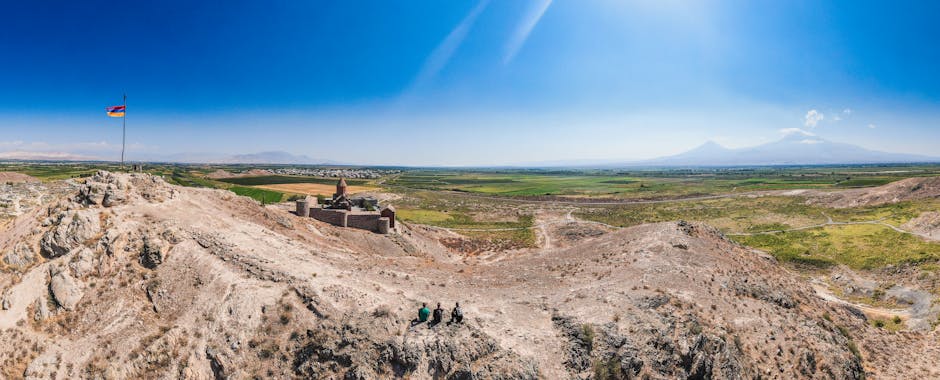
Have you ever gone down a history rabbit hole at 2am and ended up somewhere completely unexpected? I was supposed to be researching Hittite diplomacy for a blog post, but somehow—three hours later—I found myself staring at a translation of an Urartian inscription about a king named Argishti I claiming he built a canal that made ‘the desert bloom.’ I remember the exact moment: my tea had gone cold, stray cats were meowing outside my window in Kadıköy, and I thought, ‘Wait, Urartu? That’s just a footnote in Assyrian records, right?’ Wrong. So wrong. That night sent me into a deep dive that eventually led me to standing on the slopes of Mount Ararat, looking at the ruins of a fortress that once commanded a kingdom most people have never heard of. This is the story of the Urartians—the lost engineers of the ancient world who turned a harsh landscape into a thriving civilization, and whose water systems still flow today.
Hook Opening
Let me set the scene. It was around 2:30 AM, and I was in my apartment in Istanbul, scrolling through digitized copies of cuneiform tablets from the British Museum online. I had been reading about the Assyrian king Sargon II, who famously boasted about conquering ‘the house of Urartu’ in 714 BC. That name stuck with me. So I clicked. What I found was not just a footnote but an entire civilization that had built fortresses on mountain peaks, carved irrigation canals through solid rock, and created bronze cauldrons so elaborate that the Greeks later copied them. You might be wondering why this kingdom isn’t as famous as Egypt or Assyria. Well, partly because their records were lost for centuries, and partly because the few surviving inscriptions were written in a language related to Hurrian, not the more familiar Akkadian or Sumerian. Here is something that blew my mind: the Urartians were not just warriors; they were master hydrologists. Their longest canal, the ‘Canal of Menua,’ stretched over 80 kilometers and supplied water to their capital, Tushpa (modern Van), for over two thousand years. Think of it like the aqueducts of Rome, but built 600 years earlier and carved into volcanic rock.
Historical Background
The Rise of a Mountain Kingdom
Urartu emerged around the 9th century BC in the mountainous region east of the Anatolian plateau, roughly covering what is now eastern Turkey, Armenia, and northwestern Iran. Actually, let me rephrase that: they called themselves ‘Biainili’ in their own language. The name Urartu comes from the Assyrians, who used it to label this stubborn neighbor that never quite fell. The first known Urartian king was Arame (c. 858–844 BC), but the real founder was Sarduri I (c. 832–820 BC), who built the fortress at Tushpa on a massive rock outcrop overlooking Lake Van. I visited that fortress two years ago with my archaeologist friend Cem. We climbed up at sunset, and he pointed out the basalt blocks at the base, some weighing over 20 tons. ‘How did they move these?’ I asked. ‘They didn’t need cranes—they had thousands of laborers and a king who wanted to impress the gods,’ he said. But here is where it gets interesting: the Assyrians, who saw themselves as the superpower of the Near East, fought Urartu for centuries. The most famous clash was in 714 BC, when Sargon II invaded Urartu, burned their temples, and looted their treasure. Yet the kingdom survived for another 200 years.
A Kingdom of Many Gods
I had a long conversation over Turkish tea with another historian, Bilge, at a coffee shop in Kadıköy. She specializes in ancient Near Eastern religions and told me something surprising: the Urartians had a pantheon led by a god named Haldi, who was not a sky god like Zeus but a god of war and mountains. Haldi had his own temple at the top of most fortresses, and the kings would offer him bronze shields as tribute. One evening, I stayed late at the Museum of Anatolian Civilizations in Ankara, examining a bronze belt from Urartu. The belt was engraved with scenes of lions and bulls—symbols of power. I remember the guard told me it was closing time, but I couldn’t tear myself away. That belt was over 2,700 years old, and the craftsmanship was so precise it could have been made yesterday. Here is something that blew my mind: Urartian metalworkers invented a unique alloy of copper and tin that was stronger than pure bronze. They traded this metal across the ancient world, even reaching Greece. But the heart of their power was water.
The Heart of the Story
The Canal Kings
In the 8th century BC, the Urartian king Menua (c. 810–785 BC) launched one of the most ambitious engineering projects of the ancient world: a canal to bring water from the River Euphrates to the city of Tushpa. But wait—the Euphrates is far. Actually, the canal drew from the Hoşap River, a tributary of the Murat River, which flows into the Euphrates. The channel cut through hard volcanic basalt, and you can still see the chisel marks today. I stood beside it last summer, near the village of Gürpınar, and dipped my hand in the water. The canal is still in use, irrigating apple orchards and wheat fields. Think of it like a Roman aqueduct but without the arched bridges—the Urartians preferred to go through the rock rather than over it. They built tunnels, some up to 200 meters long, to bypass obstacles. One of the most impressive is near the fortress of Çavuştepe, which I visited with my wife. We entered the tunnel, and the temperature dropped instantly. Our flashlight revealed the stone walls, perfectly straight, carved by hand. ‘Who dug this?’ she whispered. ‘Probably prisoners of war,’ I said. ‘Or locals forced into labor.’ It reminded me of the stories of slaves building pyramids, but here, the result was not a tomb but a lifeline.
The Fall: A Mystery of History
But here is where it gets tricky. Urartu collapsed around the 6th century BC, but no one is sure exactly why. The traditional story is that the Medes and Scythians invaded in the 590s BC, destroying the capital. However, recent archaeological digs at Ayanis, a site on the eastern shore of Lake Van, suggest a different story. In 2018, Turkish archaeologist Mehmet Işıklı found evidence of a massive earthquake that toppled walls and buried entire temples. Carbon dating placed it around 590 BC—the same time the Medes were said to have conquered the region. So which was it? War or natural disaster? You might be thinking, ‘Why not both?’ Exactly. The Ayanis excavation shows a city that was devastated by an earthquake and then abandoned, but later tombs show signs of violence. Possibly the earthquake weakened the kingdom, and then the Medes finished it off. Here is something that blew my mind: the last Urartian king, Rusa IV, left an inscription at the fortress of Toprakkale begging the god Haldi to save his people. He wrote: ‘The lands are broken, the crops are burned, the rivers run with blood.’ It’s one of the most poetic—and tragic—records from antiquity. You can see that inscription today at the Istanbul Archaeology Museums. I stood in front of it for ten minutes, just reading and re-reading the words. That king was desperate.
The Part Nobody Talks About
Women in Urartu
When I teach history workshops at local libraries in Istanbul, someone always asks about women in ancient civilizations. And I have to admit, Urartu is almost completely silent on that topic. But there is one exception: the name ‘Bagbartu,’ the wife of King Argishti II. She is mentioned in a legal document related to property ownership. That fragment, held at the Louvre, shows that noble women could own land and manage estates. But was that common? Probably not. Most women were likely farmers, weavers, or priestesses. Yet, I remember a conversation with Dr. Figen Yılmaz at a conference in Ankara. She gave a talk on textile production in Urartu and argued that women controlled the weaving industry, which was massive because the kingdom exported woolen fabrics. She showed a relief of a woman weaving on a loom, the only intact image of a female laborer from that period. It’s small, faded, but it’s there. So maybe the part nobody talks about is that Urartian society was more complex than the typical ‘warrior kings’ narrative suggests.
The ‘Lost’ Language Connection
Another undiscussed angle: the Urartian language is distantly related to Hurrian, but it may have also influenced early Armenian. Some linguists even propose that the name ‘Urartu’ gave the root to ‘Ararat.’ Think of it like this: the biblical Mount Ararat, where Noah’s Ark supposedly landed, is actually within the heartland of Urartu. The name shift is not coincidental. When the kingdom fell, its people likely merged with the incoming Armenians, passing on their irrigation techniques and fortification methods. I visited the Urartian site of Karmir Blur in Armenia a few years back, and the guide there insisted that modern Armenian irrigation owes everything to Urartian engineering. ‘We are the children of Haldi,’ she said with a smile. It made me think about how identity is built on forgotten foundations.
Why It Still Matters Today
Modern Water Wars
Right now, in 2025, the region around Lake Van is facing water shortages due to climate change and overuse. Engineers are studying the ancient Urartian canals to see if they can be integrated into modern systems. There is a project called ‘The Urartu Heritage Canal Revival,’ started by the Van Yüzüncü Yıl University, which aims to restore part of the Menua Canal and use it to irrigate drought-prone areas. I attended a lecture by the project lead, Prof. Ali Kaya, last autumn. He showed satellite images of the ancient canal, still traceable for kilometers. ‘We can learn from their sustainability,’ he said. ‘They built it to last for millennia, and we build dams that silt up in decades.’ Here is something that blew my mind: the Urartians used a system of sluice gates and reservoirs that regulated water flow without any moving parts—just gravity and careful stone carving. That is knowledge we are slowly relearning.
Tourism and Conservation
On a personal note, every year I see more tourists visiting Urartian sites. The fortress of Van is now a UNESCO World Heritage tentative site. But with tourism comes damage. I was at Toprakkale last spring and saw a group of teenagers carving their names into an ancient wall. It broke my heart. I told the site guard, but he shrugged—there are only two guards for the whole area. So we, history enthusiasts, have a role. I now volunteer with a local group that cleans inscriptions and raises awareness. If you ever visit, please touch nothing, take nothing, and respect these stones that have stood for three thousand years.
My Personal Take
A Midnight Revelation
I want to share two moments that cemented my love for Urartu. First, that initial 2am discovery. I found a translation error in a popular history book: it claimed the Urartians did not have a written language—which is nonsense, they had cuneiform adapted from Assyrian. But the book’s author confused them with the earlier Hurrians. I corrected it in a blog post, and a professor from the University of Chicago emailed me, thanking me. That little victory felt huge. Second, a walk along the Menua Canal at dawn. I was alone, the water was cold, and for a while I stood still. I closed my eyes and imagined the day it opened: King Menua would have led a procession, priests chanting, sacrifices to Haldi. The water flowed for the first time, and a whole kingdom changed. That connection—across centuries and through water—is why I do this.
Final Thoughts
Urartu is not a footnote. It is a testament to human ingenuity, resilience, and the quiet power of water over empires. The next time you hear about Assyria or Babylon, remember that in the high mountains of Anatolia, a kingdom of engineers carved life from rock. And they still have something to teach us about living on a changing planet. Did this change how you think about this topic? Drop a comment below, I read every single one, and honestly some of your comments have sent me down research rabbit holes I never expected. That is the best part of writing about history.
Sources & Further Reading
- Burney, Charles. Urartu: The Kingdom of Van. British Museum Press, 1991.
- Zimansky, Paul. Ecology and Empire: The Structure of the Urartian State. Oriental Institute, 1985.
- National Geographic History. ‘The Lost Kingdom of Urartu.’ July/August 2019.
- Anatolian Studies Journal. ‘Irrigation Systems of the Urartian Period.’ Vol. 60, 2010.