
Introduction
The Roman Empire, a name that evokes images of grandeur, military might, and remarkable achievements, has significantly shaped the course of Western civilization. At its zenith, around 117 AD, the empire reigned supreme over vast territories, stretching from the misty isles of Britain to the sun-drenched shores of Northern Africa, encompassing parts of modern-day Europe, the Middle East, and beyond. How could one empire, born from the humble beginnings of a small settlement along the Tiber River, ascend to such formidable power? Conversely, what tragic missteps led to its eventual decay? The rise and fall of Rome are more than mere historical events; they are a powerful narrative of human ambition, governance, warfare, and culture. In this article, we will delve into the complexities of the Roman Empire’s history, examining its origins, pivotal moments, influential figures, and overarching impact on the world.
Historical Background and Context
The origins of the Roman Empire date back to around 753 BC when, according to legend, Romulus founded Rome after a series of significant events involving his twin brother Remus and the divine intervention of the gods. At first, Rome was a monarchy governed by kings; however, in 509 BC, the last king, Tarquin the Proud, was overthrown, and the Roman Republic was established. This transition marked a crucial turning point, laying the groundwork for what would eventually evolve into the Roman Empire.
The Roman Republic operated through a complex structure of checks and balances, featuring elected officials, a Senate, and assemblies empowered by the voice of Roman citizens. However, power struggles among the socio-political classes, particularly between the patricians (aristocracy) and plebeians (commoners), fostered discontent. These internal conflicts, coupled with external threats from neighboring tribes and states, often propelled Rome into crises that ultimately required strong military responses.
By the 1st century BC, Rome was embroiled in a series of civil wars that would change the landscape of power in Rome forever. The most pivotal events occurred between 49 BC and 44 BC, when Julius Caesar, with his military prowess and political acumen, seized control of the government, prompting widespread fear among the elite and leading to his assassination on the Ides of March in 44 BC. This act sparked another wave of civil wars, which culminated in the rise of Octavian (later called Augustus) as the first Emperor of Rome in 27 BC.
Augustus adopted numerous reforms to centralize authority and stabilize the empire, initiating a period known as the Pax Romana, which lasted for approximately two centuries. The empire would reach its territorial peak under Emperor Trajan in 117 AD, but this marked the beginning of a slow decline. Political instability, economic troubles, military defeats, and barbarian invasions characterized the years to come, leading to the eventual decline of this once-mighty empire.
Key Events, Battles, or Developments
The First Punic War (264-241 BC)
The First Punic War marked the beginning of Rome’s rise as a sea power and its expansion beyond the Italian Peninsula. Battling Carthage, a dominant city-state in Northern Africa, the war was chiefly about control over Sicily. Although these engagements were long and arduous, Rome ultimately emerged victorious, gaining Sicily as its first province and establishing itself as a serious contender on the Mediterranean stage.
The Assassination of Julius Caesar (44 BC)
On March 15, 44 BC, Julius Caesar was assassinated by a group of senators who feared his growing power and the potential establishment of a dictatorship. This act threw the Republic into turmoil and civil war, leading to the rise of Augustus.
The Battle of Actium (31 BC)
This naval battle against Mark Antony and Cleopatra was a crucial conflict that solidified Octavian’s path to power. With a decisive victory at Actium, Octavian was able to assume control over Egypt and consolidate power, turning the Republic into the Roman Empire.
Construction of the Colosseum (AD 70-80)
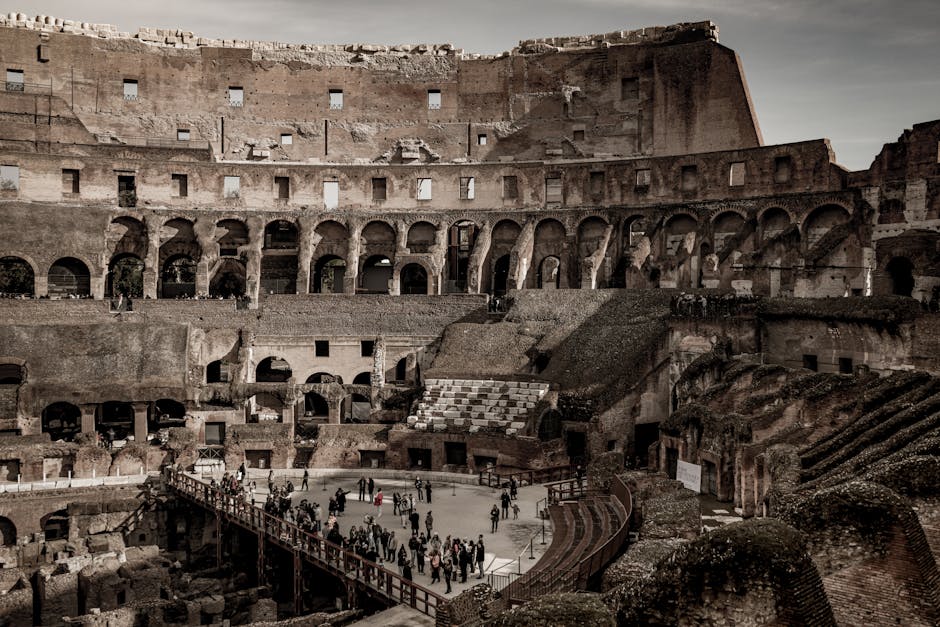
The Colosseum, an iconic symbol of Rome’s architectural prowess, was commissioned by Emperor Vespasian in AD 70. Completed by his son Titus in AD 80, this grand amphitheater became a venue for gladiatorial contests and public spectacles, representing the empire’s wealth and ambition.
The Edict of Milan (AD 313)
Issued by Emperor Constantine the Great, the Edict of Milan proclaimed religious tolerance for Christianity within the Roman Empire, heralding a monumental shift in religious and cultural dynamics. This decree legitimized Christianity’s place in society, paving the way for its future as a dominant religion.
Barbarian Invasions (4th-5th centuries AD)
The latter stages of the empire witnessed repeated invasions by various tribes, including the Visigoths, Vandals, and Huns. The sack of Rome by the Visigoths in AD 410 and the fall of the Western Roman Empire in AD 476 to Odoacer, a Germanic chieftain, exemplify the vulnerabilities that had developed within this once formidable entity.
Important Figures and Their Roles
Julius Caesar (100-44 BC)
Julius Caesar was a military general and statesman whose actions tremendously impacted Rome’s transition from Republic to Empire. His military conquests in Gaul expanded Rome’s territory and brought immense wealth. His rise to power, however, culminated in his assassination, which signaled the unraveling of the Republic.
Augustus (63 BC-AD 14)
As the first Roman Emperor, Augustus established a framework for imperial governance. He enacted several reforms that molded Roman society, many of which endured long after his rule. His centralization of power set a vital precedent for future emperors.
Constantine the Great (AD 272-337)
Constantine was a pivotal figure in the empire’s religious transformation. He endorsed Christianity and convened the First Council of Nicaea in AD 325, further solidifying the faith’s prominence within the empire.
Marcus Aurelius (AD 121-180)
Often regarded as the philosopher-king, Marcus Aurelius’ reign epitomizes the philosophy of Stoicism within governance. His writings, especially the ‘Meditations,’ remain influential philosophical texts that delve into issues of duty, ethics, and the human experience.
Odoacer (c. AD 433-493)
Odoacer was the Germanic chieftain who deposed the last emperor of the Western Roman Empire, Romulus Augustulus, in AD 476. This act is commonly cited as the symbolic end to the Roman Empire, marking a significant transition into the Middle Ages.
Causes and Consequences
The Roman Empire’s fall is attributed to multiple interconnected causes, both internal and external. Internally, the empire faced severe political corruption, economic distress, and social unrest that weakened its foundations. The intricate web of governance created a dysfunctional system where power struggles frequently resulted in instability. The population decline due to plagues and economic woes diminished the labor force and hindered production, exacerbating already existing financial strains.
Externally, the incursions by various barbarian tribes showcased the weaknesses in Roman military defenses and territorial integrity. The inability to effectively respond to these invasions foreshadowed the empire’s downfall.
The broader consequences of the empire’s fall were felt across Europe and beyond. Territorial divisions and the rise of feudalism marked the beginning of a drastic societal transformation as political power became decentralized. Moreover, the cultural legacies of Greece, Rome, and the blend of Christian theology began to shape the European Middle Ages.
Global Impact and Legacy
The Roman Empire’s influence extends far beyond its fall, establishing legal frameworks, architectural innovations, and cultural dialogues that resonate in the modern world. Roman law serves as the foundation for many contemporary legal systems, emphasizing principles like the presumption of innocence and the right to a fair trial. Architecturally, techniques such as the arch and concrete construction led to advancements that are still utilized today.
The spread of the Latin language and Roman culture laid the groundwork for the development of Romance languages, such as Spanish, French, Italian, Portuguese, and Romanian. Furthermore, the adoption of Christianity as a state religion opened the door for religious developments which would shape the moral and ethical frameworks of Western societies.
Fascinating Little-Known Facts
1. The Romans used a unique form of concrete, which allowed structures to withstand the test of time, some still standing after centuries of weathering.
2. The Colosseum could hold 50,000 to 80,000 spectators, and it featured a sophisticated system of awnings to protect viewers from the sun.
3. Many of the Roman roads were engineered with precision; some are still in use today, demonstrating their advanced construction techniques.
4. Rome had over a dozen holidays dedicated to the worship of gods, festivals, and public games, indicating the importance of religious and social life in Rome.
5. The infamous phrase “All roads lead to Rome” is a testament to the Roman Empire’s extensive network of roads, which constructed over 250,000 miles of paved highways.
Conclusion: Modern Relevance
The tale of the Roman Empire is a timeless narrative that continues to carry significant lessons for contemporary society. As we navigate issues such as political fragmentation, economic challenges, and social unrest, the Roman experience serves as both a cautionary tale and a source of inspiration for resilience and reform. Understanding its rise and fall can provide deeper insights into current global dynamics and the perpetual quest for power and stability. The Roman legacy not only informs our architecture and legal systems but also enriches our cultural understanding of governance and societal progression.