
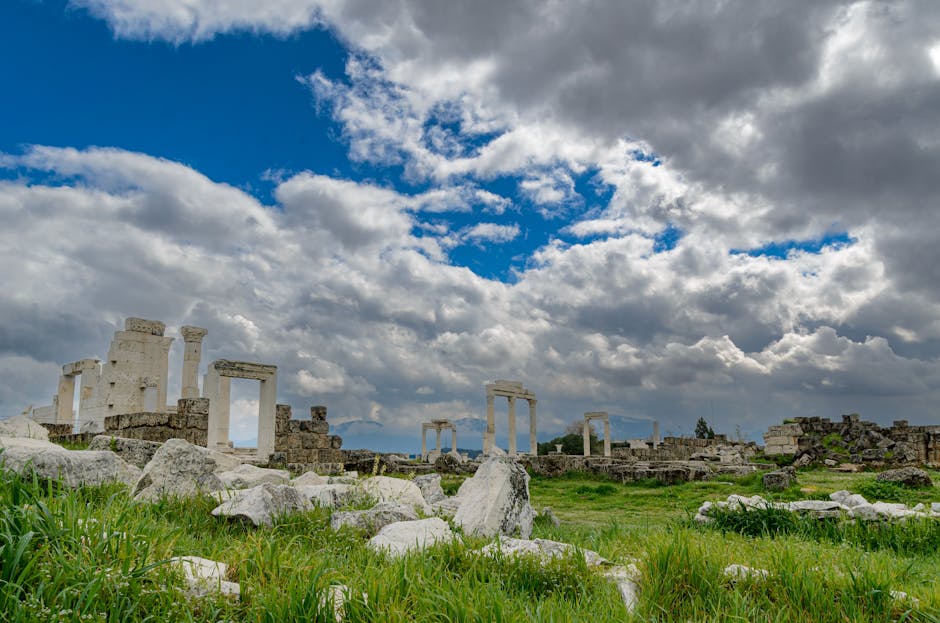
Introduction: Journey Back to the Dawn of Civilization
Imagine standing on the banks of the Nile as a young scribe watches the sunrise paint a golden hue over towering pyramids, or feeling the thunderous roar of a Roman legion marching across the dusty plains of Gaul. Ancient history is not just a collection of dates and artifacts; it is a living tapestry woven with daring conquests, groundbreaking innovations, and unforgettable personalities that continue to shape our world today. In this immersive exploration, we travel from the cradle of Mesopotamia to the far‑flung edges of the Silk Road, uncovering the forces that propelled humanity from tribal settlements to sprawling empires. Whether you’re a history buff, a student, or simply curious about the roots of modern society, this article offers a compelling, SEO‑optimized deep dive into the events, figures, and legacies that define ancient history.
Historical Background and Context
The Fertile Crescent: Birthplace of Writing and Law
Around 3500 BCE, the fertile valleys of the Tigris and Euphrates gave rise to the first cities—Uruk, Ur, and Lagash. These riverine hubs birthed cuneiform, the world’s earliest known writing system, enabling administrators to record transactions, laws, and myths. By 2100 BCE, the Code of Hammurabi, inscribed on a basalt stele, codified justice with the famous principle “an eye for an eye,” influencing legal thought for millennia.
Egyptian Eternity: The Age of the Pharaohs
Simultaneously, Egypt’s Nile Valley fostered a civilization renowned for monumental architecture and religious continuity. From the Step Pyramid of Djoser (c. 2630 BCE) to the iconic Great Pyramid of Giza (c. 2580–2560 BCE), the Egyptians demonstrated unprecedented engineering prowess. Their belief in the afterlife drove elaborate burial practices, while the pharaoh’s divine status unified a nation under a single, theocratic rule.
The Classical World: Greece and Rome’s Ascendancy
Fast‑forward to the first millennium BCE, where the Greek city‑states of Athens and Sparta pioneered democracy, philosophy, and theater. The Persian Wars (499–449 BCE) and the Peloponnesian War (431–404 BCE) set the stage for Alexander the Great’s conquests, which spread Hellenistic culture across three continents. Rome, originally a modest Italic settlement, evolved into a republic (509–27 BCE) and later an empire that stretched from Britannia to Judea, mastering law, engineering, and military organization.
Key Events, Battles, and Developments
3500–3000 BCE: The Rise of Urban Centers in Mesopotamia
Uruk’s population surged to over 50,000, making it the world’s first true metropolis. The development of irrigation canals boosted agricultural yields by an estimated 30%, supporting urban growth and specialized labor.
2686–2181 BCE: The Old Kingdom of Egypt
Construction of the three Great Pyramids at Giza required more than 2.3 million stone blocks, each weighing an average of 2.5 tons. The workforce, organized into rotating crews, demonstrates early large‑scale project management.
1274 BCE: The Battle of Kadesh
Fought between Pharaoh Ramesses II of Egypt and the Hittite king Muwatalli II near the Orontes River, Kadesh is one of the earliest battles with detailed tactical accounts. Egyptian chariots numbered around 2,000, while Hittite forces deployed comparable numbers, resulting in a stalemate that led to the first recorded peace treaty (c. 1259 BCE).
490–479 BCE: The Greco‑Persian Wars
Key battles include Marathon (490 BCE), where the Greeks outmaneuvered a Persian force of approximately 25,000 with a hoplite phalanx of 10,000. The decisive naval victory at Salamis (480 BCE) saw 371 Greek triremes defeat a Persian fleet of over 600 vessels, safeguarding Greek independence.
334–323 BCE: Alexander’s Conquests
Starting with the Battle of Granicus (334 BCE), Alexander’s Macedonian army (≈35,000 troops) defeated Persian satrapies across Asia Minor, Egypt, and Persia. The siege of Tyre (332 BCE) showcased innovative engineering—building a causeway 1.5 km long to breach the island city.
27 BCE–14 CE: Augustus and the Pax Romana
Under Emperor Augustus, the Roman Empire entered a 200‑year period of relative peace and prosperity. Infrastructure projects, such as 29,000 km of roads and 400,000 km of aqueducts, facilitated trade across three continents.
212 CE: The Edict of Caracalla
This proclamation granted Roman citizenship to all free men within the empire, expanding the tax base and integrating diverse populations under a common legal framework.
Important Figures and Their Roles
Hammurabi (c. 1810–1750 BCE)
King of Babylon who codified laws that emphasized proportional justice, influencing subsequent legal systems in the Near East and the Western world.
Cleopatra VII (69–30 BCE)
The last active ruler of the Ptolemaic Kingdom of Egypt, renowned for her political acumen, diplomatic alliances with Julius Caesar and Mark Antony, and her role in the eventual Roman annexation of Egypt.
Pericles (c. 495–429 BCE)
Athenian statesman who championed democracy, commissioned the Parthenon, and led Athens during its golden age, fostering advancements in philosophy, drama, and the arts.
Julius Caesar (100–44 BCE)
Military genius whose conquest of Gaul (58–50 BCE) expanded Roman territory by 500,000 km²; his crossing of the Rubicon in 49 BCE sparked civil war and paved the way for the imperial era.
Augustus (63 BCE–14 CE)
First Roman emperor who instituted reforms in taxation, provincial governance, and the military, establishing a stable foundation for the empire’s longevity.
Causes and Consequences
Ancient societies rose and fell due to a web of interrelated factors. Environmental pressures, such as droughts in the Late Bronze Age (c. 1200 BCE), forced migrations and disrupted trade networks, contributing to the collapse of the Hittite and Mycenaean civilizations. Technological innovations—like the chariot, iron smelting, and writing—enabled more efficient warfare, administration, and record‑keeping, accelerating state formation. Conversely, internal strife, exemplified by Rome’s transition from republic to empire, reflected class tensions and power struggles that reshaped governmental structures.
The consequences of these dynamics reverberated across centuries. The spread of Hellenistic culture after Alexander’s campaigns fused Greek, Persian, and Egyptian traditions, seeding the intellectual foundations of the Roman world and later the Renaissance. Legal codifications, from Hammurabi to the Roman Twelve Tables, established concepts of property rights and civic duty that endure in modern legal systems. Trade routes such as the Silk Road facilitated not only goods but ideas, fostering cross‑cultural exchange that would ultimately shape medieval and modern economies.
Global Impact and Legacy
The imprint of ancient history is unmistakable in contemporary society. Architectural marvels—pyramids, arches, and aqueducts—continue to inspire modern engineering and tourism. Philosophical tenets from Socrates, Confucius, and the Bhagavad‑Gītā underpin ethical debates today. Moreover, the ancient world’s emphasis on written record‑keeping laid the groundwork for present‑day information management, influencing everything from libraries to digital databases.
Fascinating Little‑Known Facts
1. The ancient Sumerians used a base‑60 (sexagesimal) numeral system, which is why we have 60‑second minutes and 360‑degree circles.
2. The Library of Alexandria, founded in the 3rd century BCE, housed an estimated 400,000 scrolls—far surpassing any contemporary library.
3. Roman concrete, made with volcanic ash, has proven more durable than many modern formulations, with structures like the Pantheon still standing after 1,900 years.
4. In 174 BCE, the Chinese state of Qin standardized weights, measures, and even axle lengths for carts, facilitating trade across the empire.
5. The ancient Maya tracked celestial events with such precision that their calendar predicted solar eclipses centuries in advance.
Conclusion: Ancient Lessons for the Modern World
From the irrigation canals of Mesopotamia to the sprawling road network of the Roman Empire, ancient history offers a blueprint of human ingenuity, resilience, and the perpetual quest for order. By studying the triumphs and failures of our ancestors, we gain insight into today’s challenges—be it climate adaptation, governance, or cultural integration. The echoes of ancient battles, inventions, and philosophies remind us that while technology evolves, the fundamental human drive to understand, create, and connect remains unchanged. Embracing these timeless lessons empowers us to build a future that honors the past while forging new horizons.