
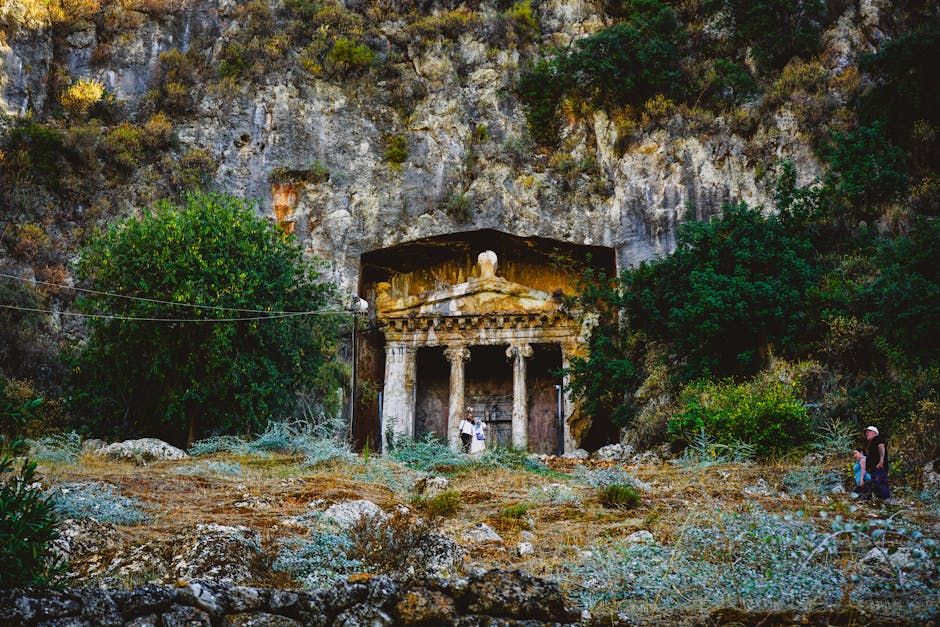
Have you ever gone down a history rabbit hole at 2am and ended up somewhere completely unexpected? I remember one such night a few years ago, sitting in my small Istanbul apartment, a stack of books on my coffee table. I was supposed to be finishing an article about the Roman Empire, but somehow I ended up reading about the Etruscans. You know, those mysterious people who lived in Italy before the Romans, the ones who gave us gladiators and that weird language nobody could read. But here is the thing that kept me up: half the ancient sources said these people came from Turkey. From Lydia, specifically — a kingdom in western Anatolia. I had visited Sardis, the Lydian capital, just a month before. I remember walking among the ruins of the Temple of Artemis, looking at the tumuli in the distance, and thinking, could these hills really hold the ancestors of Rome’s founders? That night, I started digging with a intensity that only happens at 2am. What I found challenged everything I thought I knew about ancient migrations. So let me take you on that same rabbit hole.
The Etruscan Enigma: Who Were They?
First, let’s get our bearings. The Etruscans dominated central Italy — roughly modern Tuscany, parts of Umbria and Lazio — from about 900 BC until the Romans absorbed them around 100 BC. They left behind stunning frescoes, elaborate tombs, and a language that still resists full translation. Here is something that blew my mind: they were the first to build stone temples in Italy, and they taught the Romans how to build arches and sewers. Think of it like the Etruscans were the cool older cousins of Roman civilization, the ones who showed them the ropes. But their origins? That’s been a battlefield for centuries.
Three main theories exist. One: they were native Italians, evolving from the Villanovan culture. Two: they came from somewhere else entirely, possibly the eastern Mediterranean. Three: they were a mix of both. The second theory, the one about them coming from Anatolia, has the most dramatic backstory. Herodotus, the Greek historian writing around 450 BC, told a story about the Lydian king Tyrsenos leading half his people out of Anatolia because of a long famine. After sailing around the Mediterranean, they ended up in Italy and called themselves Tyrrhenians — that’s the Greek name for Etruscans. But here is where it gets interesting: another ancient writer, Dionysius of Halicarnassus, argued they were native. So even antiquity was confused.
The Lydian Connection: More Than a Legend?
I remember talking to my friend Dr. Cemal, an archaeologist who spent years digging at Sardis, over tea one afternoon. He told me about the Lydian language — how it was part of the Anatolian branch of Indo-European, the same family as Hittite and Luwian. He said, ‘You know, Halil, the Etruscan language has some strange parallels with Lydian, but it’s not a direct match. It’s like a puzzle with half the pieces missing.’ That stuck with me. For decades, linguists have pointed to specific words — like ‘tular’ meaning boundary in both Lydian and Etruscan — as possible evidence. But critics say it’s too thin.
In 2021, a major study in Science Advances looked at DNA from 82 ancient individuals from Etruscan sites and nearby areas. The results turned everything upside down. Here is something that blew my mind: the Etruscans shared a strong genetic continuity with the earlier Villanovan people of Italy, meaning they were largely local. But wait — the same study found a subtle but real influx of ancestry from the eastern Mediterranean, specifically from Anatolia, during the Iron Age. The DNA didn’t tell a simple story. It hinted that migrations happened, but not the sudden invasion Herodotus described. It was more like a trickle of people, ideas, and genes over centuries.
I recall reading that study while sitting in a coffee shop in Kadıköy, the asian side of Istanbul. The place was buzzing with students and old men playing backgammon, and I was staring at my laptop, completely absorbed. I thought: this is what history is really like — messy, complicated, full of humans moving and mingling, not neat narrative lines. Think of it like a river that shifts course over time, not a single wave washing ashore. That’s the Etruscan origin story: a slow, winding connection between two coasts of the Mediterranean.
What the Critics Say and Why It Matters
But here is where it gets interesting: not everyone is happy with the DNA evidence. Some archaeologists argue that a genetic signal of 20-30% from the eastern Mediterranean doesn’t prove a cultural takeover. They point out that Etruscan art, religion, and customs were distinctly Italian, not Anatolian copycats. For example, Etruscan temples were built on high podiums, unlike the Lydian ones. And their language? Still an isolate — no proven relationship to any Anatolian tongue. A mini story: I once visited the Etruscan Museum in Rome, and saw a bronze mirror engraved with a scene of Calchas, a Greek prophet. The inscription was in Etruscan but the style was pure Greek. It made me realize how fluid identities were.
The political stakes are also high. In Italy, claims of Etruscan ‘outsider’ origins have sometimes been used to fuel nationalism or to downplay the indigenous roots of Italian culture. Turkey, on the other hand, has occasionally embraced the idea as evidence of ancient greatness. When I visited the site of Alacahöyük in north-central Turkey, a Hittite center, a local guide proudly told me that the Etruscans came from there. I smiled and nodded, but I knew the evidence was thinner for that claim. It’s a reminder of how modern nations invent their past.
Recent Discoveries: The Lydian Tomb Inscriptions
In 2022, a team from the University of Pennsylvania found a new inscription in Lydian at the site of Sardis. It was a dedication to the goddess Artemis, but it included a phrase that some scholars argue mirrors an Etruscan funerary formula. I remember reading the news on my phone while waiting for a ferry. The sun was setting over the Bosphorus, and I thought about how these two shores — Anatolia and Italy — were never truly separate in deep time. The inscription hasn’t been fully deciphered yet, but it adds fuel to the fire. Here is something that blew my mind: the Etruscan word for ‘god’ is ‘ais’ — and in Lydian, it’s ‘ēs.’ Not identical, but close enough to make you wonder.
Look, I’m not saying the Etruscans were simply Lydians who packed up and left. That would be like saying all Americans are British because some Pilgrims sailed over. But the evidence from DNA, linguistics, and ancient texts — taken together — suggests that the Etruscan population included a significant component of people from the eastern Mediterranean. And that is huge. It rewrites the story of how cultures formed in pre-Roman Italy.
Why It Still Matters Today
You might ask: why does this old debate matter in 2025? Because it’s not just about the Etruscans. It’s about how we think about migration, identity, and ‘native’ peoples. Every time we hear talk of ‘pure’ cultures or ‘ancient roots,’ we should remember that even three thousand years ago, people were moving, mixing, and transforming. The Etruscan case shows that genetic and cultural ancestry can be both local and foreign at the same time. I think of a conversation I had with a waiter in a small restaurant in Foça, an ancient Phocaean colony on the Aegean coast. He was descended from Greek-speaking refugees who came in the 1920s. He said, ‘Halil, my family has been here only a hundred years, but now this is home. So who is the real Anatolian?’ That is the Etruscan paradox in a nutshell.
Modern technology like ancient DNA and isotope analysis is making these debates more nuanced. We can now track the movements of individuals, not just populations. I have a friend, Dr. Leyla, who works at a lab in Ankara analyzing isotopes from teeth. She told me about a study that found a woman buried in an Etruscan tomb who had a diet consistent with a childhood in Anatolia. She was a real person, traveling across the sea, carrying her own story. That is the kind of history that makes me want to drop everything and dig.
Personal Take: What I Believe
After all this, where do I stand? I think the Etruscans were primarily indigenous to Italy, but with meaningful connections to the eastern Mediterranean. Not a mass migration, but a long-term exchange that included actual settlers, traders, and perhaps refugees. The Lydian connection is plausible, but not proven beyond doubt. What I love about this story is that it remains open. Every new discovery — from a tomb in Tarquinia to a DNA lab in Cambridge — shifts the picture just a little. That is the beauty of history: it’s never finished.
One more anecdote. Last winter, I took a road trip to the ancient city of Ephesus with a friend from high school who now teaches archaeology at Istanbul University. We sat on the marble steps of the Celsus Library, eating simit and drinking tea. I asked him, ‘What do you tell your students about the Etruscans?’ He grinned and said, ‘I tell them to keep an open mind. And to read Herodotus with skepticism, but also with respect.’ I think that’s the perfect approach. We shouldn’t believe every ancient writer blindly, but we shouldn’t dismiss them either. Sometimes, a story passed down for centuries contains a grain of truth.
So next time you hear someone say the Etruscans came from Turkey, nod and say, ‘Maybe not exactly, but there’s something there.’ It’s a gateway to a larger conversation about how human history is a web of connections, not a line of dominos.
Did this change how you think about this topic? Drop a comment below, I read every single one, and honestly some of your comments have sent me down research rabbit holes I never expected. That is the best part of writing about history.