
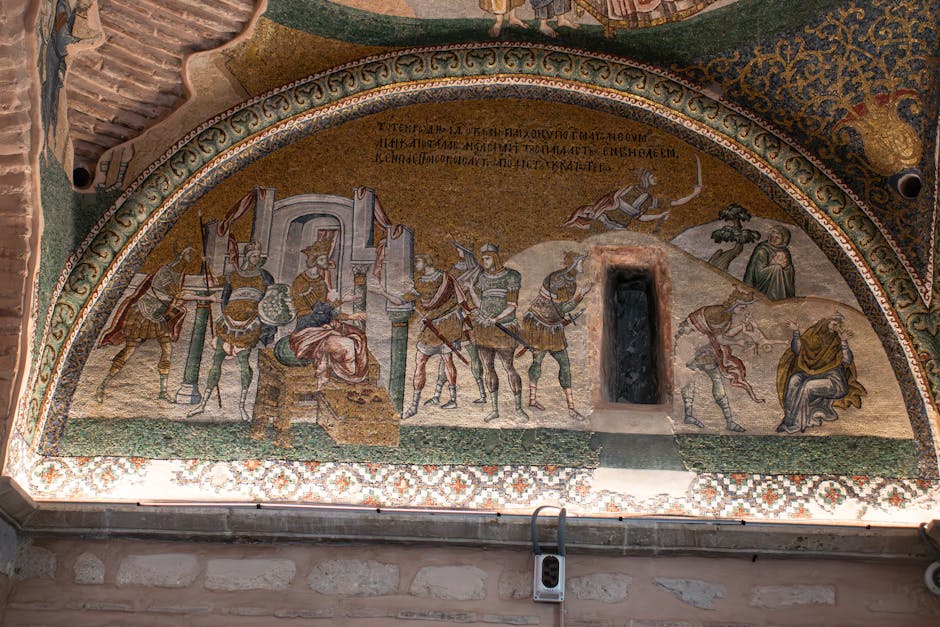
Introduction: The Byzantine Empire – A Beacon of Civilization
In the annals of history, few civilizations have left as indelible a mark as the Byzantine Empire. Nestled at the crossroads of Europe and Asia, this empire stood as a beacon of cultural and intellectual pursuits while embodying the relentless struggles for power and survival. Stretching across more than a millennium, the Byzantine Empire became the vibrant epicenter of trade, religion, and politics. At its zenith, the empire encapsulated the grandeur of Rome and the spiritual fervor of Orthodox Christianity, merging as a formidable cultural and military powerhouse. Journey with us through the tides of the Byzantine narrative, understanding the critical events, influential figures, and the profound legacy that built—and eventually dismantled—this shimmering jewel of the medieval world.
Historical Background and Context
The early history of the Byzantine Empire is intricately tied to the Roman Empire. By the 3rd century AD, the Roman Empire was unraveling due to internal strife, economic decline, and relentless invasions. As a solution, Emperor Diocletian split the vast Roman territories into East and West in 285 AD to enable easier governance. However, it was Emperor Constantine the Great who, in 330 AD, established Byzantium as the new capital of the Roman Empire, renaming it Constantinople in his honor. This decision was not merely administrative; Constantinople’s strategic position on the Bosporus Strait facilitated trade and military outreach. The Eastern Roman Empire, which later adopted the Byzantine moniker, differentiated itself from its Western counterpart through a unique blend of Greco-Roman traditions and Eastern influences. As the Western Roman Empire crumbled in 476 AD under barbarian pressures, the Eastern Empire thrived, skillfully maintaining its heritage and adapting to the changing dynamics of the medieval world.
Key Events: Battles, Cultural Developments, and Milestones
The Reign of Justinian I (527–565 AD)
Perhaps one of the most ambitious figures in Byzantine history, Emperor Justinian I’s reign marked a renaissance era. Justinian sought to resurrect the Roman Empire’s former glory, initiating ambitious military campaigns led by the legendary general Belisarius. Notably, the reconquest of North Africa from the Vandals in 533 AD and the invasion of Italy in 535 AD stand as monumental military achievements. Justinian’s influence extended beyond the battlefield; he commissioned the Corpus Juris Civilis (Body of Civil Law), which has profoundly influenced legal systems globally.
The Iconoclastic Controversy (726–843 AD)
This prolonged period of religious upheaval saw fierce debates on the veneration of icons, instigated by Emperor Leo III’s edicts against their use. The controversy led to widespread societal and theological divides, highlighting the unique religious character of the empire and contributing significantly to the ultimate schism between Western Catholicism and Eastern Orthodoxy.
The Fall of Constantinople (1453 AD)
The capture of Constantinople by the Ottoman Turks under Sultan Mehmed II on May 29, 1453, marked the twilight of the Byzantine Empire. Despite desperate defenses and heroic resistance by Emperor Constantine XI, the advent of gunpowder and cannons overpowered the city’s medieval fortifications. This loss not only terminated an era but fueled the Renaissance in Western Europe as fleeing Byzantine scholars took their knowledge and manuscripts westward.
Important Figures and Their Roles
Emperor Constantine the Great
Constantine’s establishment of Constantinople set the stage for an empire that would influence both religious and secular domains for centuries. His conversion to Christianity and the subsequent Edict of Milan in 313 AD legalized Christian worship, profoundly shaping religious practices.
Empress Theodora
As the formidable wife of Emperor Justinian I, Theodora was instrumental in influencing Byzantine politics and policies. She championed women’s rights, advocating for reforms that improved social conditions for women and marginalized groups.
General Belisarius
Belisarius, one of history’s most celebrated military strategists, played a pivotal role in Justinian’s campaigns to reclaim formerly Roman territories. His victories in North Africa and Italy underscored the empire’s military prowess during its golden age.
Causes and Consequences
The Byzantine Empire’s longevity owes much to its strategic location, robust military defenses, and diplomatic acuity. Nonetheless, internal strife, economic challenges, and external pressures from burgeoning powers like the Ottomans precipitated its decline. The empire’s fall in 1453 had profound consequences; it signaled an end to a direct continuation of Roman governance and catalyzed the spread of classical knowledge through Europe, segueing into the Renaissance. Additionally, the religious divide during the Iconoclastic Controversy sowed seeds for enduring East-West ecclesiastical schisms.
Global Impact and Legacy
The Byzantine Empire’s legacy is multifaceted. Its role as a cultural and religious bridge between East and West fostered an exchange of ideas, art, and knowledge that enriched mankind’s intellectual heritage. The Byzantine legal framework influenced both Islamic and European legal systems. Architecturally, Byzantine innovations like the pendentive dome, exemplified by the Hagia Sophia, showcased their aesthetic and engineering prowess. Ultimately, the continued cultural and theological influence of Byzantine Orthodoxy persists in Eastern Europe and Russia to this day.
Fascinating Little-Known Facts
Few know that the Byzantines used a deadly secret weapon known as “Greek fire,” a liquid incendiary that could continue burning on water, devastating enemy ships. Moreover, the empire was among the first to provide institutionalized healthcare with the Pantokrator Monastery in Constantinople. Additionally, the Byzantine tradition of silk production, another closely guarded secret, catalyzed a shift in global textile trade following the smuggling of silkworms from China in the 6th century AD.
Conclusion: The Modern Relevance of Byzantine Lessons
In today’s global landscape, the Byzantine Empire serves as a timeless study in resilience, adaptability, and influence. The strategic forethought, blended cultures, and institutional innovations exemplified by the empire offer valuable insights into the sustainable amalgamation of legacy and progress. As modern societies grapple with balancing tradition and innovation, the Byzantine narrative reaffirms that survival hinges on adaptability and cultural diplomacy. Few empires have truly matched the Byzantine’s transformative power, weaving a legacy that transcends its own time, consistently luring historians back to its marbled corridors and gilded domes.