
Compelling Introduction
Situated at the crossroads of Europe and Asia, the Byzantine Empire was a vibrant tapestry of culture, politics, and religion that endured for over a millennium. Spanning from the foundation of Constantinople in 330 AD to its fall in 1453, the empire was the bastion of Eastern Orthodox Christianity and the legacy of Roman governance. This illustrious history is not only rich in tales of grandeur but also brimming with spectacles of human resilience, innovation, and tragedy. Imagine a world where emperors wielded power, artisans sculpted masterpieces, and armies clashed over faith, territory, and trade routes. It is a world filled with intrigue, ambition, and complexity, reflecting the very essence of human civilization.
The Byzantine Empire’s story is a fascinating dichotomy of the splendid and the tragic, the wealth and the deprivation, the celebrated and the forgotten. Throughout centuries, the empire acted as a lighthouse of knowledge, preserving the classical works of the Greeks and Romans even as Western Europe fell into a period of neglect known as the Dark Ages. However, it was also a time of fierce internal and external conflict, where power struggles often put the empire’s very existence at risk. As we delve deeper into this remarkable era, we will explore instances of political maneuvering, cultural development, military engagements, and the eventual downfall of one of history’s most influential empires. Welcome to a journey that will unravel the tales behind emperors and saints, soldiers and philosophers, and discover how the remnant of the Roman Empire influenced the modern world.
Historical Background and Context
The roots of the Byzantine Empire lie in the Roman Empire, particularly in its transformation following the division of the empire in 395 AD. Prior to this division, the Roman Empire was already experiencing a gradual decline, facing formidable challenges such as barbarian invasions, economic turmoil, and social upheaval. The Western Roman Empire faced dire circumstances leading to its eventual collapse in 476 AD, while the Eastern Roman Empire found ways to adapt and flourish, even as the shadows of decline loomed over it.
Constantinople, founded by Emperor Constantine I (also known as Constantine the Great) in 330 AD, emerged as a pivotal city. The strategic location of Constantinople on the Bosporus Strait not only made it a central hub for trade connections between Europe and Asia, but it also earned the nickname ‘New Rome.’ Under the reign of Justinian I in the 6th century, the empire experienced a cultural and territorial peak, reflecting a renaissance of Byzantine art, architecture, and law. Justinian’s Corpus Juris Civilis (Body of Civil Law) became an enduring legacy influencing Western legal systems.
Despite these periods of prosperity, the Byzantine Empire underwent significant volatility. The 7th century witnessed the rise of Islam, which not only posed a military threat but also shifted the cultural dynamics in the region. By the late Middle Ages, the empire’s geopolitical standing became precarious due to territorial losses to various crusading armies, regional powers, and eventually the rising authority of the Ottoman Turks.
Throughout its existence, the Byzantine Empire was characterized by its dedication to Christianity, particularly Eastern Orthodoxy, leading to deep alliances and conflicts that shaped its policies. The schism in 1054, which formally divided Christianity into the Roman Catholic Church and Eastern Orthodoxy, would significantly impact the empire’s socio-political interactions with the West. By understanding the historical background and context, we uncover the complexities which set the stage for the monumental events that define the Byzantine Empire.
Key Events, Battles, or Developments
The annals of Byzantine history are punctuated with critical events that defined its trajectory, several of which merit detailed exploration.
The Construction of Hagia Sophia (537 AD)
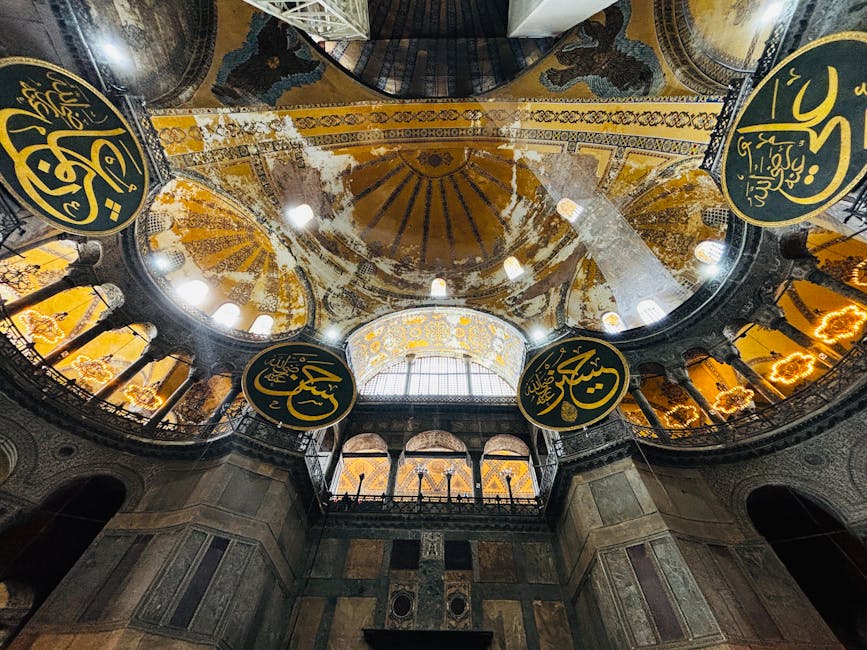
One of the defining architectural achievements of the Byzantine Empire was the construction of the Hagia Sophia in Constantinople under Emperor Justinian I. Completed in 537 AD, it was an architectural marvel that combined a massive dome with a grand interior filled with mosaics that celebrated the glory of God and the empire. The construction of Hagia Sophia was emblematic of the empire’s avowed commitment to Christianity and a testimony to its artistic prowess.
The Plague of Justinian (541–542 AD)
In the early 6th century, the Byzantine Empire faced one of its most catastrophic events—the Plague of Justinian. The outbreak, which is believed to be caused by the same bacterium that later led to the Black Death, resulted in the deaths of approximately 25 to 50 million people, significantly impacting the empire’s economy and military capabilities. The pandemic exacerbated the empire’s vulnerability to external pressures.
The Battle of Nicaea (1071)
The defeat at the Battle of Manzikert in 1071 against the Seljuk Turks marked a key turning point in Byzantine fortunes. The loss lead to the weakening of Byzantine authority in Asia Minor, giving rise to the establishment of various Crusader states and impacting the empire’s territorial integrity.
The First Crusade and the Siege of Antioch (1098)
The appeal to Western Europe for help in the face of advancing Muslim armies was a crucial moment in Byzantine history. The First Crusade, launched in 1096, resulted in the siege of Antioch in 1098, which saw various armies attempt to reclaim territories for Christendom. Although the crusaders succeeded, this event led to a redefinition of Western-Byzantine relations that was often fraught with tension.
The Fourth Crusade and the Fall of Constantinople (1204)
Perhaps one of the most tragic events was the Fourth Crusade in 1204, which deviated dramatically from its original mission. Instead of liberating the Holy Land, Crusaders diverted their efforts to Constantinople, resulting in the city’s brutal sack. This led to the establishment of the Latin Empire and a significant weakening of Byzantine authority, altering political dynamics in the eastern Mediterranean.
The Fall of Constantinople (1453)
The climax of Byzantine history came on May 29, 1453, when Ottoman Sultan Mehmed II successfully besieged Constantinople. The fall of the city marked the end of the Byzantine Empire and the rise of the Ottoman Empire, significantly shaping the geopolitical landscape in Europe and the Middle East. The event was characterized by the remarkable use of gunpowder artillery, and it showcased the violence inherent to political ambitions.
Important Figures and Their Roles
The Byzantine Empire was home to numerous influential figures whose decisions and actions had far-reaching consequences.
Emperor Constantine I (272–337)
Constantine the Great stands as a pivotal character in Byzantine history. Not only did he establish Constantinople as the empire’s capital, but he also played a significant role in the promotion of Christianity within the empire. His Edict of Milan in 313 legalized Christianity and laid the groundwork for the faith’s primacy in Byzantine society.
Emperor Justinian I (482–565)
Another monumental figure was Justinian I, known for his ambitious reforms that sought to revive the empire’s former glory. His reign witnessed the codification of Roman law, extensive construction projects, and military campaigns which temporarily expanded the Byzantine territory. His efforts to regulate ecclesiastical and secular affairs reflected his vision of a Christian empire.
Empress Theodora (c. 500–548)
Theodora, Justinian’s wife, wielded significant power and influence, championing women’s rights and societal welfare. Her political acumen and involvement in state matters were instrumental during times of civil strife, most notably during the Nika riots of 532, where she played a crucial role in suppressing dissent.
Emperor Heraclius (c. 575–641)
Heraclius was notable for his military campaigns against both the Persian Empire and the early Muslim conquests, significantly redefining the empire’s military strategy. His establishment of the theme system reorganized military administration and temporarily bolstered the Byzantine presence in the East.
Sultan Mehmed II (1432–1481)
As the leader of the Ottomans during the fall of Constantinople, Mehmed II is often referred to as ‘the Conqueror.’ His military innovations, diplomatic strategies, and unyielding determination to capture the city showcase the aggressive ambitions of the Ottoman Empire and the culmination of centuries of conflict for control of the region.
Causes and Consequences
Several causes contributed to the rise and eventual fall of the Byzantine Empire. Internally, political instability characterized by corrupt leaders, court intrigue, and dynastic struggles hindered effective governance. The empire often experienced civil strife, which undermined its military and social cohesion.
Externally, the growing incursions of various groups—especially the gradual but relentless advance of the Ottoman Turks—were disastrous for Byzantine territories. The schism within Christianity further complicated alliances, as the entanglement of religious politics shaped the geopolitical landscape of the time.
The consequences of the empire’s decline were profound, marking not merely the loss of territory but also the end of an era of influence that had shaped law, trade, and culture. The fall of Constantinople led to the extension of Ottoman authority in Europe, facilitating significant shifts in power dynamics, trade routes, and cultural exchanges.
Global Impact and Legacy
The Byzantine Empire’s legacy is indelibly etched into the fabric of modern civilization. Its contributions in law, art, and architecture had a lasting influence on subsequent European developments. The preservation of classical knowledge through Byzantine scholars during the Renaissance sparked significant advancements in Western thought and culture.
The architectural innovations exemplified by Hagia Sophia influenced mosque designs in the Ottoman Empire, while Byzantine art techniques set foundational standards for later European art forms. The empire’s stance on Orthodox Christianity shaped religious and cultural identities across Eastern Europe, affecting social structures and national identities that continue to resonate in contemporary society.
Fascinating Little-Known Facts
- Despite its advanced military technology, including Greek Fire, a devastating incendiary weapon, the Byzantine Empire often relied on diplomacy to navigate its complex international relations.
- The Byzantine Empire had a rich tradition of manuscript illumination and scholarship that preserved innumerable texts in fields such as mathematics, astronomy, and philosophy for future generations.
- The term ‘Byzantine’ was never used during the empire’s existence; it was coined by historians much later to reference the Greek-speaking Roman Empire of the Eastern Mediterranean.
Strong Conclusion with Modern Relevance
The Byzantine Empire, with its myriad of complexities, triumphs, and tribulations, serves as a quintessential example of the challenges that befall any civilization. Its story underscores the effects of internal disarray, the consequences of external pressures, and the enduring influence of cultural legacies. The rise and fall of this empire serves not just as a historical account, but as a reminder of the importance of unity, resilience, and the pursuit of knowledge.
In our modern world, where geopolitical tensions, cultural interactions, and ideological conflicts continue to play significant roles, the lessons drawn from Byzantine history become increasingly relevant. Just as the Byzantine Empire faced adversity, today, societies must navigate through their own complexities, balancing tradition and innovation. Understanding the past serves not merely as an exercise in memory but as a guide for future generations aiming to forge pathways of resilience amidst uncertainties.