
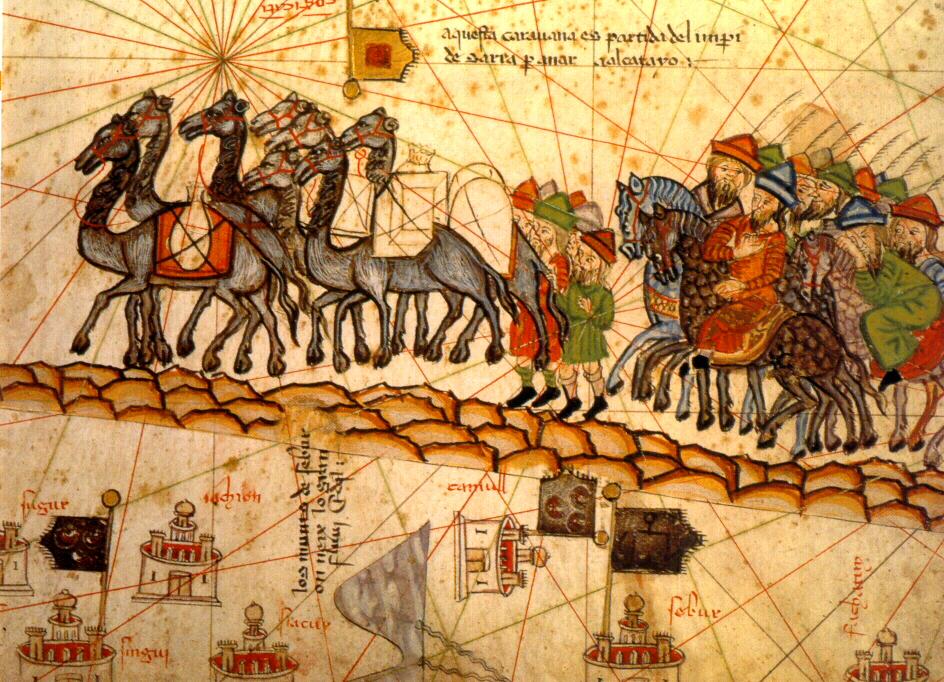
The Silk Road is often imagined as a single dusty road stretching across Asia, lined with camel caravans carrying silk from China to the Mediterranean. The reality was more complex and far more important. It was not one road, but a shifting network of land and sea routes that connected China, Central Asia, India, Persia, the Middle East, North Africa, and Europe for centuries.
Its greatest historical impact was not simply that it moved luxury goods. The Silk Road changed how civilizations understood one another. It carried technologies, religions, artistic styles, diseases, diplomatic missions, and entire ways of thinking across continents. In that sense, it was one of the first great systems of globalization.
A Network, Not a Single Road
The phrase “Silk Road” can be misleading. Merchants rarely traveled from one end of Eurasia to the other. Instead, goods passed from hand to hand through oasis towns, mountain passes, desert markets, ports, and imperial frontiers. A bolt of silk might begin in China, move through Central Asian traders, be taxed by local rulers, pass through Persian markets, and eventually reach Roman or Byzantine elites.
This network depended on geography. The Taklamakan Desert, the Pamir Mountains, the Iranian plateau, and the steppes of Central Asia shaped the movement of people and goods. Oasis cities such as Samarkand, Bukhara, Kashgar, and Dunhuang became vital because they offered water, protection, storage, translators, and access to local markets.
Why Silk Became So Powerful
Silk was light, valuable, and difficult to produce outside China for a long period of history. That made it an ideal long-distance trade item. Roman writers complained about the cost of eastern luxuries, while Chinese courts used silk not only as clothing but also as currency, diplomatic payment, and political reward.
But silk was only part of the story. Traders also carried spices, horses, glassware, paper, ceramics, precious stones, dyes, metals, and medicines. Some items moved east, others west. The trade was never one-directional. It was an exchange system in which many societies contributed something valuable.
Empires Protected and Profited From the Routes
The Silk Road expanded most successfully when powerful states protected parts of the network. The Han dynasty pushed into Central Asia partly to secure horses and alliances against nomadic rivals. Later, the Tang dynasty helped make Chang’an one of the world’s most cosmopolitan cities. In the west, Persian empires and later Islamic caliphates controlled crucial middle zones of exchange.
Rulers benefited from customs duties, diplomatic prestige, and access to rare goods. Yet they also faced a problem: no empire controlled the entire system for long. The Silk Road was strongest when different powers were stable enough to keep roads open but interconnected enough to trade with rivals.
Ideas Traveled With Merchants
One of the most important things carried along the Silk Road could not be packed into a saddlebag: belief. Buddhism spread from India into Central Asia and China through merchants, monks, translators, and oasis communities. Cave temples at places like Dunhuang preserve traces of this movement, showing a blend of Indian, Chinese, Central Asian, and Persian influences.
Other religions also moved through these routes, including Christianity, Islam, Zoroastrianism, Manichaeism, and Judaism. The result was not a simple replacement of one culture by another. Instead, border cities often became places of translation and adaptation, where religious art, language, and ritual changed as they crossed regions.
Technology Crossed Borders
The Silk Road helped spread technologies that reshaped societies. Paper-making moved west from China, eventually transforming administration, scholarship, and religious life across the Islamic world and later Europe. Knowledge of crops, irrigation methods, metalwork, and military techniques also circulated through the same broad exchange networks.
These transfers were rarely instant. A technology could take generations to move from one region to another. It might be adapted, improved, or used in ways its originators never expected. That slow process is precisely why the Silk Road matters: it shows how history often changes through repeated contact rather than one dramatic event.
The Dark Side of Connection
Interconnection brought wealth and knowledge, but it also carried danger. Diseases could travel with armies, merchants, animals, and ships. Many historians connect the wider Eurasian exchange networks to the spread of devastating epidemics, including the plague outbreaks that struck parts of Asia, the Middle East, and Europe.
This does not mean trade caused disaster by itself. It means that connected worlds share risks as well as benefits. The same roads that moved silk, paper, and religious texts could also move pathogens and instability. The Silk Road was powerful because it linked societies; that link could enrich them or expose them.
The Mongol Era and a New Wave of Exchange
In the thirteenth and fourteenth centuries, the Mongol Empire created one of the largest connected political zones in history. Under Mongol rule, travel across Eurasia became safer for certain merchants, envoys, and missionaries. This period is sometimes called the Pax Mongolica, though the phrase can hide the violence that created the empire in the first place.
Still, the Mongol era intensified long-distance contact. European travelers such as Marco Polo became famous for accounts of the east, while goods and information moved across lands that had previously been divided among many competing powers. The Silk Road did not become peaceful everywhere, but its connections became more visible to distant societies.
Why the Silk Road Declined
The land routes did not disappear overnight. They changed gradually as political instability, shifting empires, and the growth of maritime trade altered the balance of global commerce. Sea routes became increasingly attractive because ships could carry larger volumes of goods at lower cost than caravans crossing deserts and mountains.
By the early modern period, European oceanic expansion, Ottoman control of key territories, and new global trade patterns reduced the centrality of the old overland routes. Yet the Silk Road’s legacy did not vanish. The desire to connect markets, secure routes, and control strategic corridors remained a central theme of world politics.
Why It Still Matters
The Silk Road still matters because it challenges the idea that civilizations developed in isolation. Ancient and medieval societies were more connected than many people assume. A change in one region could influence markets, beliefs, technologies, and politics thousands of miles away.
It also reminds us that globalization is not a modern invention. Today’s supply chains, cultural exchanges, and geopolitical corridors have older echoes in the caravan routes and port cities of Eurasia. The tools have changed, but the basic question remains the same: who controls connection, and who benefits from it?
In the end, the Silk Road changed world history not because it was a road, and not because it carried silk alone. It changed history because it turned distance into contact. Across deserts, mountains, and empires, it made separate worlds part of one larger story.