
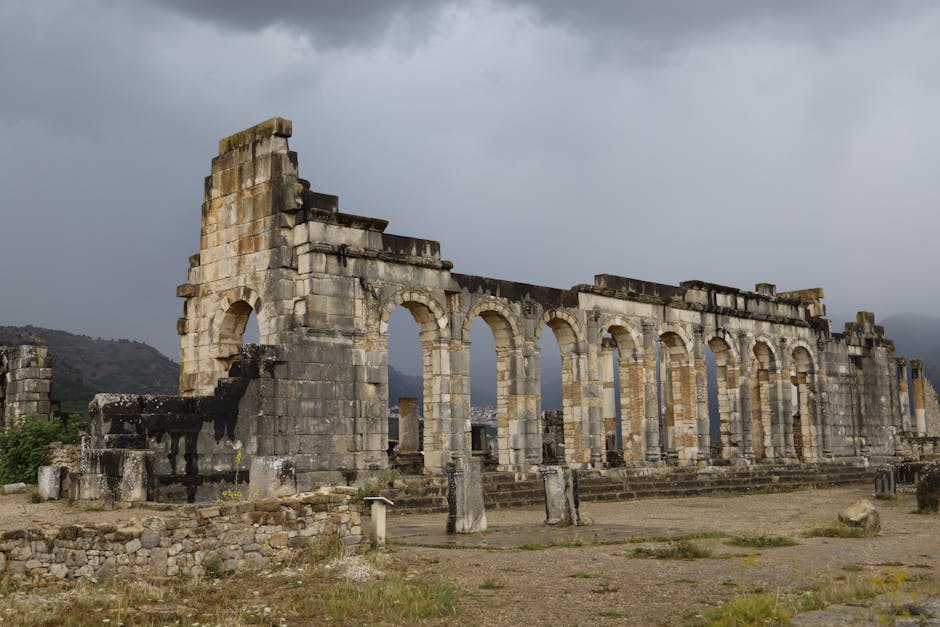
Introduction: The Legendary Saga of Rome’s Empire
Few events in the annals of history capture the imagination as vividly as the rise and fall of the Roman Empire. Spanning centuries, the narrative of Rome is one of ambition, resilience, and adaptation, painting a vivid tableau of power’s impermanence. At its zenith, Rome’s dominion stretched from the rolling green hills of Britain to the arid expanses of North Africa and from the sunlit coasts of modern-day Portugal to the Middle East’s ancient trade routes. Devastating battles, brilliant leaders, profound cultural achievements, and eventual decline form the rich mosaic of this empire that still fascinates historians, writers, and enthusiasts alike.
Founded in 753 BC according to legend by the twin brothers Romulus and Remus, Rome’s ascent was neither swift nor uncontested. It was a story molded by both opportunism and strategic ingenuity. This colossal empire, once rooted in the legendary lore and mythic constitution, grew to define governance, law, and civilization for generations that transcended beyond its physical borders. However, as with all great powers, the empire’s colossal strength eventually succumbed to internal strife, external pressures, and an inevitable transformation into something new.
In this comprehensive exploration, we delve into the foundation, expansion, pivotal figures, and monumental events that crafted and ultimately dismantled the Roman Empire—an epic epoch that reshaped the ancient and modern worlds forever.
Historical Background and Context: From Myth to Might
The story of the Roman Empire’s inception is deeply interwoven with mythology, historical conjecture, and archaeological discovery. The birth of Rome is traditionally dated to 753 BC, marked by the establishment of a settlement on the Palatine Hill. However, evidence suggests that human habitation dates back further, to a time when small communities existed in the region, thriving off the fertile soil of Italy’s heartland and the strategic trade routes of the Mediterranean.
The Roman Kingdom, ruled initially by monarchs, saw growth through the amalgamation with the neighboring Latin tribes and the imposition over the Sabines and the Etruscans. The early Romans forged a distinct cultural and social identity, influenced by proximity to the Etruscans and, eventually, contact with the Greeks to the south.
By 509 BC, the Roman Kingdom transformed into a Republic following the expulsion of its last king, Lucius Tarquinius Superbus. The establishment of the Roman Republic marked a pivotal shift in governance, characterized by consuls and a Senate, a complex political system that underpinned Rome’s expansion and influence. Rome gradually established itself as a dominant force, navigating through conflicts like the Latin and Samnite Wars, which laid the foundations for broader territorial acquisition.
As Rome expanded, it encountered numerous cultures and empires, each contributing to and challenging its supremacy. The Punic Wars, a series of conflicts with the formidable Carthaginian Empire, were significant, culminating in Rome’s victory and annexion of Carthage’s territories in North Africa, Spain, and parts of the Mediterranean. Such victories signaled the onset of the Roman Empire’s golden age, as the Republic steadily transitioned to an imperial structure under ambitious leaders and conquerors.
Key Events, Battles, or Developments
The Rise of Imperial Rome
The transformation from Republic to Empire was neither immediate nor peaceful. Central to this was Julius Caesar, whose crossing of the Rubicon River in 49 BC ignited a civil war that led to his eventual dictatorship. Caesar’s tenure brought many reforms and territorial expansion, but his assassination in 44 BC plunged Rome into further turmoil, fostering the rise of his grandnephew and adopted heir, Octavian.
The Reign of Augustus and the Pax Romana
Octavian, later known as Augustus, emerged victorious in a series of conflicts against Mark Antony and Cleopatra, marking the end of the Republic and the dawn of the Empire in 27 BC. Augustus’s reign is often credited with ushering the Pax Romana, a term describing approximately 200 years of relative peace and stability across the empire, facilitating economic, cultural, and architectural achievements.
Under Augustus, and his successors, Rome experienced a prolific era of infrastructural advancements, including the construction of roads connecting far-flung provinces and monumental edifices like the Colosseum. Augustus’s era saw the consolidation of imperial power, administrative reforms, and the strengthening of military and cultural identity that solidified Rome’s hegemony.
The Fall of the Western Roman Empire
Despite a period of prosperity, the Roman Empire faced mounting challenges leading to its decline. The 3rd century AD was marred by political instability, economic troubles, and military defeats. External pressures, particularly from Germanic tribes and Huns, exacerbated internal weaknesses. In 476 AD, the deposition of the last Roman emperor, Romulus Augustulus, by the Germanic chieftain Odoacer, symbolically marked the end of the Western Roman Empire.
While the Western Empire fragmented into various successor states, the Eastern Roman Empire, known later as the Byzantine Empire, persisted as a symbol of Roman continuity for another millennium, until the fall of Constantinople in 1453.
Important Figures and Their Roles
Julius Caesar
A populist leader and formidable military tactician, Julius Caesar’s contributions to Rome were both revolutionary and controversial. His reforms cut across social and political strata; from recalibrating the calendar to redefining citizenship laws. His actions and alliances, however, sowed seeds of division that would later germinate into civil war.
Augustus (Octavian)
Considered Rome’s first emperor, Augustus adeptly navigated the aftermath of Caesar’s assassination to emerge as the primary architect of the new imperial order. His leadership emphasized stability, prosperity, and consolidation through astute governance.
Marcus Aurelius
Renowned as a philosopher king, Marcus Aurelius ruled during the latter part of the Pax Romana. His reign was marked by a series of military campaigns defending Rome’s borders, yet his philosophical works, particularly “Meditations,” underline a stoic approach to rule and personal virtue.
Constantine the Great
Constantine’s reign is pivotal for his embrace and promotion of Christianity, fundamentally altering the religious landscape of the empire and the Western world. By founding Constantinople (modern-day Istanbul) as a new capital in 330 AD, he laid a foundation for the continuity of Roman governance and culture.
Causes and Consequences
Causes of the Empire’s Decline
History identifies several catalysts for Rome’s decline. Political corruption, administrative inefficiencies, and economic strife gnawed at the core of Roman stability. Widespread reliance on slave labor stifled technological advancement and engendered social divide. As Rome’s territorial expansion outpaced its governance capability, vulnerabilities emerged, attracting invasion and rebellion from external forces.
Consequences of the Fall
The fall of the Western Roman Empire paved the way for the Medieval period, often termed the Dark Ages, in medieval Europe. The chaotic aftermath saw the rise of barbarian kingdoms, a feudal system, and the entrenchment of the Christian Church as a significant socio-political power. The Eastern Roman Empire, meanwhile, preserved elements of Roman law, culture, and administration, bridging ancient practices with medieval advancements.
Global Impact and Legacy
Rome’s legacy extends far beyond its temporal reach. The Roman legal system, particularly the Twelve Tables and subsequent codifications, remains a cornerstone of modern jurisprudence. Latin, the empire’s lingua franca, laid the foundation for the Romance languages and heavily influenced English.
Architecturally, Roman innovations such as the arch, dome, and aqueducts exemplify advancements still evident in contemporary engineering. Roman culture, philosophy, literature, and legal systems echo through centuries, underscoring the empire’s enduring influence on governance, Western civilization, and global cultural narratives.
Fascinating Little-Known Facts
- The Roman Navy: Originally an army power, Rome’s naval prowess was catalyzed during the Punic Wars, leading to innovations in naval strategy and ships.
- The Currency of Conquest: Roman conquests and expansions were often funded through looting and tributes from subjugated territories, a testament to Rome’s pragmatic, albeit aggressive, fiscal strategies.
- The Mystery of Roman Concrete: Roman concrete, or opus caementicium, was uniquely durable, with marine structures that withstand erosion by seawater—an enigma modern science seeks to replicate.
Conclusion: Echoes of Empire in the Modern World
The Roman Empire’s intricate tapestry of governance, culture, and conquest is more than an ancient narrative—it is a lens through which we view the foundations of modern society. Its innovations in law, architecture, and linguistics continue to influence today’s global tapestry of cultures and governments. Rome’s stories entertain, its lessons educate, and its legacies shape our understanding of empire’s possibilities and pitfalls.
Beyond the streets of Rome, where the ancient and modern converge, the footprints of this empire are omnipresent in how nations aspire, strategize, and construct their omnipresent futures. In an era where global powers once again reappraise dynastic longevity and influence, the Roman Empire offers a potent reminder of power’s ephemeral nature, urging reflection on history’s cyclical patterns.