
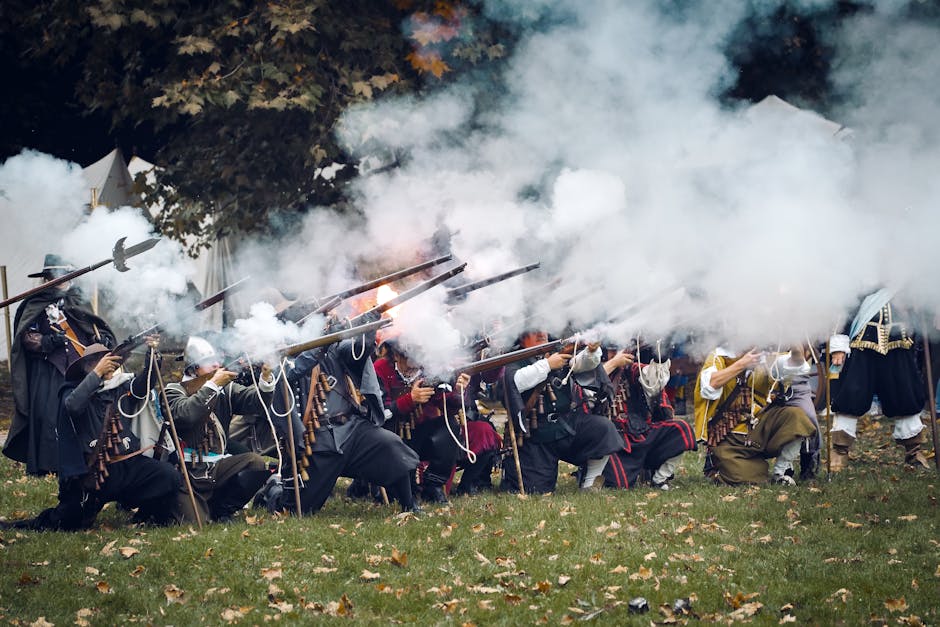
Introduction: The Thrill of Clash and the Echoes of History
Imagine the thunder of marching legions, the iron clang of swords, and the deafening roar of artillery that has echoed across continents for millennia. Battles and conflicts are the crucibles where nations are forged, empires rise, and societies transform. From the ancient fields of Marathon to the digital battlegrounds of cyber‑war, each clash tells a story of strategy, bravery, and human ambition. In this comprehensive guide we will travel through time, uncovering the pivotal engagements that reshaped our world, meet the commanders whose decisions altered the course of history, and explore the lasting impact of warfare on culture, technology, and geopolitics. Whether you are a history buff, a student, or simply curious about why the past still matters today, this article offers a deep‑dive, SEO‑optimized treasure trove of facts, dates, and insights that keep you hooked from the first line to the final conclusion.
Historical Background and Context
The story of battles begins long before recorded history, when early humans first fashioned spears and organized hunts. As societies grew, so did the need to defend resources, expand territories, and assert dominance. The Bronze Age (c. 3300–1200 BCE) introduced organized armies and fortified cities, setting the stage for the legendary confrontations of ancient Egypt, Mesopotamia, and the Indus Valley. The classical era—Greece and Rome—refined tactics such as the phalanx and legions, creating a military tradition that would influence later Western warfare.
Middle Ages warfare (5th–15th centuries) saw feudal levies, castles, and the rise of cavalry dominance, while the invention of gunpowder in the 13th century sparked a revolution in siegecraft and battlefield firepower. The early modern period (16th–18th centuries) introduced linear infantry formations, professional standing armies, and naval supremacy, exemplified by the Spanish Armada (1588) and the Battle of Lepanto (1571).
The industrial revolution accelerated the lethality of conflict: rifled muskets, iron‑clad warships, and railways turned regional skirmishes into global wars. World War I (1914‑1918) epitomized trench stalemate, while World War II (1939‑1945) unleashed mechanized blitzkrieg and atomic horror. The Cold War era shifted focus to ideological proxy wars, nuclear deterrence, and finally, the digital age’s cyber‑conflicts.
Understanding this layered backdrop is essential; each epoch builds upon technological breakthroughs, political ideologies, and cultural values that shape why and how battles are fought.
Key Events, Battles, or Developments
1. Battle of Marathon – 490 BCE, Greece
When the Persian Empire under Darius I attempted to subjugate Athens, the outnumbered Athenian hoplites secured a decisive victory at Marathon on 12 September 490 BCE. Approximately 10,000 Greek soldiers faced an estimated 25,000 Persians. The Greeks’ disciplined phalanx and strategic use of terrain resulted in a 6:1 casualty ratio favoring Athens, cementing the concept of a citizen‑soldier defending liberty.
2. Siege of Jerusalem – 70 CE, Roman Empire
General Titus, son of Emperor Vespasian, besieged Jerusalem from 17 April to 4 August 70 CE. Over 600,000 Jewish inhabitants were either killed, enslaved, or displaced. The destruction of the Second Temple marked a turning point for Judaism, prompting the diaspora and altering religious practices forever.
3. Battle of Agincourt – 25 October 1415, Hundred Years’ War
King Henry V of England faced a numerically superior French army at Agincourt in northern France. Using longbows, English archers decimated the French knights, achieving a 1:10 casualty ratio. Of the 7,000 English troops, fewer than 300 were lost, while French casualties exceeded 6,000. This battle showcased the power of ranged infantry against heavy cavalry.
4. Battle of Waterloo – 18 June 1815, Belgium
Napoleon Bonaparte’s final defeat came at Waterloo, where a coalition of British, Dutch, Prussian, and other forces under the Duke of Wellington and Field Marshal Blücher halted his empire‑building ambitions. Approximately 73,000 French troops faced 118,000 coalition soldiers. French casualties numbered around 25,000, compared with 22,000 on the allied side.
5. Battle of Gettysburg – 1–3 July 1863, USA
The turning point of the American Civil War, Gettysburg saw 165,000 soldiers clash over three days. Union General George G. Meade repelled Confederate General Robert E. Lee’s invasion of the North. Union losses: 23,000; Confederate losses: 28,000. The battle ended Lee’s offensive and marked a strategic shift toward Union victory.
6. Battle of Stalingrad – 23 August 1942 – 2 February 1943, USSR
One of the bloodiest confrontations in history, the siege of Stalingrad involved over 2 million casualties. German 6th Army (≈300,000) was encircled by Soviet forces under General Zhukov. The surrender on 2 February 1943 marked the first major defeat of Nazi Germany and shifted the Eastern Front in favor of the Allies.
7. D-Day (Operation Overlord) – 6 June 1944, Normandy, France
Allied forces launched the largest amphibious invasion in history, landing on five beaches (Utah, Omaha, Gold, Juno, Sword). Over 156,000 troops crossed the English Channel, establishing a foothold that enabled the liberation of Western Europe. Casualties on D-Day reached 10,000 (both sides).
8. Battle of Thermopylae – 480 BCE, Greece
While ultimately a defeat, the Spartan-led stand of 300 warriors against Xerxes’ Persian army (estimated 100,000–150,000) became a symbol of courage and tactical genius. Their delay allowed Greek city‑states to organize a counter‑offensive that later won the Persian Wars.
Important Figures and Their Roles
Sun Tzu (544‑496 BCE) – Ancient Chinese strategist whose “The Art of War” still guides modern military theory.
Alexander the Great (356‑323 BCE) – Conqueror who created an empire spanning from Greece to India, employing the Macedonian phalanx and innovative siege tactics.
Genghis Khan (c. 1162‑1227) – Founder of the Mongol Empire; his mobile cavalry and psychological warfare conquered over 30% of the world’s land area.
Napoleon Bonaparte (1769‑1821) – French Emperor whose reforms in artillery deployment and corps organization reshaped European warfare.
Ulysses S. Grant (1822‑1885) – Union General whose relentless pressure at Vicksburg and in the Overland Campaign secured victory in the American Civil War.
Causes and Consequences
Most large‑scale conflicts arise from a blend of political ambition, economic competition, ideological differences, and resource scarcity. For instance, World War I’s spark—archduke Franz Ferdinand’s assassination—was merely the catalyst for deeper nationalist tensions and imperial rivalries. Consequences can be immediate, like territorial redrawing at the Treaty of Versailles (1919), or long‑term, such as the rise of fascism that led to World War II. Economic devastation often follows battles; the Battle of Stalingrad alone cost the USSR an estimated 1.1 million soldiers and massive industrial capacity, yet its victory accelerated the Soviet push into Eastern Europe, shaping the Cold War map.
Global Impact and Legacy
Every major battle leaves a cultural imprint. The bravery at Thermopylae inspired Western concepts of heroism; the writing of the “Gettysburg Address” redefined American identity. Technologically, WWI’s trench warfare spurred the development of tanks, while WWII’s Manhattan Project birthed nuclear deterrence doctrine. Modern conflicts increasingly involve hybrid warfare—combining conventional forces, cyber attacks, and information operations—demonstrating that lessons from ancient battlegrounds still inform contemporary strategy.
Fascinating Little‑Known Facts
1. During the Battle of Cannae (216 BCE), Hannibal’s forces executed a double‑envelopment that resulted in the death of over 50,000 Romans—a tactical masterpiece still taught in military academies.
2. The longest recorded artillery duel occurred in the Siege of Sevastopol (1854‑1855) during the Crimean War, with both sides firing over 1 million shells across 11 months.
3. In the 1904 Battle of Port Arthur, the Japanese navy used wireless telegraphy to coordinate attacks, marking one of the first uses of radio in combat.
4. The battlefield at Trench Hill in Vietnam (1968) was the first to deploy laser‑guided smart munitions, revolutionizing precision strike capability.
5. The term “blitzkrieg” (lightning war) was coined by German journalists after analyzing the rapid 1939‑1940 campaigns over Poland and France.
Conclusion: Modern Relevance of Historic Battles
While the sounds of cannons and the smell of gunpowder belong to the past, the strategic principles gleaned from battles such as Marathon, Waterloo, and Stalingrad remain vital in today’s security environment. Understanding cause‑effect chains, leadership decisions, and technological innovations helps policymakers, military professionals, and citizens navigate modern challenges—from conventional wars to cyber‑threats. History reminds us that conflicts are rarely isolated; they ripple across generations, shaping economies, cultures, and the very definition of nationhood. By studying the great battles and conflicts of humanity, we not only honor those who fought but also equip ourselves with the wisdom to seek peace, preparedness, and progress in an ever‑changing world.