
Achaemenid history · source-reading guide
The Behistun Inscription: how Darius carved power into a cliff
Behistun is often called a “Rosetta Stone” of cuneiform, but the cliff inscription is more than a decipherment milestone. It is also Darius I’s carefully staged argument that rebellion, kingship and divine favor should be remembered on his terms.

High above the road between the Iranian plateau and Mesopotamia, Darius I ordered a royal message to be cut into limestone. The result, known as the Behistun or Bisotun inscription, combines a monumental relief with a long cuneiform text in three languages. UNESCO describes the setting as an ancient trade route and identifies the main monument as the relief and inscription commissioned when Darius rose to the Persian throne in 521 BC. That location matters: this was not a tablet for an archive shelf, but a public statement placed where movement, memory and imperial authority met.
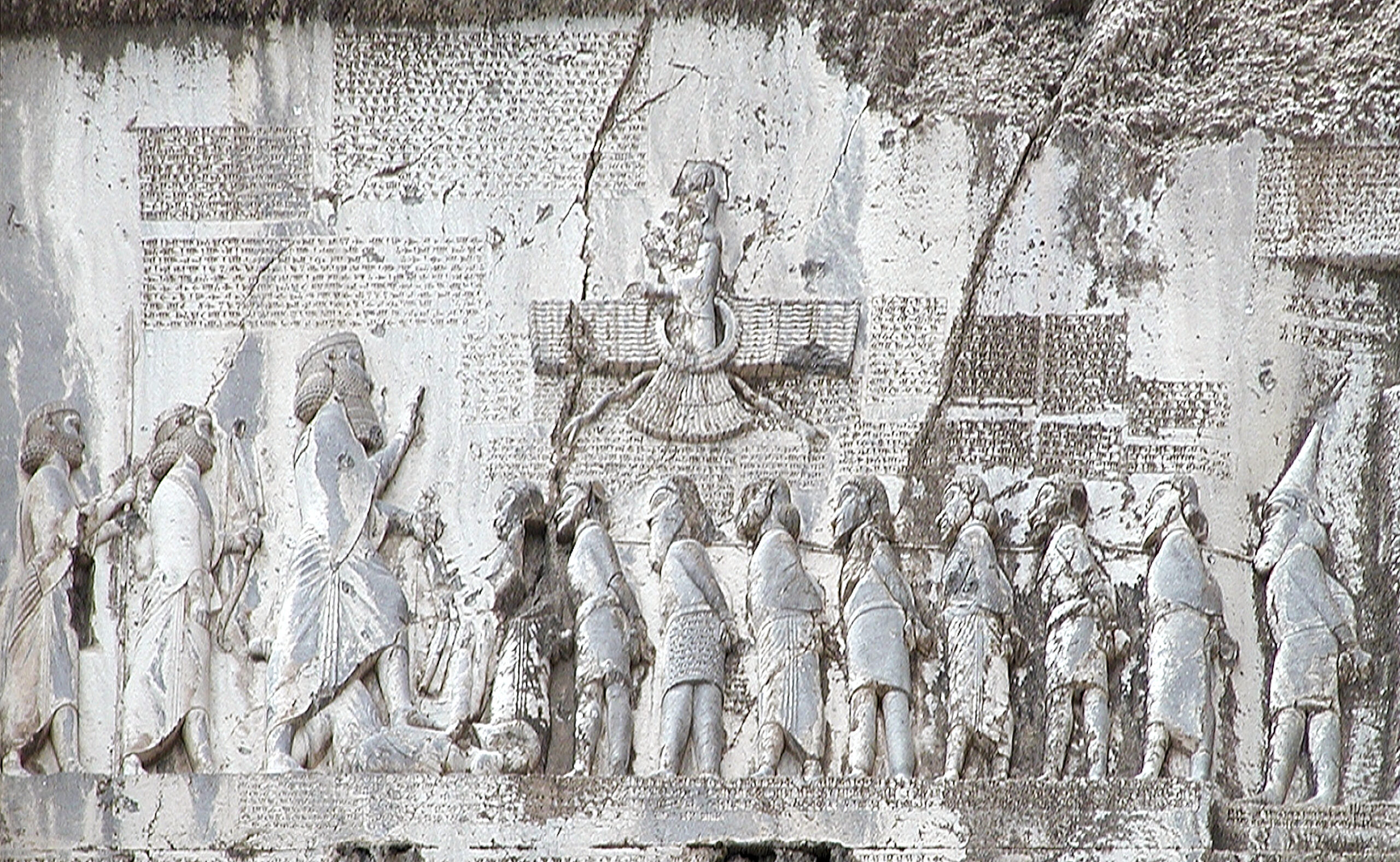
The image is direct and political. Darius stands with a bow, a sign of sovereignty, while a defeated figure lies under his foot. A line of bound captives faces him. Around and below the figures run roughly 1,200 lines of inscription. The text recounts battles in 521–520 BC against governors and claimants who, in Darius’s version, tried to tear apart the empire founded by Cyrus. For a reader today, the first rule is caution: Behistun is indispensable evidence, but it is not neutral evidence.
What the monument says
The Old Persian opening is a royal self-presentation: Darius names himself “great king,” “king of kings,” and an Achaemenid. He then builds a family argument for legitimacy before narrating the crisis after Cambyses and the killing of the alleged usurper Gaumata. The story is structured to make Darius’s rule look inevitable, lawful and favored by Ahura Mazda. In that sense, the cliff is not just reporting events. It is teaching viewers how those events should be interpreted.
UNESCO’s summary highlights why the inscription is exceptional: it is the only known monumental Achaemenid text documenting Darius’s re-establishment of the empire, and it also records an important exchange of artistic and written traditions across the Persian imperial world. Encyclopaedia Iranica likewise treats Darius’s inscriptions at Bisotun as a core source for Achaemenid royal history, while preserving the scholarly distinction between the text’s evidentiary value and its royal agenda.
Why three languages changed the afterlife of the cliff
Behistun’s modern fame comes from its trilingual layout. The inscription uses Old Persian, Elamite and Babylonian/Akkadian versions. Once scholars could make progress with Old Persian, the other versions offered a route into more complex cuneiform systems. This is why Behistun is frequently compared to the Rosetta Stone. The comparison is useful, but it can become too simple.
The decipherment was not a single heroic moment. Henry Creswicke Rawlinson’s dangerous copying work in the 1830s and 1840s was crucial, and his publications made the text available to European scholars. But CDLI’s history of cuneiform decipherment stresses that the process was international and cumulative: earlier work by Georg Friedrich Grotefend, Rasmus Rask, Christian Lassen, Edward Hincks and others shaped the reading of Old Persian and the later understanding of Akkadian. CDLI also warns against saying that the Babylonian text at Behistun alone unlocked Akkadian; it was part of a wider evidence chain.
That nuance is important for HistoryZ readers because it changes the lesson of the monument. Behistun did not magically translate the ancient Near East. It supplied a rare, high-value control text, and scholars used it alongside names, repeated royal formulas, related inscriptions, language comparison and painstaking sign-by-sign testing.
How to read Behistun responsibly
A responsible reading starts with genre. This is royal inscription, not courtroom transcript. Darius has every reason to present opponents as rebels and impostors, and every reason to connect his victory to divine support. The relief’s visual grammar reinforces that message before the text is even read: order stands upright; revolt is bound, named and placed beneath the king’s authority.
That does not make the inscription useless. Quite the opposite. Its details can be compared with Babylonian business documents, Greek narratives such as Herodotus, later traditions and archaeological context. Where these lines of evidence converge, confidence improves. Where they diverge, the divergence itself becomes historically useful. It shows how imperial legitimacy was argued, challenged and remembered.
The monument also preserves the mechanics of empire. The rebel list is geographical as much as personal. Darius’s narrative moves across provinces, dates and claimants, turning a succession crisis into a map of restored control. For a ruler of a vast empire, the message was blunt: rebellion could be named, defeated and carved into stone as a warning.
What visitors and students should notice
- Height and visibility: the inscription’s placement made it monumental and hard to alter, even if not easy for ordinary travelers to read in full.
- Image before text: Darius’s pose, the bow, the defeated figure and the bound captives summarize the political claim visually.
- Language strategy: Old Persian, Elamite and Babylonian versions point to an empire communicating across administrative and cultural worlds.
- Source limits: the text is closest to Darius’s own case for legitimacy, so it must be checked against independent evidence wherever possible.
- Decipherment history: Rawlinson matters, but so does the network of scholars and prior inscriptions that made reading possible.
Why Behistun still matters
Behistun survives as a double monument: one from the Achaemenid age and one from the history of modern scholarship. For Darius, it stabilized a contested rise to power by fixing his version of events in stone. For nineteenth-century decipherers, it helped turn unreadable wedges into historical language. For readers today, its value lies in holding both truths together. The cliff gives us evidence, but it also gives us propaganda. The historian’s task is not to choose one label and stop; it is to ask what the source can prove, what it wants us to believe, and where other evidence can test it.
Sources and further reading
- UNESCO World Heritage Centre
- Encyclopaedia Iranica, “Bisotun iii. Darius’s Inscriptions”
- Cuneiform Digital Library Initiative, “The Earliest Contributions to the Decipherment of Sumerian and Akkadian”
- World History Encyclopedia, “Behistun Inscription”
- Rawlinson, H. C., JRAS article at Internet Archive
Editorial note: This guide distinguishes between Darius’s royal claim and independently testable historical evidence. No claim here depends on a single unsourced modern retelling.